


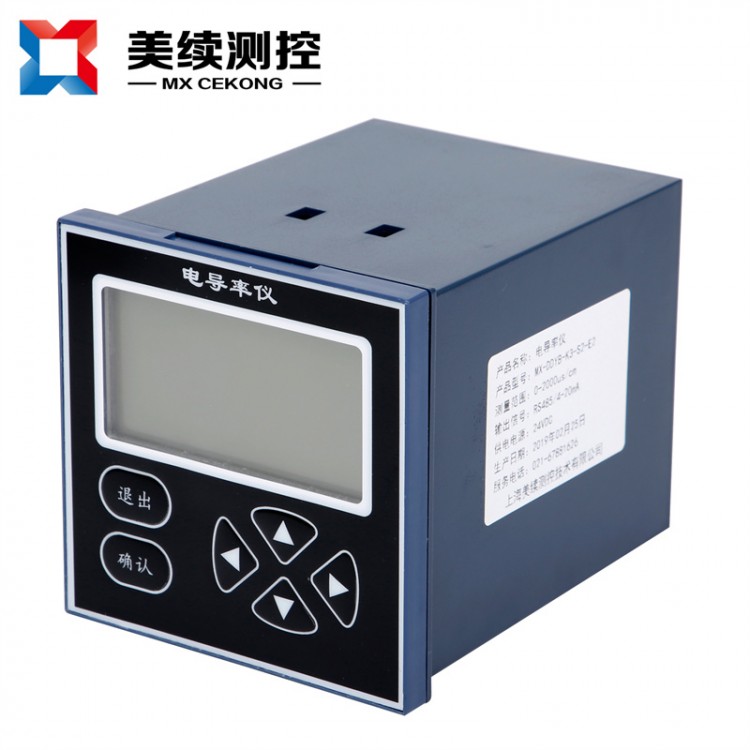
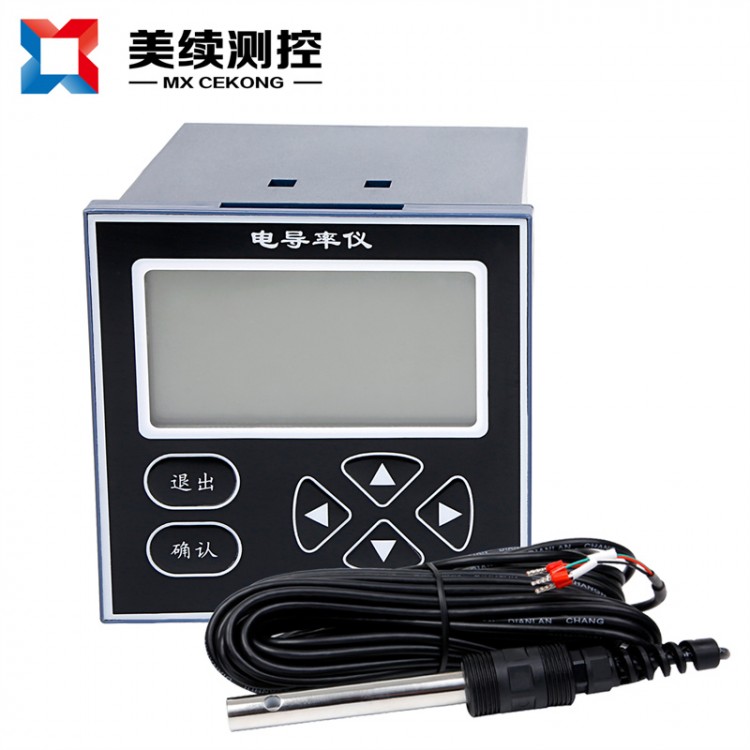
Conductivity: A physics concept, also known as conductance. In a medium, this quantity multiplied by the electric field strength E equals the current density J. For isotropic media, conductivity is a scalar; for anisotropic media, it is a tensor. In ecology, conductivity refers to the ability of a solution to conduct electricity, represented by a number. Units are Siemens per meter (S/m).
Measurement Principle: To avoid electrode polarization, the instrument generates a high-stability sine wave signal and applies it to the electrode. The current passing through the electrode is proportional to the electrical conductivity of the solution being measured. The instrument converts the current into a voltage signal using a high-impedance operational amplifier, then amplifies it programmatically, performs phase-sensitive detection, and filters it to obtain a potential signal that reflects the electrical conductivity. The microprocessor alternates between sampling temperature and electrical conductivity signals through switching, processes them, and compensates for temperature, thereby obtaining the electrical conductivity value and the current temperature of the solution at 25°C.
Principle of Temperature Compensation: The electrical conductivity of an electrolyte solution is affected by temperature changes, necessitating temperature compensation. The temperature coefficient for dilute solutions is 2.00% per °C, decreasing with increasing concentration. For solutions with lower concentrations (1 µS·cm⁻¹), the temperature coefficient does not apply as 2.00% per °C.
Conductivity Unit Conversion: The standard unit for specific conductivity is Siemens per meter (S/m), with "S" representing Siemens, 1S = 1000mS = 1,000,000μS, and 10,000μS/cm = 1 S/m. "μ" is the Greek letter representing 10^-6, pronounced "micro"; "S" is the international unit of conductivity, pronounced "Siemens"; "cm" is the length unit "centimeter," 1cm = 10^-2m. μS/cm is read as "micro-Siemens per centimeter," which is a unit of conductivity. Conversion: 1μS/cm = 10^-4 S/m.
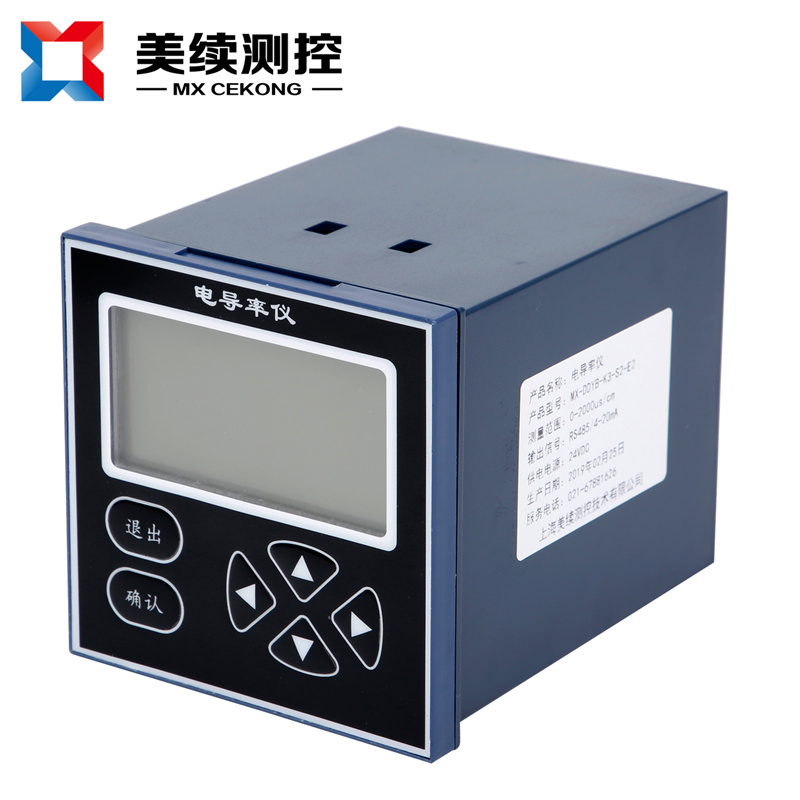
Application Fields
Water Treatment Plant/Desalination Plant
Wastewater treatment, sewage testing
Mining and smelting, papermaking, pulp concentration
Environmental Protection Industry, Desulfurization and Denitrification, Waste Water Evaporation
Sanitary applications, food and beverage processing industry
Laboratory or Testing Equipment, Thermal Power Generation, Power Plant Cooling Water, Make-up Water
Monitoring and control of raw and product water quality for water treatment equipment such as saturated water, condensate water, boiler water, ion exchange, reverse osmosis EDL, and seawater distillation.
Product Features
Features current or voltage output, supports intelligent RS485 protocol
Range freely settable, high/low limit alarm prompts, and dual relay control switches with adjustable hysteresis range.
LCD liquid crystal display; with automatic or manual temperature compensation
Excellent antistatic properties
Technical Specifications
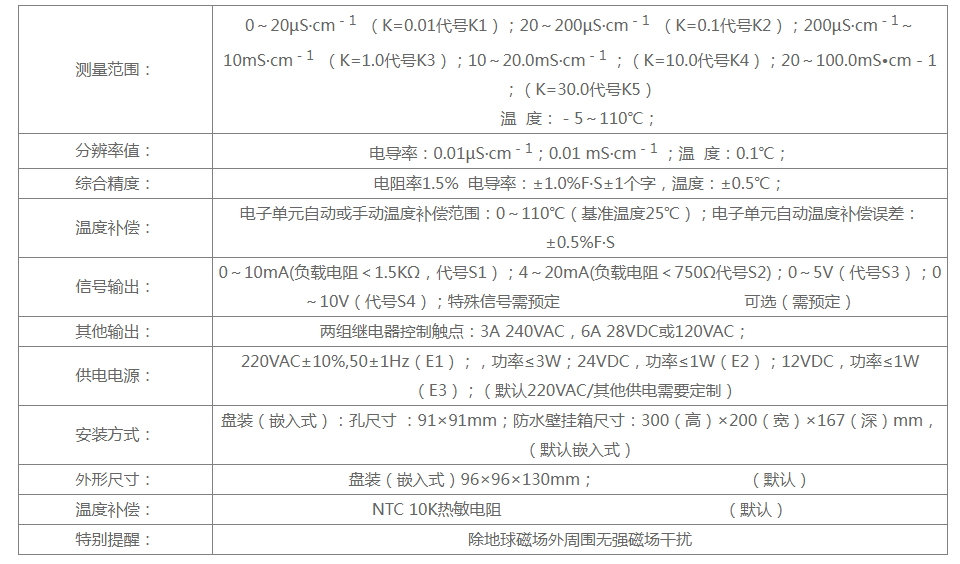
The table below is the resistance-conductivity correspondence table (set the instrument's "parameter" - "temperature coefficient" to 0.00%, "auto mode" to "off", and the "electrode constant" corresponds to the K in the table).

