


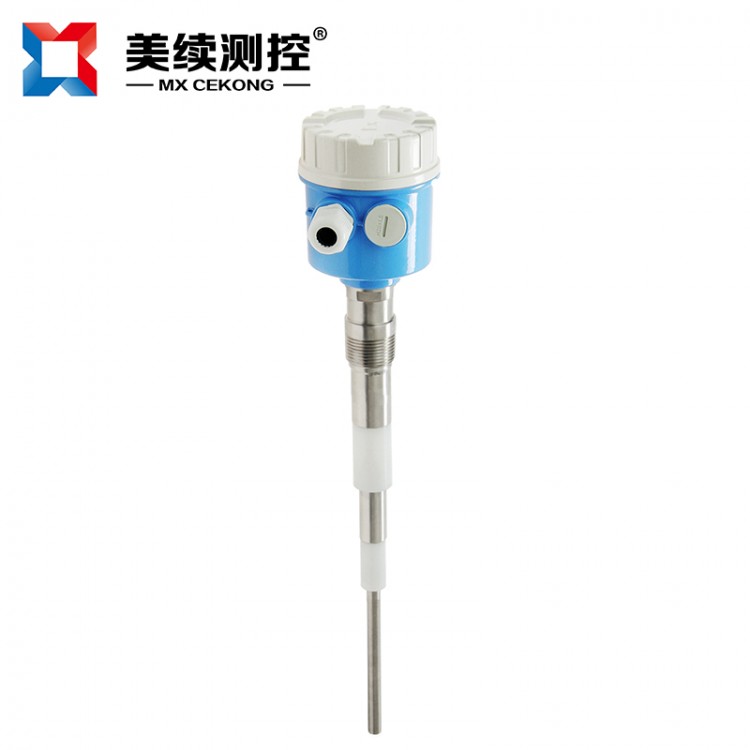
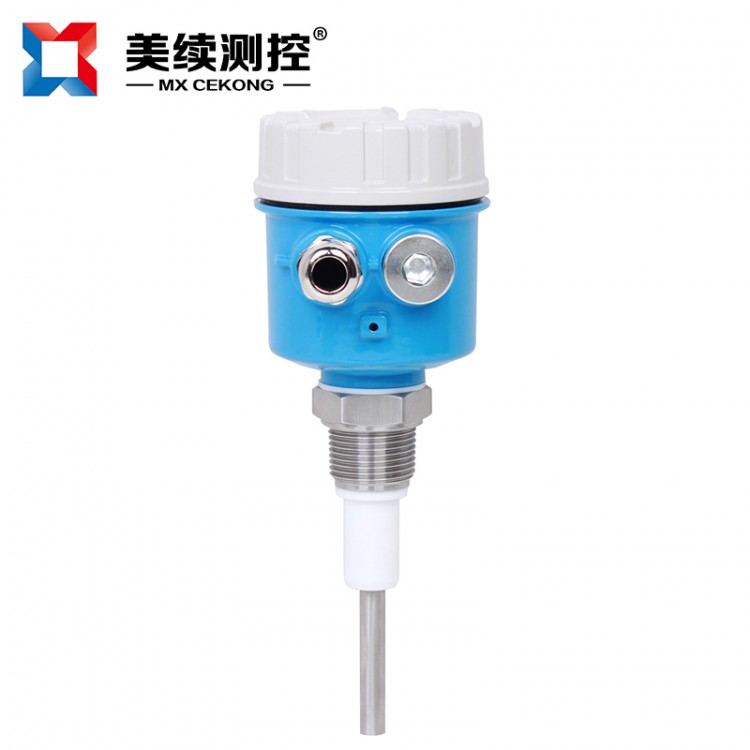

The RF admittance level switch MX-WW-144-06 utilizes high-frequency technology to generate a low-power RF signal at the probe, where the probe acts as a sensitive element, feeding back signal changes caused by the dielectric constant of the material level to the electronic circuit. Since these changes include variations in capacitance and conductivity, the electronic circuit processes the reactance signal (a composite change of capacitive and resistive signals). The changes in reactance also cause the phase of the high-frequency signal on the electrode rod to vary. Consequently, the phase difference between the high-frequency signal on the electrode rod and the reference signal in the electronic circuit also changes. After processing, this change drives the output circuit to emit an alarm signal, thereby detecting the presence or absence of material in the storage bin. The RF admittance level switch is a position control instrument used to detect the level of adhesive liquids, solid particles, dust, and other mixed slurries in storage bins, bins, or other containers. It can also be used for interface measurements between two different liquids, such as oil-water interface measurements. The major difference between the RF admittance level switch and the tuning fork level switch is that the tuning fork can only measure a single property medium, such as well-flowing solids, fine particles and dust, or liquids and slurries, whereas the RF admittance level switch can measure adhesive liquids, solid particles, dust, and other mixed slurries.

Application Fields
Conductive & Insulating Liquids... Chemical Industry, Oil Fields, Water & Wastewater Treatment
Conductive & Insulating Paste... Papermaking, Water & Wastewater Treatment
Powder: Grey, Fine... Power plants, metallurgy, cement
Granules: Coal, Grain... Power Plants, Metallurgy, Grain
Interface: Two Different Liquids …… Oilfield, Chemical Industry
Liquid Filling, Sewage Pool, Oil Tank
Textile industry, pulp measurement for the papermaking industry.
Product Features
High versatility: Widely applicable in various scenarios, including fly ash, particles, powders, liquids, and materials with varying degrees of viscosity, conductivity, and non-conductivity?Adaptability: The measured medium's different electrical parameters and density have no effect on the measurement. Scaling, stirring, turbulence, bubbles, vibration, moderate viscosity, high temperature, high pressure, and other harsh conditions have no impact on the detection;?Anti-adhesive: The unique circuit design allows the measurement circuit to ignore the material accumulation on the probe and automatically correct it;?Detachable probe: The probe and the controller can be separated, without cable connections, making installation and removal convenient and not affecting on-site operations;?Robust functionality: Large output contact capacity, with status indicator lights to show working status, and a 0-30 second delay to eliminate the impact of material fluctuations;?Power failure protection: Normally open or normally closed (can be switched on-site).
Probe Installation
The probe should be installed with a downward tilt in the horizontal direction (>5°).
2. The probe installation location should be far from the feed opening (>10cm)
3. The probe should maintain a certain distance from the container wall (>10cm)
4. The shield section should extend inward from the container wall (>5cm)
The distance between the high and low level probes is greater than 50 cm.
6. When vibration equipment is installed on the tube groove or conveying pipeline, consider whether it may damage the internal parts of the switch.
7. If the switch is used for liquid detection, do not install it below the inlet to avoid liquid impact on the sensor rod and cause false operation.
8. When installing in a storage tank with a mixing device, use a circuit board equipped with a delayed setting function to prevent false operation caused by fluctuations.
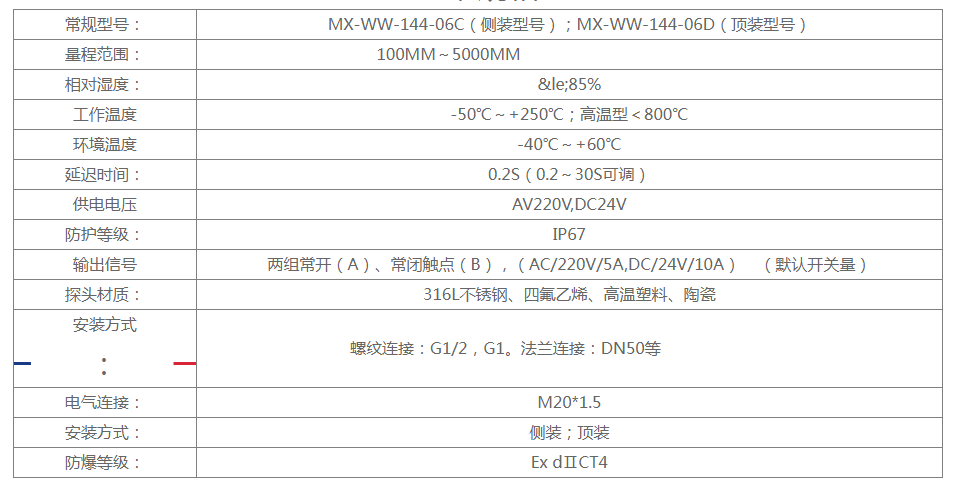
Technical Specifications
Ordering Guide

