
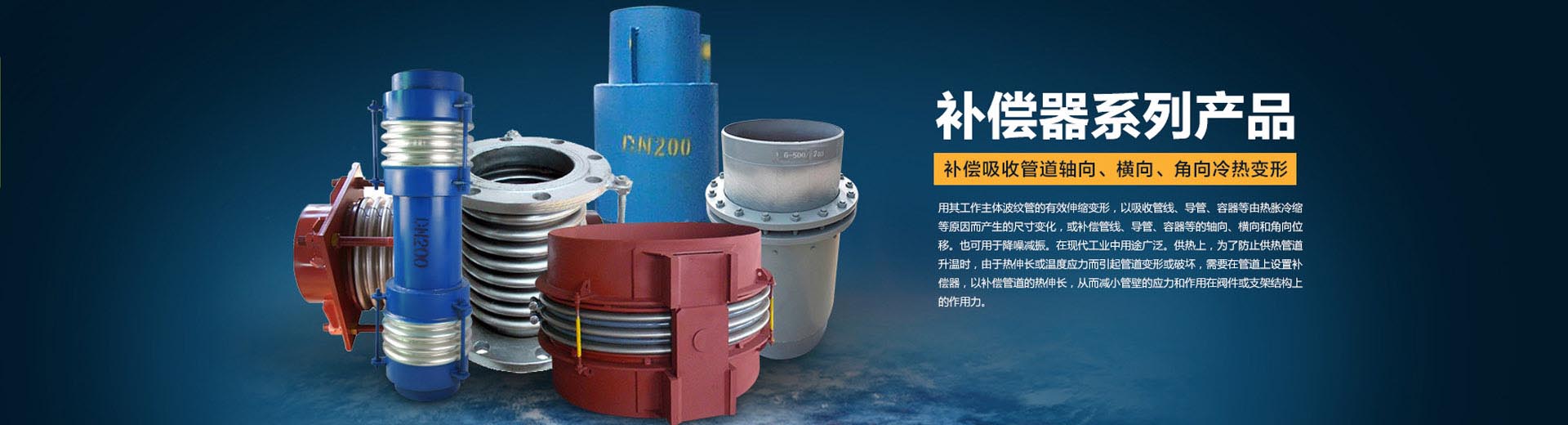




Expansion joints, also commonly referred to as compensators or bellows, are composed of the corrugated tube (an elastic element) that forms the core of their operation, along with end pipes, supports, flanges, conduits, and other accessories. These joints are designed to be flexible structures mounted on vessel shells or piping to compensate for additional stresses caused by temperature differences and mechanical vibrations. By utilizing the effective expansion and contraction deformation of the corrugated tube, they absorb dimensional changes in pipelines, conduits, and vessels due to thermal expansion and contraction, or compensate for axial, lateral, and angular displacements of pipelines, conduits, and vessels. They can also be used for noise reduction and vibration damping, and in heating systems. To prevent pipeline deformation or damage due to thermal expansion or temperature stress when heating pipes, compensators must be installed on the pipes to compensate for the thermal expansion, thereby reducing the stress on the pipe walls and the forces acting on valves or support structures.
Expansion joints, as elastic compensation elements that can freely expand and contract, offer reliable operation, excellent performance, and compact structure, and are widely used in industries such as chemicals, metallurgy, and nuclear energy. In terms of expansion joints used on vessels, there are various types, with U-shaped expansion joints being the most widely used, followed by Ω-shaped and C-shaped ones. For expansion joints used on pipelines, in terms of structural compensation, they are further categorized into types, pressure-balancing, hinge, and universal joint styles.
