
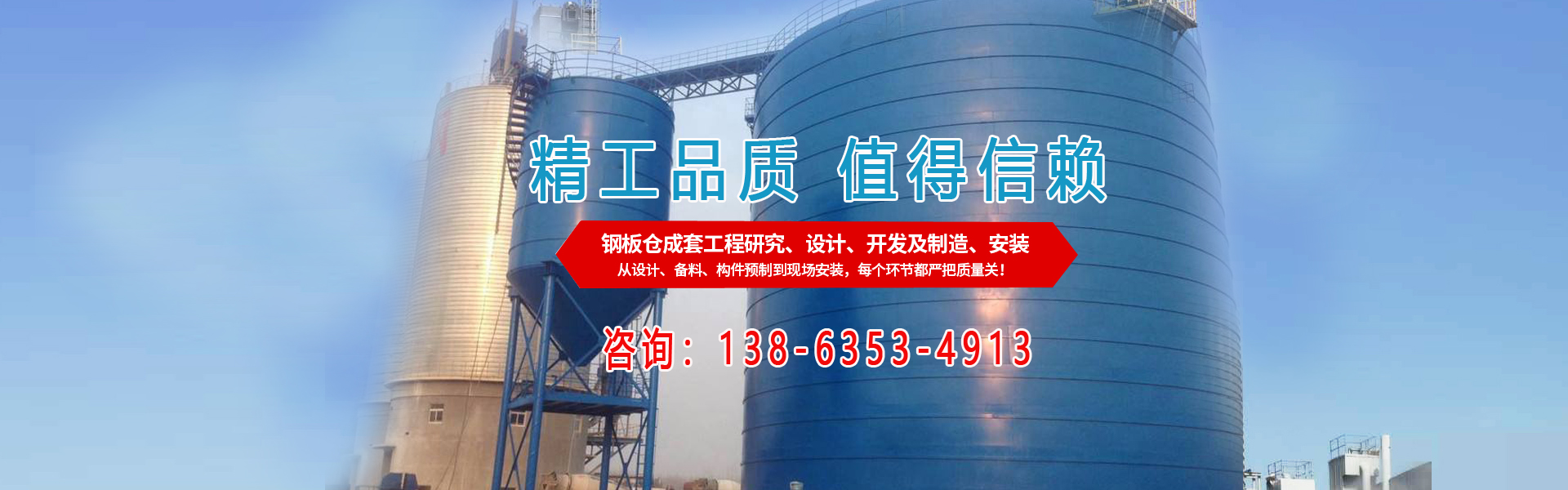

In layman's terms, any cylindrical structure used for storing granular materials can be referred to as a silo. A warehouse made of steel plates is known as a steel silo. Steel silos are equipped with functions for containment, storage, loading, unloading, and reversing, and they play a role in balancing the production process, ensuring continuous production, saving labor, and enhancing mechanization.
Steel silos are a highly advanced and popular storage solution in the modern era, continually expanding their application range in the industry due to their diverse functionalities. They are suitable for industrial sectors such as coal, steel, mining, construction materials, chemicals, and port environmental protection.
Steel silos are generally categorized into three types: assembled steel silos, spiral steel silos, and welded steel silos.
1. Prefabricated steel plate silos are steel plate storage bins that are assembled on-site by connecting pre-drilled steel plates with high-strength bolts. These prefabricated steel plate silos feature the following characteristics:
(1) The same specifications offer lower strength and cost compared to other warehouse types.
(2) Assembly can be done on-site directly, with a quick construction speed and low technical requirements for installation personnel.
(3) Removable, reconfigurable, and reusable.
(4) High-tensile bolts are used to connect the steel plates, resulting in relatively poor airtightness and unsuitability for storing powdered and deteriorated materials.
2. Spiral steel plate silo
Spiral steel plate silos, also known as rolled edge silos, utilize the "cold rolling bending" principle to continuously laminate steel plates with a cold-rolled edge. Their structure dictates that they are only suitable for thin plates. The features of spiral steel plate silos are as follows:
(1) Excellent sealing performance, suitable for storing cement, fly ash, food, and various powdered and liquid materials.
Due to continuous cold bending and edge biting, the overall stability and safety have been enhanced (based on experience from severe earthquake tests in various regions), with a longer lifespan.
(3) Non-decomposable, for use only.
(4) High technical requirements for on-site equipment operators and stringent specifications for the coil material, which in turn narrows the scope of materials available.
(5) The steel consumption for warehouse assembly is higher compared to the same specification, resulting in increased costs.
3. Welded steel plate silo
Welded steel plate silos, also known as steel plate storage silos, are constructed from steel plates welded together and represent a large-scale, independently developed welded steel plate silo in China's continuously evolving steel plate silo industry. The features of the welded steel plate silos include:
(1) Our warehouses are spacious, with individual capacities ranging from 10,000 to 100,000 tons, capable of forming larger storage clusters.
(2) Compared to spiral steel plate silos, construction time is longer, and the weight is 2-3 times that of spiral steel plate silos, requiring anti-corrosion treatment every 3-5 years.
How to extend the lifespan of steel plate silos during use?
1. Regularly inspect the walls for warping, and reinforce bolt connections. If bolts fall out, be sure to fill them in promptly.
After unloading and emptying the container, verify the seal integrity, check for deformation of the door frame and adjacent side panels, and look for cracks. If any abnormalities are found, take appropriate corrective actions promptly. Additionally, inspect the cone connection area for any anomalies and address them accordingly.
If welding deformation or cracks are detected, the supply should be temporarily halted to prevent any unforeseen incidents.
