
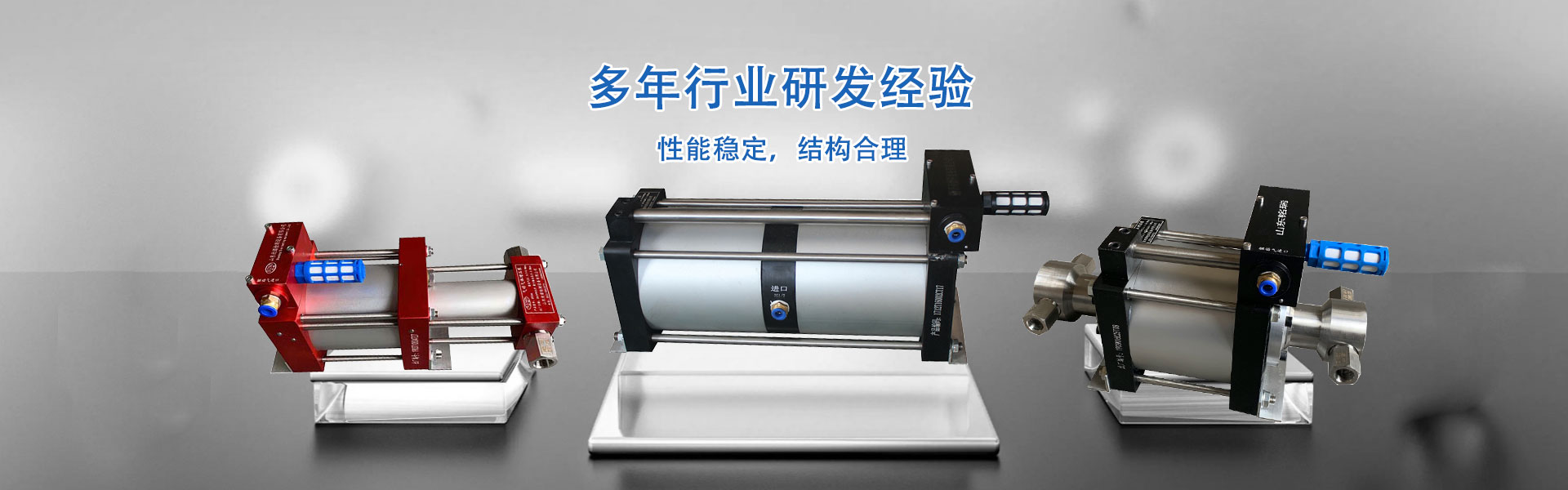
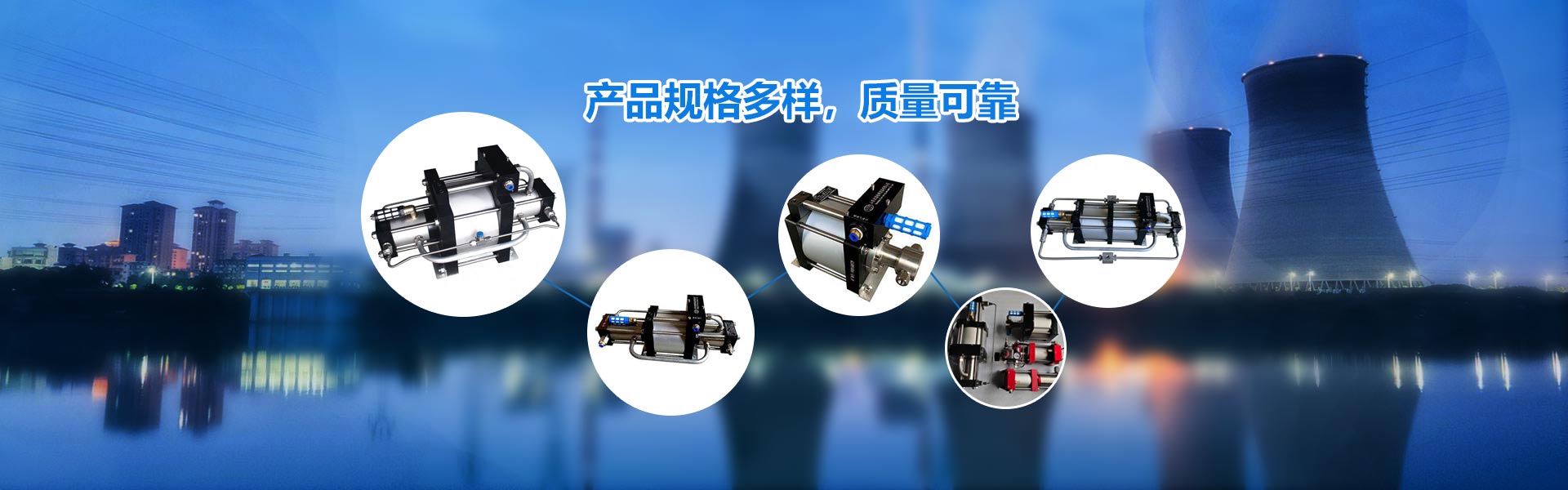


Selection Considerations for Gas Pressure Boosters
Firstly, we need to clarify the following questions: 1. What type of pressure medium are we dealing with? 2. What is the range of the inlet pressure for the pressure medium? 3. What is the current pressure of the gas source? 4. Are there any requirements for the flow after high-pressure boost? 5. What is the purpose of the increased pressure after boosting?
Determine the type of supercharger based on the增压 medium.
For instance, if the boosting medium is air/nitrogen, we choose from air boosters/nitrogen boosters. If the boosting medium is a gas, we opt for a gas booster; if it's a liquid, we select an air-pneumatic liquid booster.
Determine the pump model initially based on the required system pressure.
Generally, the driving pressure of pneumatic booster pumps is ≤ 8bar. Therefore, the boost ratio (RaTIo) = Po/Pa. Where Po is the system's output pressure; Pa is the driving pressure of the pneumatic pump, typically taken as the maximum value of 0.7MPa. Based on the calculated boost ratio, select the model from the pump chart for the corresponding type.
Be aware that we typically opt for pumps with slightly higher boost ratios than calculated values to ensure our pumps can consistently deliver the required system pressure under normal circumstances.
Are the flow rates of the calculation pumps sufficient to meet system requirements?
Once we preliminarily select a pump model based on the discharge pressure, we need to calculate if the flow rate of the pump meets the requirements. The method to calculate the flow rate is as follows: Displacement per stroke × Action frequency per minute (usually 40).
For instance, the pneumatic liquid pressure booster model 10-4000W003, according to our pump table, has a displacement of 42.50ml per stroke. Therefore, its flow rate Q = q × n = 42.50ml × 40 = 1700ml/min = 1.7L/min. Compare this flow rate with the required system flow to determine if it meets the requirements.
If the flow rate is insufficient, we will select a pump with a similar boost ratio but a higher flow rate, and calculate the flow rate until it meets the system's flow requirements.
Please note that the term "flow" we use refers to flow at atmospheric pressure, meaning the volume of the medium (liquid or gas) that passes through the pump and is pressurized within one minute is measured under atmospheric pressure. Therefore, for gases, we need to consider the size of the pre-increase pressure.
For instance, by using an air booster pump, we increase the pressure of 7bar air to 1.2MPa, resulting in a flow rate Q = 7 × q × n = 7 × 47.6ml × 40 = 13,328ml/min = 13.328L/min.
