


Handrails for Accessibility, literally, are designed to allow those with mobility challenges to move without hindrance, preventing falls and injuries. To align with the modern theme of environmental protection, these handrails are also recyclable and can even be reclaimed, as they are made from environmentally friendly materials.
Handrails for accessibility, at first glance, are designed to allow those with mobility challenges to move without hindrance, preventing falls and injuries. However, their primary intent is to assist the vulnerable in performing basic self-care tasks. Who wouldn't want to be completely dependent on others, unable to do anything for themselves? Many elderly individuals who struggle with mobility are also unwilling to become a burden to their families, which is why such handrails were developed.
What are the features of the accessible handrails? Firstly, they are designed with a non-slip structure to ensure better grip for the elderly, while also maintaining comfort. Moreover, as these handrails come in different types, each suitable for various environments, this model boasts numerous performance advantages for enhanced adaptability. They do not generate static electricity, are easy to clean, and are even resistant to corrosion and rust. In line with the theme of modern environmental protection, the accessible handrails are recyclable and can be recycled due to their use of environmentally friendly materials.
Standard Dimensions for Accessible Bathroom Grab Bars
Handrails are a boon for the disabled and elderly, serving as an essential application in many venues. Today, we introduce the requirements for installing handrail sizes in accessible restrooms, hoping to provide reference for construction work.
Accessible Handrails, also known as safety grasp bars or safety railings, are primarily used on both sides of corridors, in bathrooms, and public toilets, serving as public facilities to aid the elderly and individuals with disabilities in walking and ascending. Places where accessible handrails are commonly found include nursing homes, high-rise office buildings, and bathrooms for elderly individuals at home. With society's increasing concern for the elderly and disabled, these handrails are also increasingly visible in public places. Many elderly households are also beginning to use them. Editor's Note: The following brief description outlines the sizes and types of accessible handrails for bathrooms.
Accessible toilet grab bar dimensions
Hallway Handrail
1. Handrails should be installed on both sides of ramps, steps, and staircases, with a height of 0.85 meters. When two levels of handrails are provided, the lower handrail should be 0.65 meters high.
2. The spacing between the inside of the handrail and the wall should be 40 to 50 mm.
The handles should be securely mounted and shaped for easy gripping.
Accessibility Handrails for Restroom and Public Toilets: Safe Grip Bars
1. Safety grab bars should be installed 50mm from both sides of the washbasin and 50mm from the front edge.
2. Safety grab bars should be installed on both sides and above the toilet, with a width of 0.60 to 0.70 meters and a height of 1.20 meters.
The commode is 0.45m tall, with 0.70m high horizontal grab bars on both sides. A straight grab bar 1.40m high should be installed on one side of the wall.
4. The diameter of the safety grab bar should be 30~40mm.
5. The safety grab bar should be 40mm away from the wall on the inside.
The rod should be securely mounted.
In the early 20th century, spurred by the call of humanism in the West, a new approach to architectural design emerged—Universal Design. Its purpose was to utilize modern technology to fulfill environmental needs, providing convenient and safe spaces for the elderly, people with disabilities, women, and children, and to create an environment of equality and participation.
What are the standards for high-quality accessible handrails?
As society rapidly develops and the aging population becomes more pronounced, the use of handrails has become indispensable. What are the standards for high-quality accessible handrails? Below, we provide a brief introduction:
One, High-quality grab bars are primarily made from engineering plastics or composite plastics with antibacterial properties. The surface color can be customized for different settings, offering a variety of choices such as red, yellow, and blue. This makes it easier for the elderly and people with disabilities to locate the grab bars and also adds a certain decorative effect.
Secondly, the surface of the barrier-free handrails should not have any connecting gaps and cannot have rough, prickly plastic edges, otherwise it will affect the tactile feel when gripping.
Thirdly, the wall thickness of stainless steel pipes must be at least 2mm, ensuring they will not bend or deform under the straight-down pressure of a person weighing 75kg.
Four, the curvature of the handrail bend should be appropriate, generally keeping the handrail spacing from the wall between 5cm to 6cm. It should not be too wide or too narrow; too narrow may cause hands to touch the wall, and too wide may accidentally trap the arms of the elderly or disabled. Therefore, high-quality accessible handrails are made from engineering plastics or composite plastics with antibacterial properties, encasing stainless steel tubes of 2mm thickness or more. The surface is free of plastic burrs and seams, providing a comfortable grip.
How to Choose Accessible Handrails for Corridors
Handrails are an essential accessibility feature in modern buildings, typically installed at both ends of corridors to assist patients in holding onto for support.
The need for accessible grab bars varies among users, from homebound patients, individuals with disabilities, to caregivers assisting elderly patients with their daily living. As terminal products, they must be sturdy and easy to use.
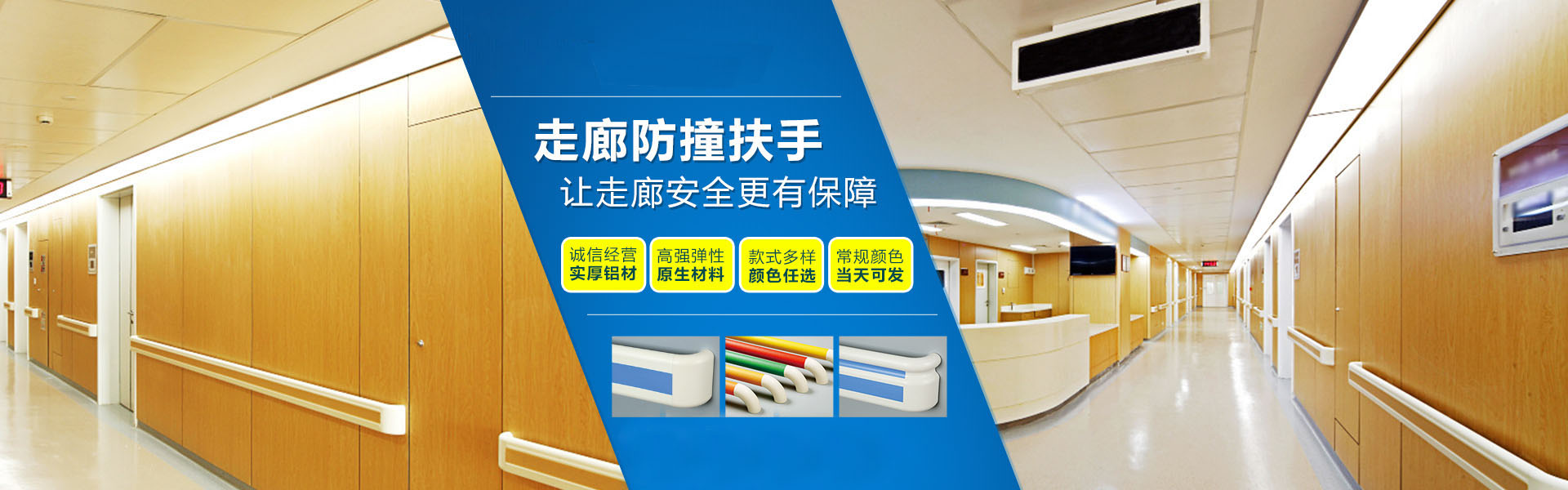
The corridor barrier-free handrails are made of a combination of PVC panels and an aluminum alloy base with a base. They offer antibacterial, fire-resistant, wear-resistant, wall-protective, and anti-slip properties. Suitable for public places such as nursing homes. Not only do they assist the physically challenged and the weak in walking, but they also serve to protect the walls.
Accessibility Handrails include models such as 140, 143, 159, 90, and 38, which are conventional styles commonly found in nursing home corridors. The only difference is in their dimensions, allowing you to choose the handrail style based on individual circumstances. These accessibility handrails are made with an aluminum core and a 2.0mm thick PVC panel, available in multiple colors to match the overall design style. They are also corrosion and bacteria-resistant, and easy to install.
