
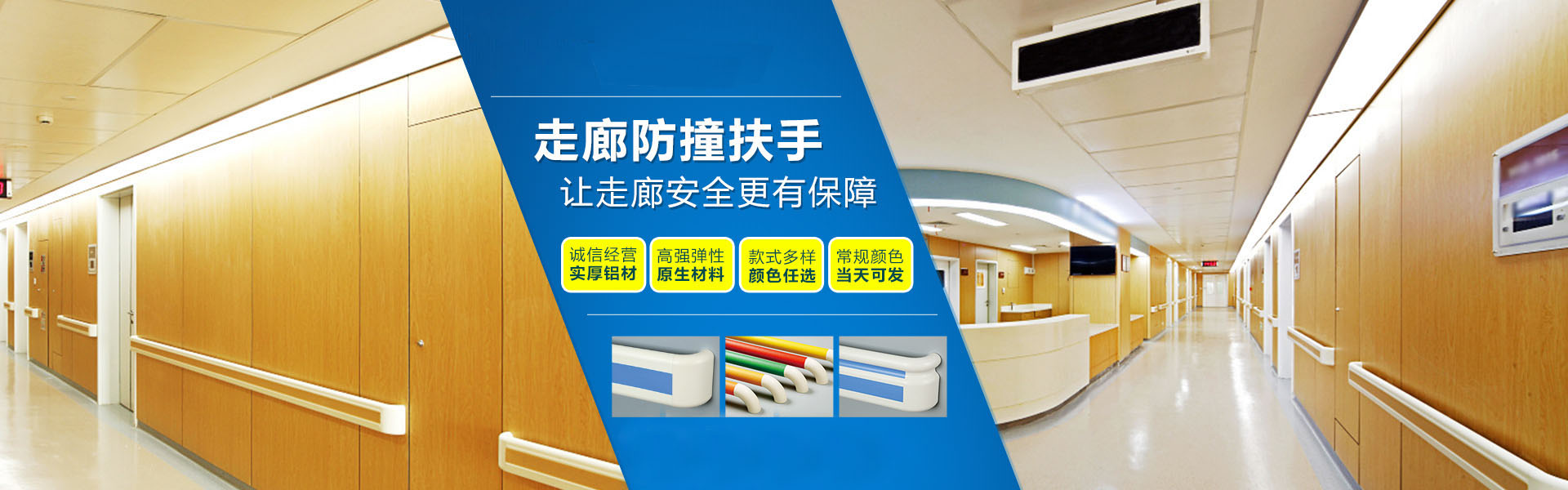


As society rapidly evolves and faces significant aging populations, the use of handrails has become indispensable. What are the standards for high-quality accessible handrails? Below is a brief introduction.
One, High-quality handrails are primarily made from antibacterial engineering plastics or synthetic plastics, with the exterior color customizable for different settings, offering options like red, yellow, and blue. This aids elderly individuals and the disabled in easily identifying the location of the handrails, while also serving a decorative purpose.
Secondly, the appearance of the accessible handrails should not have any gaps in the joints, and they must not have rough, prickly plastic burrs, as this would affect the tactile feel when gripping.
Thirdly, the wall thickness of stainless steel pipes must be at least 2mm, ensuring they do not bend or deform under the vertical pressure of a person weighing 75kg.
Four, the bend radius of the handrail should be appropriate, generally keeping the handrail 5-6cm away from the wall. It should not be too wide or too narrow; too narrow may cause hands to touch the wall, and too wide may lead to older adults and individuals with disabilities accidentally getting their arms caught.
High-quality accessible handrails are made of stainless steel tubes with a thickness of 2mm or more, coated with engineering or synthetic plastics that offer antibacterial properties. The surface is free of plastic burrs and seams, providing a comfortable grip.
Handrails, a boon for the physically challenged and the elderly, are widely used in various locations. Today, we share insights into the installation of these handrails and important considerations to ensure proper installation, hoping they serve as a reference for your construction work.
The height of the accessible single-handrail should be between 850mm and 900mm, while the upper handrail of the accessible double-handrail should be between 850mm and 900mm, and the lower handrail should be between 650mm and 700mm.
The accessible handrails should be continuous, with the starting and ending points of handrails along the wall extending horizontally for a length of not less than 300mm.
The end of the accessible handrail should curve inward towards the wall or extend downward for at least 100mm.
4. The distance between the interior of the barrier-free handrail and the wall is no less than 40mm.
5. Barrier-free handrails should be round for easy grip, with a diameter of 35mm being ideal.
Accessibility Handrail Installation Precautions and Standards are mainly divided into two cases.
One, Standard for Installation of Handrails in Corridors and Hallways
Handrails should be installed on both sides of ramps, steps, and stairways, with a height of 0.85 meters. When two handrails are installed, the lower one should be 0.65 meters high.
The distance between the inside of the handrail and the wall should be 40-50mm.
The handrails should be installed securely and shaped for easy gripping.
Section 2: Installation Standards for Wheelchair-Accessible Grab Bars, Bathing Room Grab Bars, and Safety Handles in Toilets and Public Restrooms
1. Safety grab bars should be installed 50mm from the sides and front edge of the lavatory.
2. Safety grab bars, 0.60-0.70m wide and 1.20m high, should be installed on both sides and above the toilet.
The toilet seat height is 0.45 meters, and both sides should have horizontal grab bars at 0.70 meters, with a vertical grab bar at 1.40 meters on the wall side.
4. The diameter of the handrails should be 30-40mm.
5. The inside of the handrail should be 40mm away from the wall.
The handle should be securely installed.
