

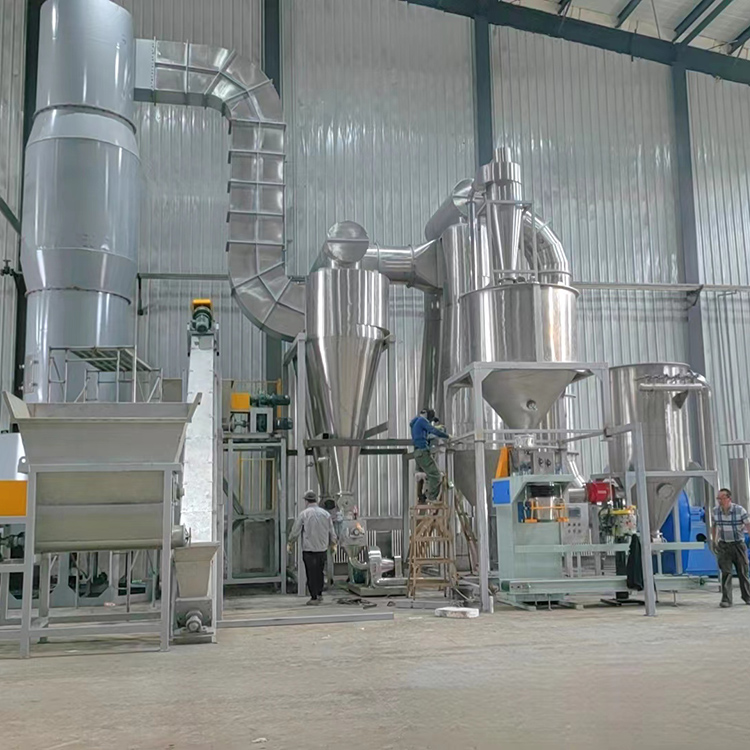

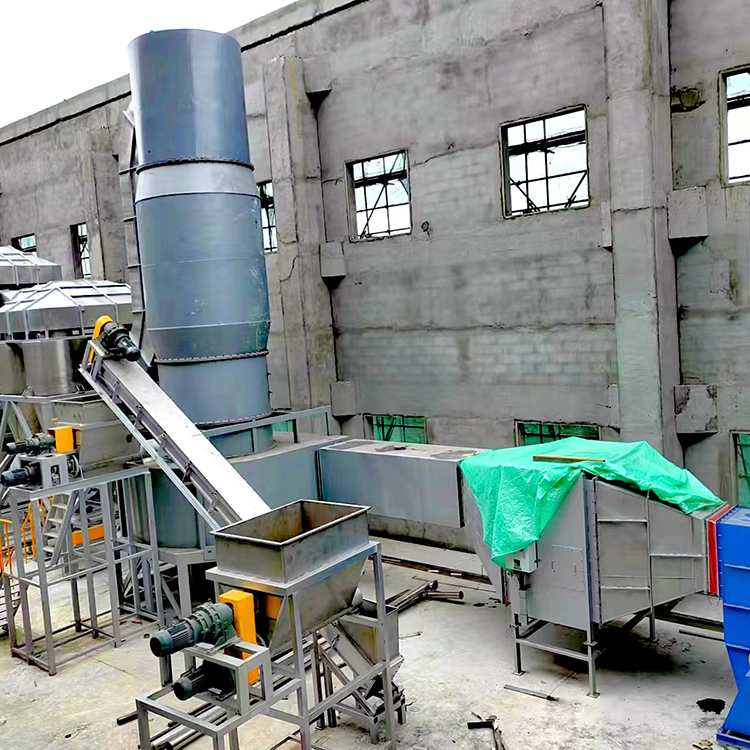
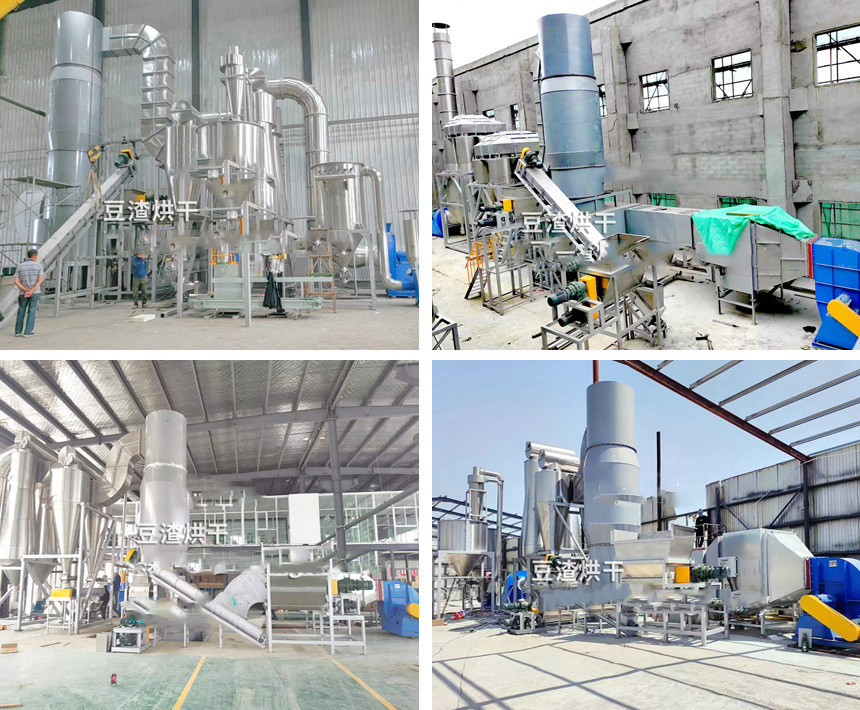
Our company specializes in the research, development, and production of a complete set of soybean dreg drying machine production lines, designed for drying soybean dreg. Equipped with an integrated continuous collection device, the production capacity exceeds 1500kg/h. Due to the high moisture content of the drying material, conventional dryers cannot achieve such high capacity. It is precisely this advantage that allows our soybean dreg drying machine production line to achieve high yield, successfully applied to many customers, and receives unanimous praise.
Dreg Dryer Introduction
The soybean dreg dryer is a specialized machine designed for processing soybean dregs. Soybean dregs are by-products generated during the production of tofu, soy milk, and other soy products, characterized by high moisture content and difficulty in preservation.
The soybean dreg dryer employs excellent drying technology, capable of reducing moisture content to below 12%. During the drying process, the dryer maximizes heat energy utilization, ensuring even heating of the soybean dreg, resulting in a good color and minimal nutrient loss, with low energy consumption.
In addition, our soybean dreg dryer employs the rotating rapid flash drying technology, which effectively addresses the challenges of difficult drying and uneven moisture content in soybean dreg. The dried material boasts good color, no sticky residue, low energy consumption, and minimal nutrient loss.
Dreg Introduction
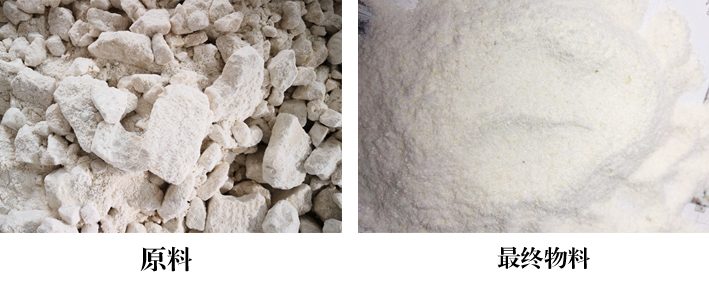
Soybean dregs are a byproduct of the tofu-making process, a sticky material containing bound water. The advantages after processing include easy storage, transportation, and processing. Fresh soybean dregs have about 90% moisture content and are richer in nutrients than many other dregs, with a high content of crude protein. Particularly during hot summer temperatures, they are prone to spoilage and mold. Dried soybean dregs contain three times more crude protein than rice, making them a nutritious feed suitable for pigs, chickens, ducks, and more. Additionally, they are also a good raw material for making cat litter.
With the economic development and the enhancement of environmental protection requirements, the drying and dehydration process of soybean dreg has gained increasing attention from the state. On this basis, various drying equipment for soybean dreg has emerged, such as drum dryers and rake dryers. Although these machines can be used, their drying performance is not ideal; they are either inefficient or unevenly dried, or have high energy consumption. Our company's specially developed soybean dreg soybean fiber dryer utilizes an integrated continuous collection system, boasts high production capacity, and has received unanimous praise from customers.
Soybean dreg dryer working principle
The hot air from the bean dreg drying machine enters the mixing, crushing, and drying chamber from the bottom through the inlet pipe at an appropriate jet speed, exerting strong shearing, blowing, and rotational forces on the material. This causes the material to be micropulverized through centrifugal force, shearing, and collision friction, thereby enhancing mass and heat transfer.
Material enters the dryer through a helical feeder, where it is subjected to dispersion due to the strong action of a high-speed rotating mixer. The material is impacted, abraded, and sheared, causing the lumpy material to be quickly crushed and to come into full contact with hot air, heat up, and dry. The dried powder is carried up with the hot gas. The large particles are retained by the grading ring, while the smaller particles are discharged out of the dryer through the center. They are collected by a cyclone separator. Un-dried or large pieces are thrown against the wall by centrifugal force, fall back to the bottom, and are then crushed and dried again.
Dreg Dryer Performance Features
1. The desiccant is structured with an inverted conical shape at the bottom, allowing the cross-sectional area of the dried gas to gradually expand from bottom to top. The bottom air flow is relatively greater, while the top air flow is relatively smaller. This ensures that larger particles at the bottom are in a fluidized state while smaller particles at the top are also fluidized. Additionally, the hot air rotates along the conical section, enhancing the bottom air speed, reducing the length of the cantilever part of the agitator shaft, and increasing the operational safety and reliability.
2. Install scraper blades on the agitator teeth. While the material is being crushed by the agitator teeth, it is also thrown against the machine wall, sticking to the surface. If not removed promptly, it can cause severe equipment vibration and even lead to the agitator jamming and not turning. Installing scraper blades on the agitator teeth can timely remove the material stuck to the machine wall, preventing sticking.
3. The rotation speed of the agitator shaft is controlled by a variable-speed motor. Select different speeds based on the product particle size requirements; the faster the agitator shaft rotates, the finer the particle size of the product will be.
4. The dryer is equipped with a classifier at the top, which adjusts the air flow rate by changing the hole diameter of the classifier and the height of the classification section. This controls the particle size and quantity exiting the dryer, the final moisture content, and the material's residence time in the drying section.
5. The screw conveyor of the feeder is controlled by an inorganic variable-speed motor. The feeding speed is controlled according to the material properties and drying process parameters.
