
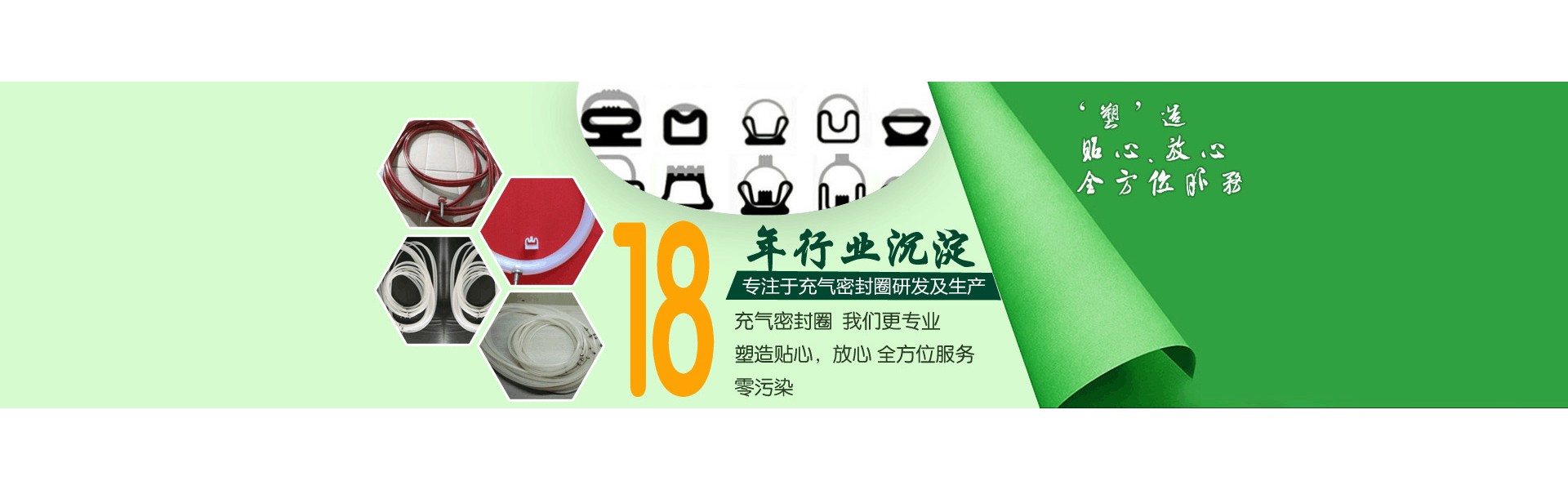


Air-filled sealing rings are generally installed into grooves, and attention should be paid to ensure the seal is completely concealed within the groove to prevent damage to the seal during the opening and closing of the cabin door. The air compressor for the air-filled sealing ring should be equipped with a pressure relief valve. During the initial use, the inflation pressure typically starts at 0.1 MPa and gradually increases until the sealing effect is achieved, but not exceeding 0.6 MPa.
The material of an inflatable sealing ring depends on the environment of use. As is widely known, different environments can affect the physical and chemical changes in materials. Here, let's introduce the choice of materials for inflatable sealing rings in the current major environments.
Silicone material should be chosen for high-temperature environments: Silicone is a highly active adsorption material, belonging to amorphous substances with the chemical formula mSiO2·nH2O. It is insoluble in water and any solvent, chemically stable, and does not react with any substance except for strong alkalis and hydrofluoric acid. Different micro-porous structures are formed due to varying manufacturing methods among various silicone types. The chemical composition and physical structure of silicone determine its unique features that are difficult to be replaced by other similar materials: high adsorption performance, good thermal stability, stable chemical properties, and high mechanical strength.
2. When it comes to aging resistance, choose三元乙丙橡胶 (EPDM, Ethylene Propylene Diene Monomer): As a copolymer of ethylene, propylene, and a small amount of non-conjugated diene, it is a type of ethylene propylene rubber. Its main chain consists of chemically stable saturated hydrocarbons, containing only unsaturated double bonds in the side chains. This makes it highly resistant to ozone, heat, and weathering, and it is widely used in automotive parts, waterproofing materials for construction, cable sheaths, heat-resistant hoses, tapes, and automotive seals.
3. Nitrile rubber is used in conditions of acidic or alkaline corrosion or oil contamination: Nitrile rubber is obtained by emulsion polymerization of butadiene and acrylonitrile. It is mainly produced by low-temperature emulsion polymerization, featuring excellent oil resistance, good elasticity, good heat resistance, and strong adhesion. Its drawbacks include poor low-temperature resistance, poor ozone resistance, poor insulation properties, and slightly lower elasticity. Nitrile rubber is primarily used for manufacturing oil-resistant rubber products. Abbreviated as NBR, it is a synthetic rubber obtained by copolymerization of butadiene and acrylonitrile. It is a synthetic rubber with good oil resistance (especially alkane oil) and aging resistance. Currently, silicone is commonly used and can be applied in various industries. In situations where resistance to aging, acidity/alkalinity, or high temperatures is recommended, silicone materials are suggested.

