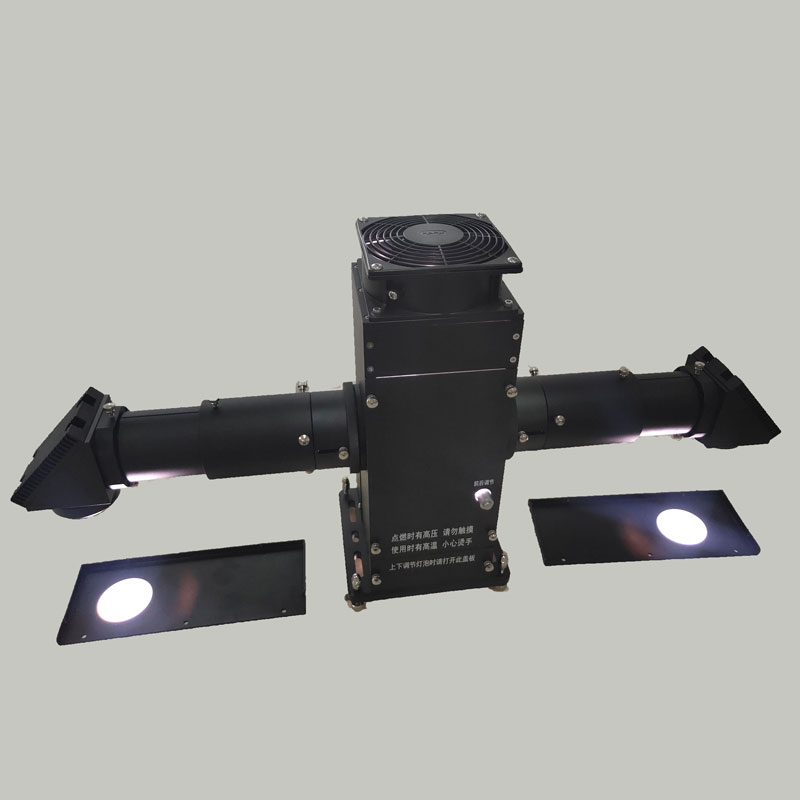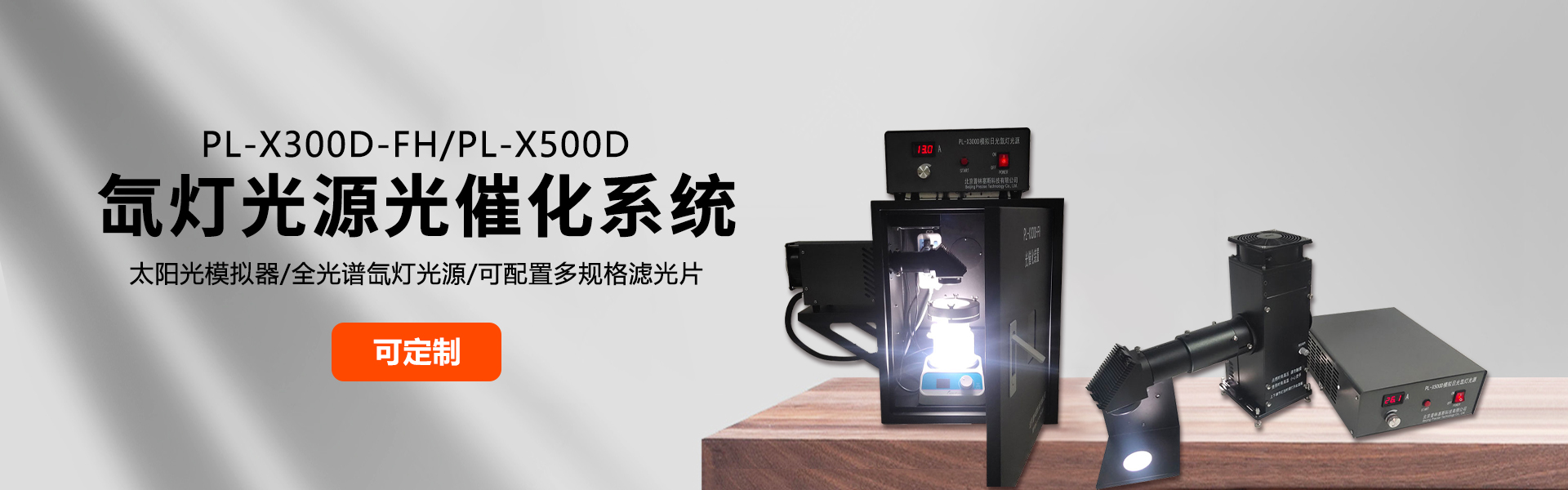

The Xenon light sources have been upgraded with fiber optic output options, providing monochromatic light sources for various instruments. Examples include the HSX-UV Xenon light source and the HSX-F300 Xenon light source. The spherical Xenon lamps require high-precision optical path design, typically achieved by collecting and focusing light into a point source through rear-mounted mirrors, which is then passed through an optical lens assembly to produce parallel light output. This ensures a high degree of uniformity in the output parallel light, making it suitable for photonic, solar cell, and photobiological experiments. They are often used in conjunction with monochromators to form adjustable monochromatic light sources.
Xenon light sources are categorized by bulb structure into long-arc, short-arc, and spherical xenon lamps, and by illumination methods into internal and external illumination sources. Long-arc xenon lamps typically use tubular xenon lamps, positioning the tube inside the reactor for a diffused, all-around illumination, known as internal illumination sources. These sources provide full-spectrum illumination, do not require filter plates, and are cost-effective, making them suitable for primary photochemical research. Short-arc xenon lamps usually feature spherical xenon lamps, with parallel light beams passing through an outlet for adjustable 360-degree illumination. The light output can be equipped with different filter plates to produce ultraviolet, visible, or monochromatic light. Photochemical reactors are typically placed below the xenon lamp for experiments, as the light source illuminates the reaction liquid externally, hence termed external illumination sources. However, these are more expensive than long-arc xenon lamps. Both bulb lifespans are around 2000 hours, but NBeT's international heat dissipation technology model boasts an average bulb lifespan of approximately 3000 hours, with even longer lifespans for bulbs with lower light intensity requirements.
The interior of the Xenon light source room can accommodate a 150W high-voltage short-arc spherical Xenon lamp, which generates an arc discharge under high-frequency high-voltage excitation. The high-voltage short-arc spherical Xenon lamp is a point source with a very small luminous point; when ignited, it emits a strong and stable continuous spectrum from ultraviolet to near-infrared. The visible light color is extremely similar to sunlight, with a high luminous frequency. Xenon light sources are an ideal light source for various physical, biochemical, and environmental protection measurement instruments, such as infrared line detectors, ultraviolet spectrophotometers, chromatography UV detectors, and fluorescence spectrophotometers. They are also suitable for lighting and simulating sunlight.
Xenon light sources typically have a diffused light source, where the light is not processed and radiates uniformly in all directions (in the form of a spherical wave). In photochemistry, they are often used in conjunction with cold traps and reactors to uniformly irradiate the reaction substances, forming what is known as an internal irradiation system (in the entire system, light irradiates from the inside out). Parallel light sources are generally created by passing the light through optical devices, while in high-energy applications, ellipsoid reflecting mirrors are used. In photochemistry, a xenon light source can form an external irradiation system by combining a parallel light source with the reflective sample (light irradiates from the outside in as a parallel beam). As for light sources that can form a convergent point source, or central diffused source and parallel source, these require specific discussions and cannot be generalized.
Xenon light sources have a spectral energy distribution that closely resembles sunlight, with a color temperature of approximately 6000K. The spectral distribution of the continuous spectrum in xenon lamps is almost independent of the lamp's input power and remains nearly constant throughout their lifespan. The light and electrical parameters of xenon lamps are consistent, and their operating state is minimally affected by external conditions. Once ignited, xenon lamps achieve stable light output almost instantaneously; they can also be reignited instantly after being turned off. Xenon lamps have lower luminous efficacy and a smaller potential gradient. The xenon light source system is divided into point and parallel light sources, which are experimental devices that utilize xenon lamps as the light-emitting core. They are equipped with professional heat dissipation systems, stable power supplies, and triggering devices to illuminate and operate the xenon lamps. Point sources are typically connected to optical fibers to simulate sunlight in confined, dark experimental equipment. Parallel light sources generally consist of a beam of light, with the size of the spot adjustable according to experimental requirements.