
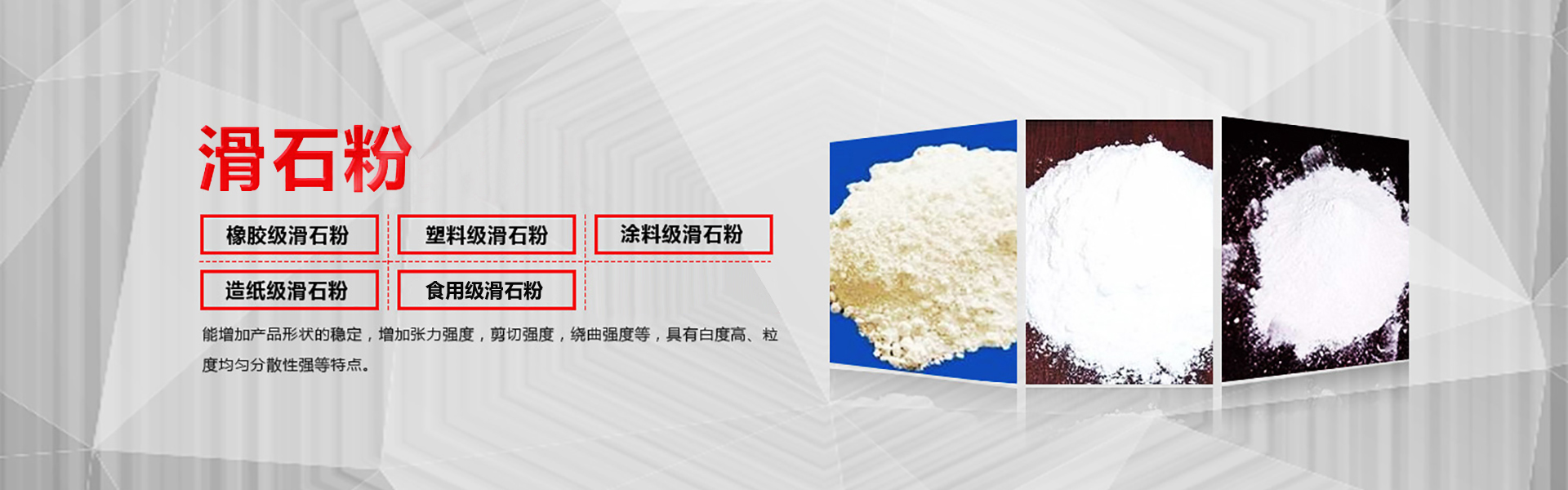

Talc powder is primarily composed of talc, which is itself a hydrated magnesium silicate with a crystal structure that is pseudo-hexagonal or rhombic in shape. It typically forms dense masses, lamellar, radial, or fibrous aggregates. It is colorless and transparent or white, but may appear pale green, yellow, brown, or even pale red due to trace impurities. It has a hardness of 1 and a specific gravity of 2.7 to 2.8. Structurally, it possesses a layered structure, with adjacent layers prone to sliding or peeling off. Now, what are the product characteristics and uses of talc powder? I. Product Characteristics: 1. Talc exhibits excellent physical and chemical properties such as lubricity, refractoriness, acid resistance, insulation, high melting point, inactive chemistry, good coverage, softness, luster, and strong adsorption. Due to its layered crystal structure, it has a tendency to split into scales and a unique lubricity. However, a high content of Fe2O3 can reduce its insulating properties. 2. Talc also has properties such as lubricity, ant sticking, flow assistance, refractoriness, acid resistance, insulation, high melting point, inactive chemistry, good coverage, softness, luster, and strong adsorption. Its layered crystal structure leads to a tendency to split into scales and a unique lubricity. A high Fe2O3 content can decrease its insulating properties. II. Product Uses: Talc powder is widely used in paints, inks, coatings, plastics, rubbers, ceramics, glass, electronics, cosmetics, food, and other fields. (1) Ceramic grade: Used in the production of high-frequency ceramics, radio ceramics, various industrial ceramics, building ceramics, daily ceramics, and glazes. Features: color stability at high temperatures, enhanced brightness after firing, uniform density, good luster, and smooth surface. (2) Chemical grade: Used in the rubber, plastic, and paint industries as a reinforcing and modifying filling agent. Features: improves product shape stability, tensile, shear, flexural, and compressive strengths, reduces deformation and elongation, thermal expansion coefficient, high whiteness, and uniform particle size distribution. (3) Plastic grade: Used in polypropylene, nylon, PVC, and polyethylene. (4) Pharmaceutical grade: Used in traditional Chinese medicine prescriptions, food additives, and isolators.
News Center Co., Ltd.
