

- AllProduct Category
-
Nanofiltration Reverse Osmosis Equipment
Company News
Wastewater Treatment Equipment
Industry Trends
Dyeing and Printing Wastewater Reuse
Tech Articles
Low-Temperature Evaporation Equipment
Laboratory Membrane Separation Equipment
Ultrasonic Cleaning Wastewater Reuse
Integrated Wastewater Treatment Equipment
Single-effect, Double-effect, Multi-effect Evaporation Equipment



详情描述
Process Description:
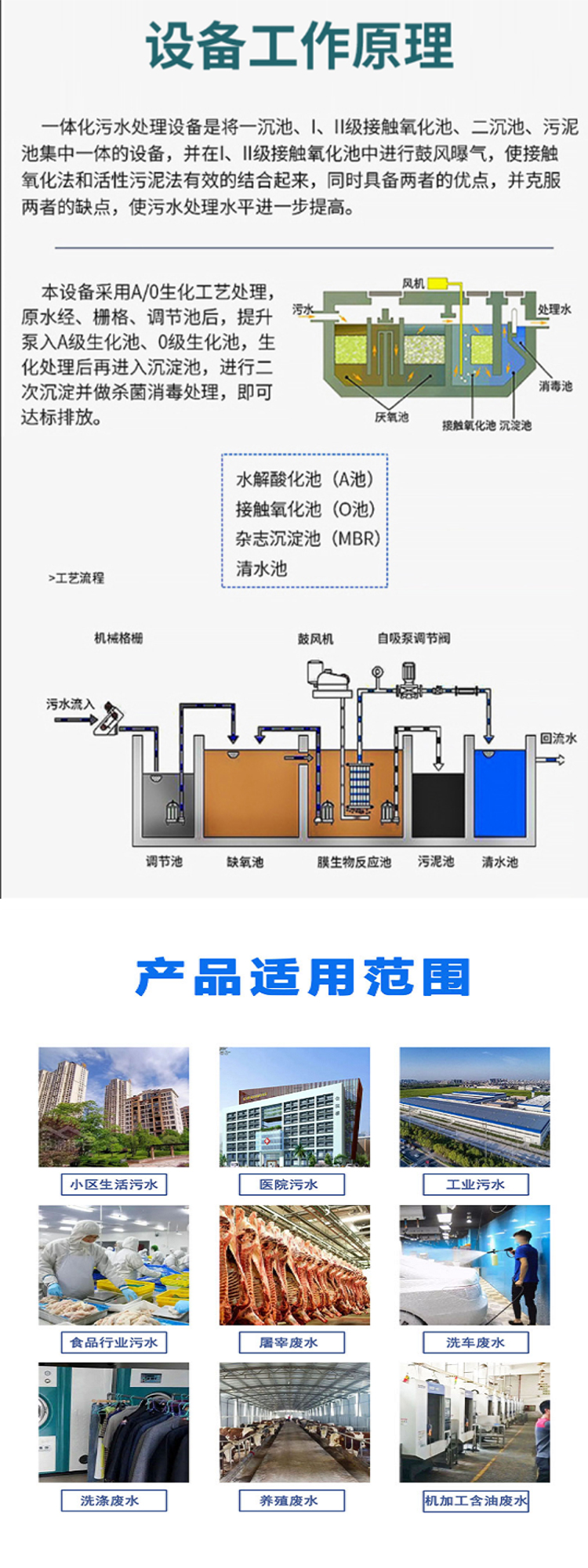
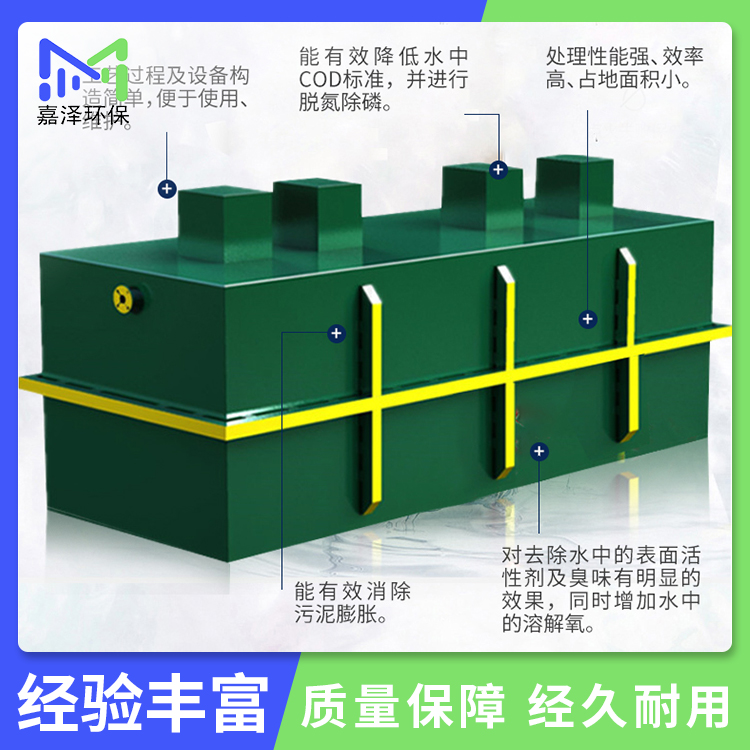
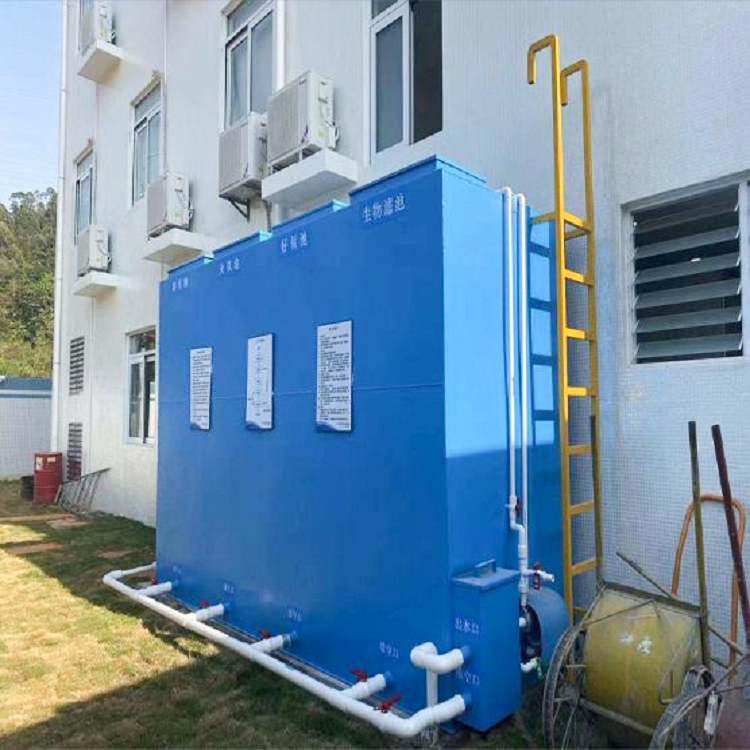
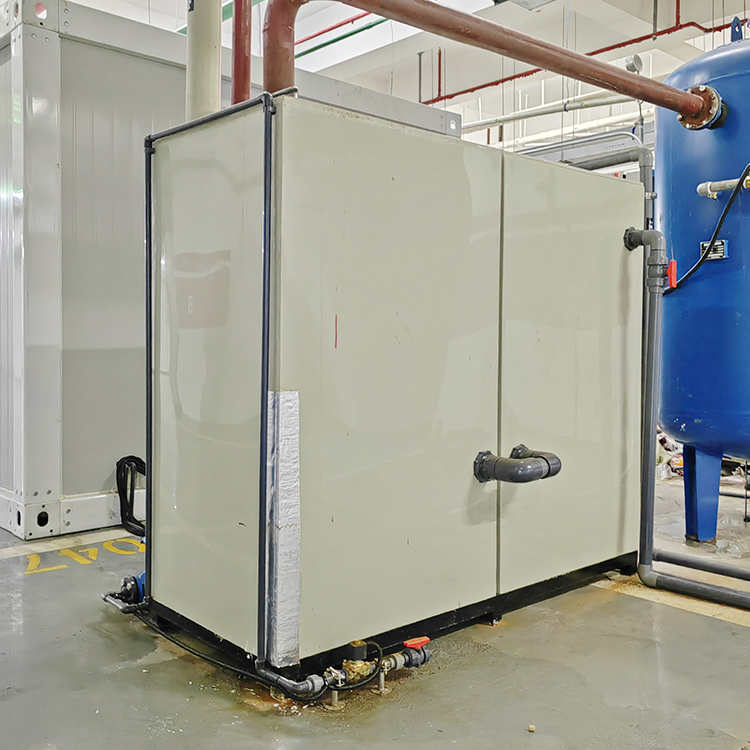
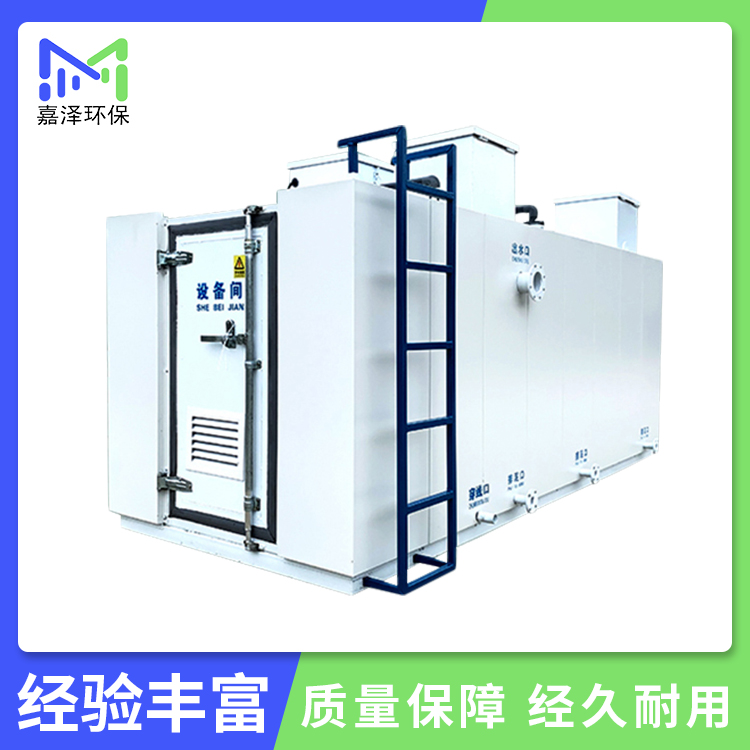
The design of the buried integrated sewage treatment equipment primarily focuses on the treatment of domestic and similar industrial organic wastewater. The main treatment method employs a mature biochemical technology—biological contact oxidation process. The water quality parameters are designed and calculated based on general domestic wastewater standards. The system consists of six main components: (1) Primary Sedimentation Tank (2) Contact Oxidation Tank (3) Secondary Sedimentation Tank (4) Disinfection Tank, Disinfection Unit (5) Sludge Tank (6) Fan Room, Fans.
Advantages of Submerged Integrated Wastewater Treatment Equipment
1. Wastewater treatment equipment can be buried below ground level, allowing the surface to be used for landscaping or plaza purposes. Therefore, the equipment does not occupy any ground space, does not require a building, and neither heating nor humidification is needed.
2. The wastewater treatment equipment consists of two-stage pools, with the first stage being a reinforced concrete structure, buried deeply, and the other being a steel structure, buried shallowly. The steel structure pool is coated with a corrosion-resistant paint, a domestic innovation, which forms an interpenetrating network polymer by intertwining rubber and plastic networks. It is resistant to acids, alkalis, salts, gasoline, aging, abrasion, and can prevent rust while allowing rust to remain. After applying this paint, the equipment's corrosion resistance can last for over 12 years.
3. The treatment process in the wastewater treatment equipment employs a plug flow biological contact oxidation pond, which boasts superior treatment effects compared to complete mix or two-to-three stage series complete mix biological contact oxidation ponds. Additionally, it is smaller in volume than an activated sludge pond, highly adaptable to water quality, with good shock resistance. The effluent water quality is stable and does not cause sludge bulking. Moreover, a new type of elastic three-dimensional packing material is used in the biological contact oxidation pond, featuring a larger actual specific surface area, ease of microbial film formation and removal, and higher organic removal rates compared to other packing materials under the same organic load conditions. It also enhances the solubility of oxygen in water from the air.