


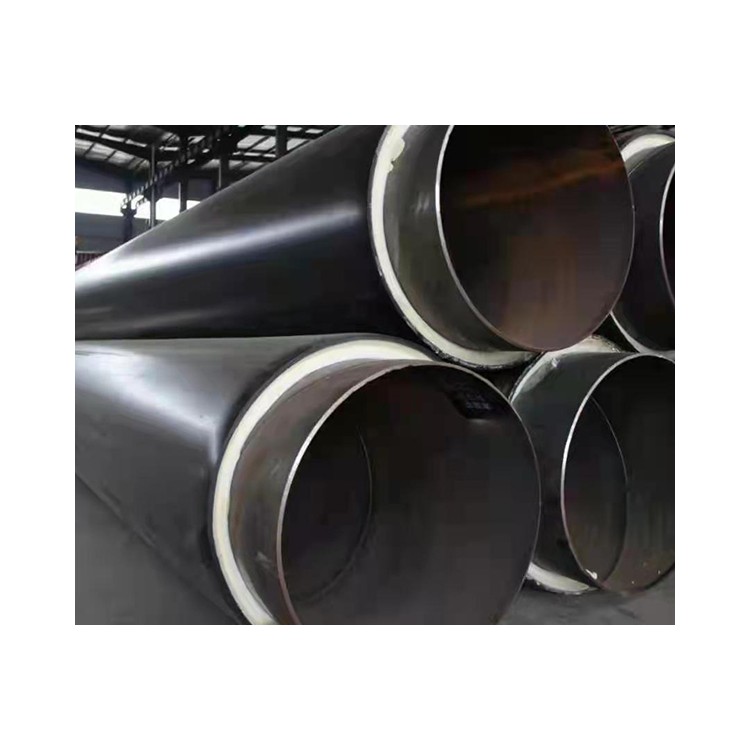

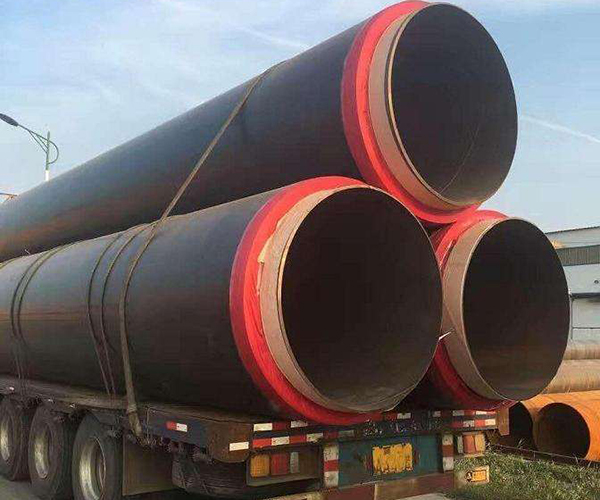
Polyurethane insulated pipeline, full name: High-density polyethylene plastic outer sheath polyurethane foam pre-insulated buried pipeline, composed of a working steel pipe for conveying medium, a polyurethane insulation layer, and a polyethylene plastic outer sheath, assembled sequentially by equipment.
National standard polyurethane insulated steel pipes are structured in three layers from the inside out.
Layer 1: Working Steel Pipe Layer - Generally, seamless pipes (GB8163-87), spiral-welded pipes (GB9711-88; SY/T5038-92), and straight seam welded pipes (GB3092-93) are selected according to design and customer requirements. After being treated with an advanced shot blasting rust removal process, the steel pipes can achieve a rust removal grade of Sa2 as per GB8923-1988 standard, with a surface roughness of R=12.5 micrometers as per GB6060.5-88 standard.
Second Layer: Insulating polyurethane layer - Made by injecting a liquid polyurethane foam plastic into the cavity formed between the steel pipe and the outer sheath using a high-pressure foaming machine. This is commonly referred to as the "pipe-in-pipe foaming process." Its functions include: 1) waterproofing, 2) thermal insulation, and 3) supporting the weight of the heating network. When the temperature of the medium being transported is between -50℃ and 120℃, use rigid polyurethane foam plastic as the insulation layer.
Layer 3: High-density polyethylene protective layer - Preformed black (yellow) plastic pipes with specified wall thickness, serving the purpose of protecting the polyurethane insulation layer from mechanical damage and preventing corrosion and water damage.
Product Structure: The pre-fabricated buried steam-insulated pipe consists of a core pipe (working steel pipe), a reducing layer, an insulating layer, a reflective layer, a fastening steel strip, a sliding support, an air layer, an outer steel pipe, sprayed polyurethane, and wrapped glass fiber reinforced plastic.
Features:
Steel pipes are used for the external protective layer, offering high strength and resistance to damage, capable of withstanding significant upper loads. To ensure a long service life, anti-corrosion treatment is necessary for the steel cladding.
The rolling support structure design is rational, with reduced rolling friction and minimized force on the fixed support. Its mechanical analysis principle is simple, significantly improving the pipeline stability and safety.
The vacuum layer completely eliminates heat conduction and convection through air layers, reducing heat loss. Compared to an air layer structure, it can lower the outer wall temperature by 8-13°C under the same insulation thickness.
The vacuum pump system completely solves the problem of internal wall corrosion of the outer steel casing due to hot, humid air, significantly extending the service life of the directly buried steam pipeline. The product lifespan is now up to 30 years.
