
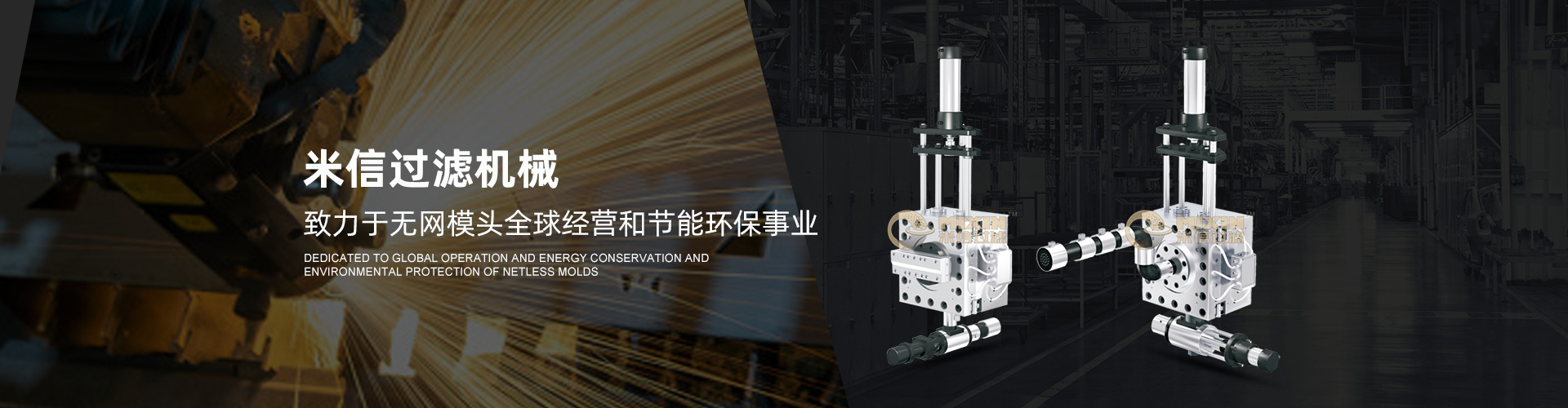

The filter changer is an essential component for almost all plastic extruders used to filter impurities, particularly in the field of recycled plastic applications. It is an indispensable piece of equipment, playing a crucial role in enhancing production efficiency, reducing labor intensity and safety accidents, and improving the degree of equipment automation.
Below, we provide a brief introduction to the construction principle of the hydraulic double-plate changeable die net.
The construction and principle of the hydraulic double plate screen changer:
The main structure of the hydraulic double die changer includes two systems: the die main system and the hydraulic power system. The die main system has some similarities to electric dies, but differs in that the hydraulic die main's filter plate is extended and features two filtering directions. It slides up and down (in a vertical arrangement) or side to side (in a horizontal arrangement) within the walls formed by the die's front and rear plates, replacing the need for automatic (common hydraulic changer) or rapid (momentary hydraulic storage equipped hydraulic changer) filter replacement. Therefore, the sliding filter plate of the hydraulic die is flat, without any conical shape, and relies on the infinite clamping force of the die's front and rear plates to increase the driving force on the filter plate during operation. This is supplemented by a hydraulic drive system consisting of a hydraulic station and hydraulic cylinder as the driving force.
2. Introduction and Principle of Function for Each Part of the Hydraulic Double Plate Screen Changer
The mold head assembly includes the mold front plate, mold rear plate, filter plate with two filtration orientations (double-sided), end strips, end posts, and cross beam.
The hydraulic power system includes an electric motor, hydraulic pump, hydraulic piping, hydraulic control valves, exterior surfaces, as well as hydraulic storage tanks, hydraulic cylinders, and related exterior components.
3. The Application, Protection, and Precautions for Hydraulic Double Plate Mesh Changeover Units
In addition to the independent hydraulic system, the hydraulic dual-screen changer's structure is simpler than that of an electric screen changer. The sliding stroke of its filter plate is automatically controlled, making its operation even simpler.
During operation, due to the hydraulic screen changer's filter plate always being exposed outside the mold cavity by half, attention must be paid to the temperature to prevent the filter plate from freezing and resulting in a non-operational state. In severe cases, it may even cause mechanical accidents.
During normal operation, like with other changeover switches, remember to regularly replace the filters to avoid the nozzle from operating under a blocked condition, which may then lead to overloading and mechanical failure.
If the main body of the hydraulic screen changer shows deformation, leakage, or other issues, it requires repair.
