






- AllProduct Category
-
PP Lab Bench
Steel and Wood Lab Bench
All Steel Lab Bench
Fume Hood
Medicine Cabinet, Reagent Cabinet


详情描述
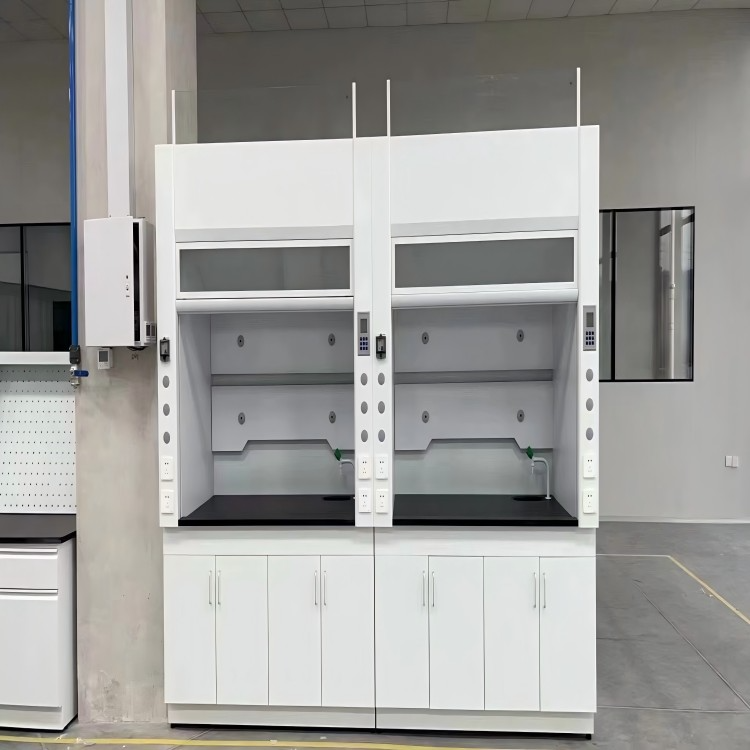
All-steel ventilation cabinet:
1. Cabinet: Made of 1.0mm thick Shanghai Baosteel hot-dipped galvanized steel plate, coated with epoxy resin electrostatic powder paint on an automatic production line, high-temperature cured, acid and alkali corrosion resistant, suitable for chemical laboratories. It features strong load-bearing capacity.
2. Drainage plate (liner sideboard): Made of 5mm thick Dupont board.
3. Surface: 12.7mm thick solid core chemical board with reinforced edge up to 25.4mm.
4. Glass Sliding Doors: Equipped with synchronous wheels, synchronous belts, and synchronous shafts for easy, smooth operation. The door can stop at any position without a step, ensuring no tilt. The windows are made with PVC profiles and 5mm tempered clear glass. The counterweight is achieved through a rear sliding track and sound-insulating sealing felt.
5. Features a liquid crystal control panel for operation.
6. Includes 4x 10A single 5-hole outlets.
7. Illumination method is the instant-start LED three-proof light.
Fume hoods, also known as smoke cabinets or ventilation cabinets, are large equipment commonly used in laboratories, particularly chemical ones. Their purpose is to minimize contact between the experimenter and harmful gases. Full isolation requires the use of glove boxes. Fume hoods serve as the primary barrier in protecting personnel from toxic chemical fumes. They act as a crucial safety backup, effectively expelling harmful gases during chemical experiments that fail, when chemical fumes, dust, and toxic gases are produced, thereby safeguarding both staff and the laboratory environment.
Ventilation cabinet usage instructions
First, stand or sit in front of the cabinet, then lower the glass door as much as possible. Simply reach your hand through the bottom of the door into the cabinet to perform the experiment. Due to the exhaust fan pulling air inward through the open door, harmful gases should not溢出 in large amounts under normal conditions. Caution: When more than one fume hood shares one fan, only one operator should control the on/off of the fan to prevent operation errors or improper use. While in use, the fume hood should receive 10 minutes of make-up air every 2 hours.
Safety Precautions for Using Fume Hoods
❖
The indoor air temperature is between -5°C and +40°C, with a 24-hour average not exceeding +25°C.
❖
In the laboratory, ventilation should be frequent even when the fume hood is not in use, which is beneficial to the health of the laboratory personnel.
❖
When more than two fume hoods are using the same fan, to prevent operational errors or misuse, the "on" and "off" control of the fan should be handled by only one operator; if another fume hood is temporarily not in use or needs to be shut down, use the airflow control valve to seal the ventilation opening; avoid repeatedly turning the fan on and off, as this not only damages the fan's lifespan but also affects the experimental results.
❖
When in use, avoid disturbances caused by personnel movement that may create a reverse airflow affecting the fume hood.
❖
The fume hood should be topped up with 10 minutes of fresh air (i.e., open the window for ventilation) every 2 hours. For use exceeding 5 hours, the windows should be left open to prevent negative pressure inside the room.


