
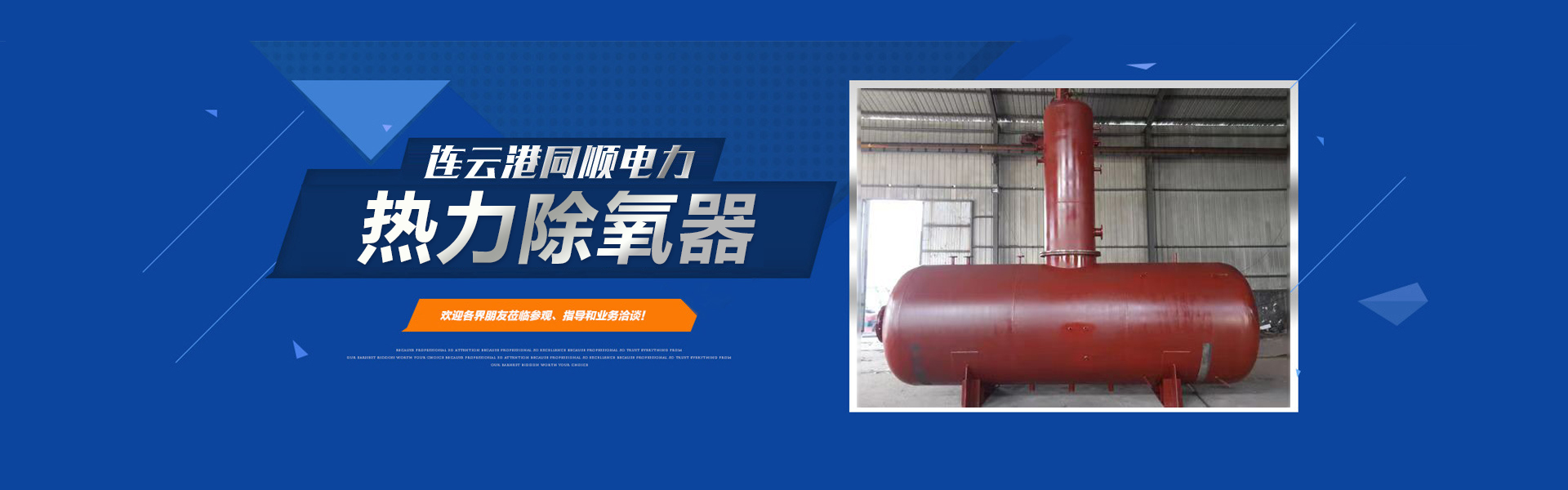

The Heat Exchanger Deaerator (Rotating Film Deaerator) is a new type of deaeration unit that removes dissolved oxygen and other gases from the water in the thermal system, preventing corrosion of thermal equipment. It is an essential device for ensuring the safe operation of power plants and industrial boilers.
The Heat Exchanger Oxygen Remover is a new type of oxygen remover, capable of operating under fixed pressure, sliding pressure, and negative pressure conditions. It features high dissolved oxygen content in the inlet water, low inlet water temperature, and large water supply volume, making it suitable for oxygen removal in various power plant boilers, industrial boilers, and thermal power plant make-up water systems.
Advantages
1. High deoxygenation efficiency, with 100% qualified water oxygen content. The water oxygen content for atmospheric deoxygenators should be less than 15 mg/L, and for pressure deoxygenators, it should be less than 7 mg/L.
2. Stable operation with no vibration. Suitable for vacuum start-up and sliding pressure operation, it reduces the need for complex manual adjustments during start-up and operation.
In addition to its excellent adaptability, not being stringent in terms of water quality and temperature requirements, the product can also operate at approximately 50% above its capacity for short periods.
4. Low exhaust volume, low energy consumption.
3. Drip Grating: The water for oxygen removal in the membrane forming section and the condensate introduced by the drain pipes are here subjected to flow reduction and secondary distribution, resulting in a uniform drizzle-like descent to protect the lower liquid-vapor network. The grating's open area is not less than 50% of the total cross-section, constructed of stainless steel, and operates year-round without requiring maintenance.
4. Filling Liquid-Gas Network: It consists of spaced flat steel strips and a cylindrical body, which houses two layers of specially designed 0.3mm O-type stainless steel flat wire mesh. Here, water is in thorough contact with the secondary steam, heated to saturation temperature, and undergoes deep deoxygenation to ensure the oxygen content of the deoxygenated water.
5. Steam Distribution Plate: The main heating steam is introduced here, and the uniform distribution structure ensures excellent heating quality, maintaining an even distribution of the heating steam. It rises to heat softened water without throttling, working at a saturated temperature for deoxygenation.
The Air and Water Separator: Composed of stainless steel filling, it features an internal mesh and an aeration-type shell design. It effectively separates and recirculates the water carried by the exhaust gas during oxygen排放, making it an indispensable component for ensuring exhaust gas is free of water.
7. Water Tank: Merged from a cylinder body and stamped elliptical end caps, internally equipped with reinforcing rings. The base is mounted on a prefabricated workbench, with one end fixed and the other end for installing the expansion roller assembly. The tank is fitted with inspection manholes, safety valve connections, drain outlets, recirculation pipe outlets, water seal tube openings, level gauge interfaces, pressure gauge openings, temperature gauge openings, and water intake ports.