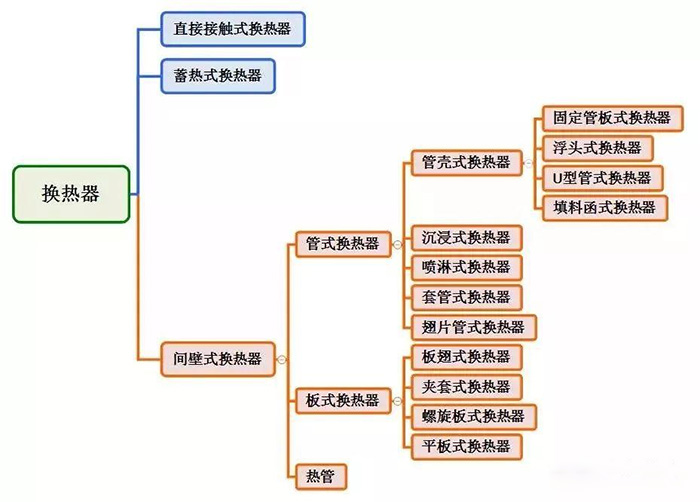

According to the heat transfer method of heat exchangers, they can be divided into three main categories:
Direct-contact heat exchangers, also known as mixed heat exchangers, are devices where cold and hot fluids come into direct contact and exchange heat. Typically, the two fluids in direct contact are gases and liquids at low vapor pressures.
The working principle of an energy storage heat exchanger is to utilize the thermal conductivity of solid materials. Specifically, the heat medium first heats the solid material to a certain temperature, and then the cold medium absorbs heat from the solid material, enabling the transfer of heat through this process.
Shell and tube heat exchangers utilize the thermal conduction of an intermediate medium, separating cold and hot fluids with a solid wall and exchanging heat through the wall. Widely used in heating companies, these heat exchangers can be further categorized into tubular, plate, and heat pipe types based on their structure.
Shell and Tube Heat Exchanger
Shell and tube heat exchangers, also known as tube bundle heat exchangers, are an interfacial heat exchanger that uses the wall surface of the tube bundle enclosed within a shell as the heat transfer surface. These heat exchangers have a simple structure, are reliable in operation, and can be manufactured from various structural materials, primarily metals. They are capable of withstanding high temperatures and pressures and are widely used in various applications.
Based on the adopted compensation measures, shell-and-tube heat exchangers can be categorized into four types: fixed tube sheet heat exchangers, floating head heat exchangers, U-tube heat exchangers, and packed gland heat exchangers.
Two: Fixed Tube Sheet Heat Exchangers
The Fixed Tube Sheet Heat Exchanger is a type of Shell-and-Tube Heat Exchanger. The tube plates at both ends of the Fixed Tube Sheet Heat Exchanger are welded to the shell. It is mainly composed of the outer shell, tube plates, tube bundle, and top cover (head).
The advantages of a fixed tube sheet heat exchanger are:
◆Simple structure
With the same shell diameter, there are more pipe rows and fewer bypasses.
Each heat exchange tube is replaceable, and cleaning the inside of the tube is convenient.
The drawbacks of a fixed tube sheet heat exchanger are:
◆ Shell cannot be mechanically cleaned.
When there is a significant temperature difference (greater than 50℃) between the heat exchanger tubes and the shell, temperature difference stress will occur. The solution is to install expansion joints on the shell, thus the pressure in the shell is limited by the strength of the expansion joints and cannot be too high.
◆ Suitable for working conditions involving fluid cleaning and minimal scaling, with relatively small or large temperature differences between the two fluids, but with low shell side pressure.
Three: Floating Head Heat Exchanger
A floating head heat exchanger is a type of shell-and-tube heat exchanger with one end tube sheet that is not connected to the shell, allowing it to float freely along the axial direction, hence known as a floating head. The floating head consists of a floating tube sheet, a hook ring, and a floating head cover, and it features a removable connection, enabling the tube bundle to be pulled out of the shell.
The advantages of floating head heat exchangers are:
If there is a temperature difference between the heat exchanger tube and the shell, i.e., when either the shell or the heat exchanger tube expands, no temperature difference stress will be generated.
The restraint can be pulled out from within the shell, facilitating the cleaning of both inside the tube and between tubes.
The disadvantages of a floating head heat exchanger are:
The structure is more complex, requiring a larger amount of materials, and is thus more expensive to build.
If the seal between the floating head cover and the floating tube sheet is not tight, internal leakage will occur, causing a mixture of the two media.
U-tube heat exchanger
The U-tube heat exchanger is a type of shell-and-tube heat exchanger, consisting of tube plates, shell, tube bundles, and other components. Each tube in the U-tube heat exchanger is bent into a U-shape, with the inlet and outlet installed on opposite sides of the same tube plate. The heads are separated into two chambers by a baffle, allowing each tube to expand and contract freely without affecting the other tubes or the shell.
The advantages of the U-tube heat exchanger are:
The restraint can float freely without considering temperature difference stress, making it suitable for environments with large temperature variations.
It features a single pipe plate, fewer flanges, less leakage points, and a simple structure.
The U-tube heat exchanger operates reliably and is cost-effective.
The disadvantages of the U-tube heat exchanger are:
Challenges exist in internal cleaning. Due to the requirement for a certain bend radius for the pipes, the utilization rate of the tube plates is relatively low.
◆The spacing between the tubes within the containment is large, making the shell prone to short circuits. When the flow rate inside the tubes is too high, it will cause severe erosion on the U-shaped bend section, affecting its service life.
Inner tubes that are damaged cannot be replaced, thus leading to a higher rate of scrapping.
Fifth, Spray-type Heat Exchanger
The spray-type heat exchanger is a type of tubular heat exchanger, where a row of heat exchange tubes is fixed on a steel frame. Hot fluids flow inside the tubes, while cooling water is sprayed evenly from the top spray device, hence also known as a spray-type cooler. The exterior of the spray-type heat exchanger features a highly turbulent liquid film, significantly increasing the heat transfer coefficient compared to immersion-type. Additionally, most spray-type heat exchangers are placed in well-ventilated areas, with the evaporation of cooling water also carrying away some heat, effectively reducing the temperature of the cooling water and enhancing the driving force for heat transfer. Compared to immersion-type heat exchangers, the spray-type heat exchanger exhibits greatly improved heat transfer efficiency.
The advantages of a spray-type heat exchanger are:
◆Simple structure, cost-effective pricing;
◆ The device can effectively reduce the temperature of the cooling water and enhance the driving force for heat transfer.
With high-pressure resistance capabilities.
◆Easy for maintenance and cleaning, with low water quality requirements.
The disadvantages of a spray-type heat exchanger are:
Inadequate cooling water spray distribution affects heat transfer efficiency.
◆ Must be installed outdoors only.
Six: Tubular heat exchanger
The shell-and-tube heat exchanger is a type of tubular heat exchanger, consisting of concentric tubes made of two different standard tubes. The outer one is called the shell side, and the inner one is known as the tube side. Two different media can flow in the opposite direction (or in the same direction) within the shell side and tube side to achieve heat exchange. Shell-and-tube heat exchangers are typically composed of a shell (including the inner and outer shells), U-shaped elbows, stuffing boxes, and other components.
The advantages of the shell and tube heat exchangers are:
Simplified structure, capable of withstanding high pressure.
The heat transfer area can be increased or decreased as needed, offering convenient application.
The disadvantages of a shell and tube heat exchanger are:
◆ Too many pipe joints increase the risk of leaks.
The site covers a large area, resulting in a significant amount of metal consumption per unit of heat transfer surface.
Spiral Heat Exchanger
Shell-and-tube heat exchangers are a type of plate heat exchanger, constructed by installing a shell around the container's outer wall, featuring a simple structure. However, their heating surface is limited by the container wall, and the heat transfer coefficient is not high. To enhance the heat transfer coefficient and ensure uniform heating of the liquid inside the vessel, a stirrer can be installed within the vessel. When cooling water or a heating agent without phase change is introduced into the shell, spiral baffles or other measures to increase turbulence can be set up within the shell to improve the heat transfer coefficient on one side of the shell. To compensate for the insufficient heat transfer surface, serpentine pipes can also be installed inside the vessel. Shell-and-tube heat exchangers are widely used for heating and cooling in reaction processes.
The advantages of a jacketed heat exchanger are:
◆Simple structure
◆Easy processing.
The disadvantages of a jacketed heat exchanger are:
Small heat transfer area, low heat transfer efficiency.
Section 8: Spiral Plate Heat Exchanger
Spiral plate heat exchangers are a type of plate heat exchanger, constructed from two parallel metal plates rolled together to form two concentric spiral channels inside. A baffle is placed in the center of the exchanger to separate the spiral channels, with fixed spacers welded between the plates to maintain the spacing of the channels.
The advantages of spiral plate heat exchangers are:
High thermal conductivity coefficient
◆ Non-fouling and clog-resistant;
Our technology leverages cooler heat sources.
◆Compact structure.
The disadvantages of spiral plate heat exchangers are:
◆Do not operate at excessively high pressures and temperatures.
◆ Not easily repairable.
Section 9: Heat Pipe Heat Exchanger
Heat pipes are made by filling a sealed metal tube with a certain amount of working fluid after removing non-condensable gases. The working fluid absorbs heat and boils at the hot end, producing steam that flows to the cold end to condense and release latent heat. The condensed liquid returns to the hot end, where it boils and vaporizes again. This cycle repeats, continuously transferring heat from the hot end to the cold end.
The advantages of the heat pipe heat exchanger are:
Simple structure, long service life, and reliable operation.
◆High thermal conductivity and good isothermal properties;
◆ The heat transfer area on both the cold and hot sides can be arbitrarily adjusted, allows for long-distance heat transfer, and temperature control.
Its drawbacks include: ◆ Poor antioxidant and high-temperature resistance properties.