
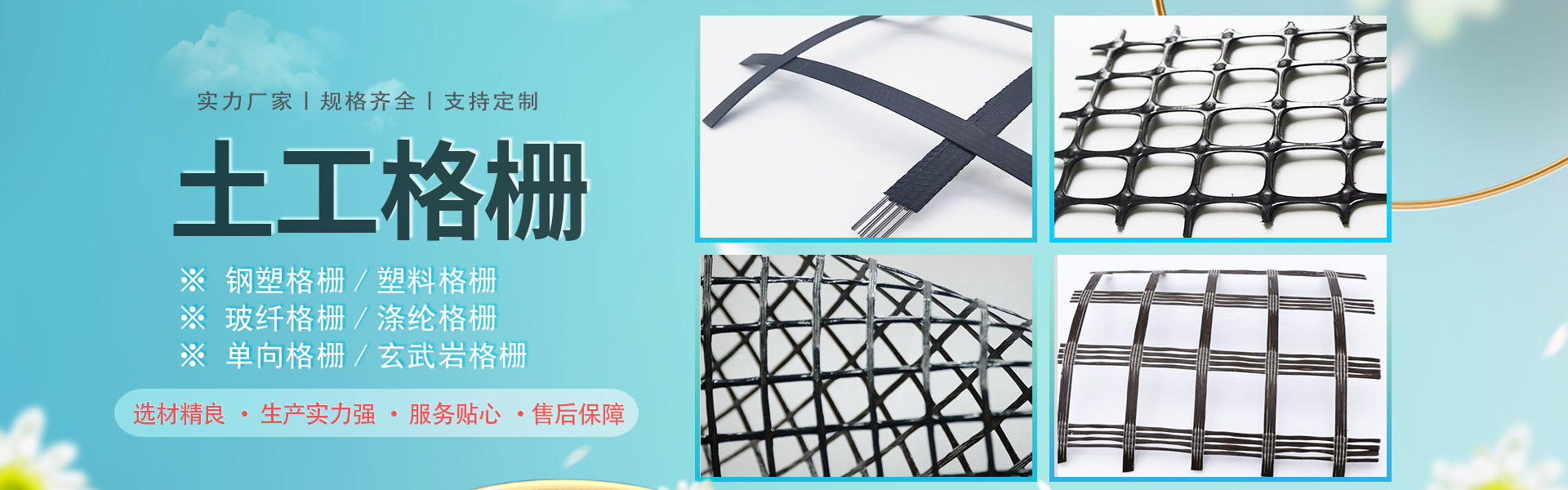


Our company offers a variety of geogrid products for different engineering projects. To enhance the lifespan of our high-quality geogrids, we incorporate specific UV-resistant and anti-aging additives during the manufacturing process. By unidirectional stretching, the originally randomly distributed chain molecules are reoriented to form a linear arrangement. This method is also applied step by step in the production of high-strength steel-plastic geogrids.
To enhance the strength of the steel-plastic geogrid laying, fill material is spread and compacted underneath, meaning that after the geogrid is laid and positioned, it should be promptly covered with soil, with no exposure exceeding 48 hours. Alternatively, a continuous process of laying and backfilling can be employed. Begin by spreading fill material at both ends, securing the geogrid, and then push it towards the center. The compaction sequence is to start from the sides before moving to the center. During compaction, the roller should not come into direct contact with the reinforcement. Uncompacted reinforced structures are typically not allowed to be driven over by vehicles to prevent misalignment of the reinforcement. The layer-by-layer compaction should be between 20-30 cm. The degree of compaction must meet the design requirements, as this is the key to the success of the reinforced soil engineering.
Whether it's steel-plastic geogrid or other types of grid products, the laying process is generally similar, but there may be differences. Therefore, it's essential to consult clearly during the procurement phase for ease of future construction.
