
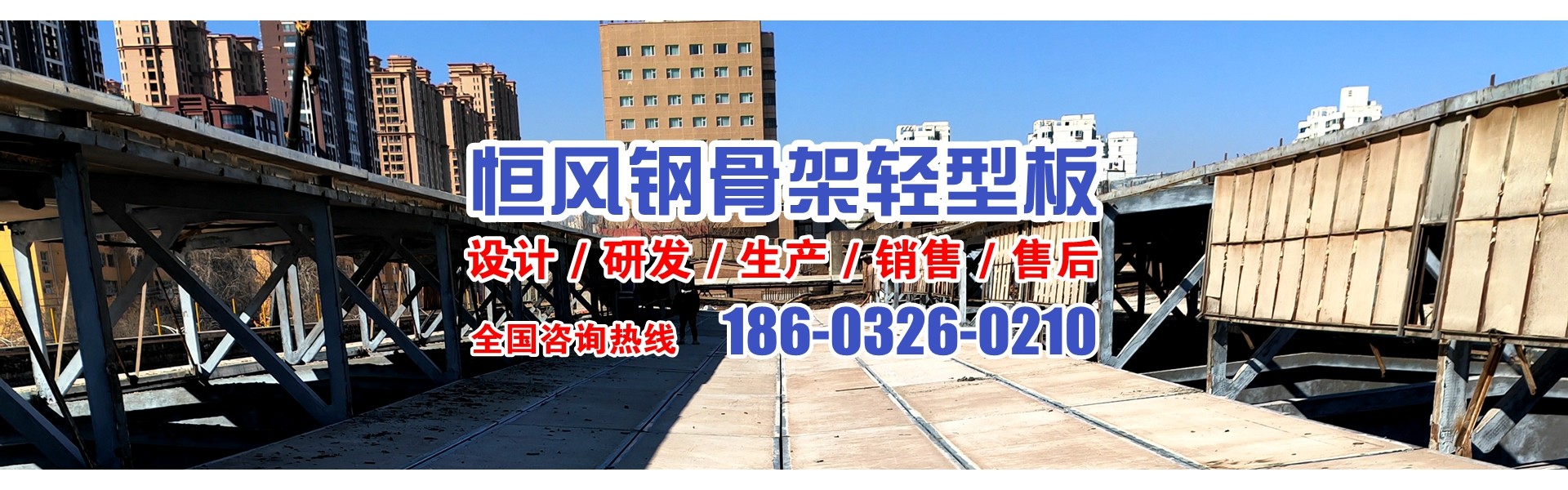


1. After the handover from the previous process, position the steel frame lightweight grid deck edges according to the layout diagram. At the same time, check if the layout diagram aligns with the on-site construction.
2. Crane lifting of truss deck: Prior to lifting, the principal company should mark the axes and alignment lines of the pre-assembled components, which serve as calibration indicators for installation. Carefully lower the lightweight steel truss deck onto the steel frame using lifting equipment, following the principle of proximity. If the crane cannot immediately reach the location, hoist the roof deck onto a specially designed flat surface transport flatbed, and then move it to the specific installation location.
3. Furniture Panel Installation: During lifting, the steel frame lightweight grid panels are placed back according to the installation line. The length of the panels resting on the brackets must not be less than 60mm. Once in place, the main ribs should be securely welded to the brackets (pre-buried in concrete beams) to ensure even overlap and spacing of the reinforcing bars. If there are gaps at the support points, they should be filled with metal sheets and then welded to prevent movement. Each panel should have three welds to the truss, with the end portions having at least two welds, each not less than 60mm in length to ensure the longitudinal stability of the roof panels. The panels should be connected with φ6 reinforcing bars, spaced every 1.5 meters to ensure the integrity of the roof panels.
4. Adjusting the spacing between panels: According to regulations, the spacing between the steel frame light-weight grid panels should be adjusted within the permissible tolerance range, with the total width error not exceeding ten millimeters.
5. Hidden Engineering Inspection: Steel frame light-weight grid deck and roof truss, flat roof beam are electrically welded together using Φ6 steel reinforcement splices. Each panel is electrically welded at three points, with weld lengths of 60mm and thickness of 4mm, with smooth welding and no exhaust ports or weld beads; anti-corrosion paint is evenly applied.
6. Panel Seam Treatment: Fill the panel seam with high-pressure polyethylene rods that exceed the total width of the seam. For instance, if the seam width is 20mm, a high-pressure polyethylene rod with an outer diameter of 24mm can be used. The rod is then pressed to the bottom reinforcement steel using building reinforcement bars. Subsequently, the mixed concrete glass bead cement mortar concrete is poured into the seam, ensuring that the mortar is compacted with the reinforcement bars during the pouring process.
