

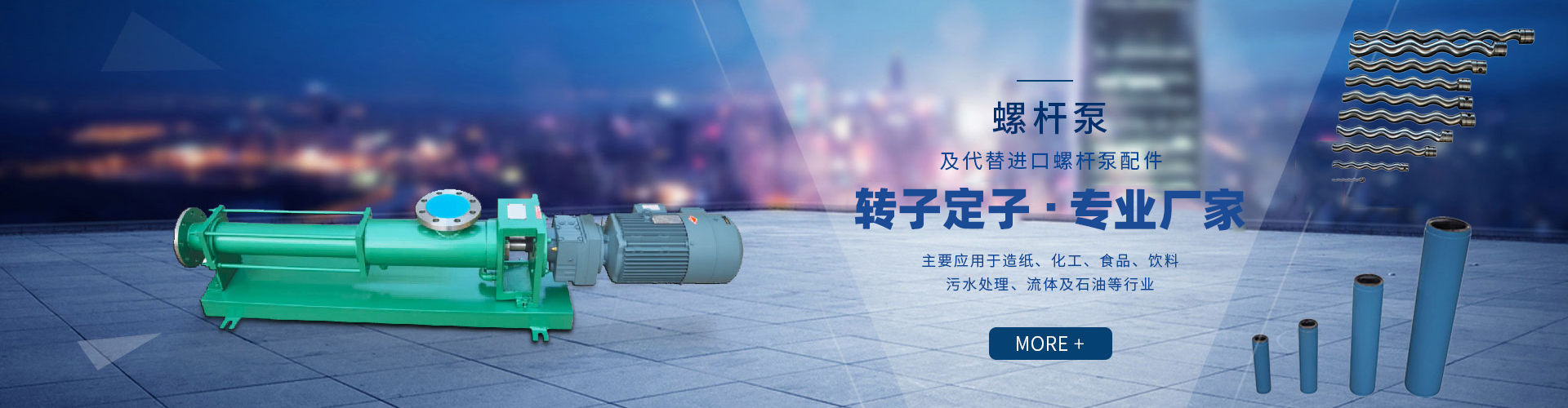

Screw pump service media: Various viscosity liquids, especially thick and difficult-to-handle media. Liquids of various concentrations and dried materials after separate dehydration. Liquids containing solid particles, fibers, and suspended matter. Mixtures of liquids, gases, and solids, as well as sensitive liquids that cannot be agitated, sheared, or skimmed.
Single Screw Pump Operation Features: Wide adaptability, capable of conveying all active media as well as inactive materials. Stable flow and pressure with no pulsation. Variable speed allows for adjustment of output flow, suitable for metering addition. Strong suction capacity, low operating noise, no leakage, and no temperature rise.
When it comes to single screw pumps, the correct selection is crucial to achieving optimal performance. To meet the varying physical and chemical properties of the medium, we recommend that customers provide the pump operating data, which will then be used by our professionals to recommend the appropriate model. The customer will confirm the selection before proceeding.
Screw Pump Structure Principle: The critical component of the magnetic drive in screw pumps consists of an external magnetic rotor, an internal magnetic rotor, and a non-magnetic spacer sleeve. As the electric motor drives the external magnetic rotor to rotate, the magnetic field can penetrate through the air gap and non-magnetic materials, causing the internal magnetic rotor connected to the impeller to rotate synchronously, completing the contactless transmission of power and converting dynamic sealing into static sealing.
The screw pump features an advanced mixed-type axial return water pump body design, comprising an suction chamber, storage chamber, volute, return hole, and separate gas-liquid chambers. Once the pump starts, under the action of centrifugal force, the remaining liquid in the suction chamber and the air in the inlet pipeline are mixed by the impeller to form a gas-liquid mixture. This mixture enters the gas-liquid separate chamber through the volute, where the velocity decreases, causing separation of gas and water. The air is discharged through the pump outlet. The magnetic self-priming pump's driving equipment is equipped with an active magnetic coupling directly mounted on the motor shaft, which drives the impeller rotation on the rotor assembly through magnetic force. The pump chamber is fully sealed, ensuring no leakage.
