



- AllProduct Category
-
Control Cabinet Division
Cable & Wire Division
Pressure Gauge Division
Digital Gauge Division
Validation Instrument Division
Level Measurement Division
Temperature Instrument Division
Transmitter Division
Flow Meter Division





详情描述
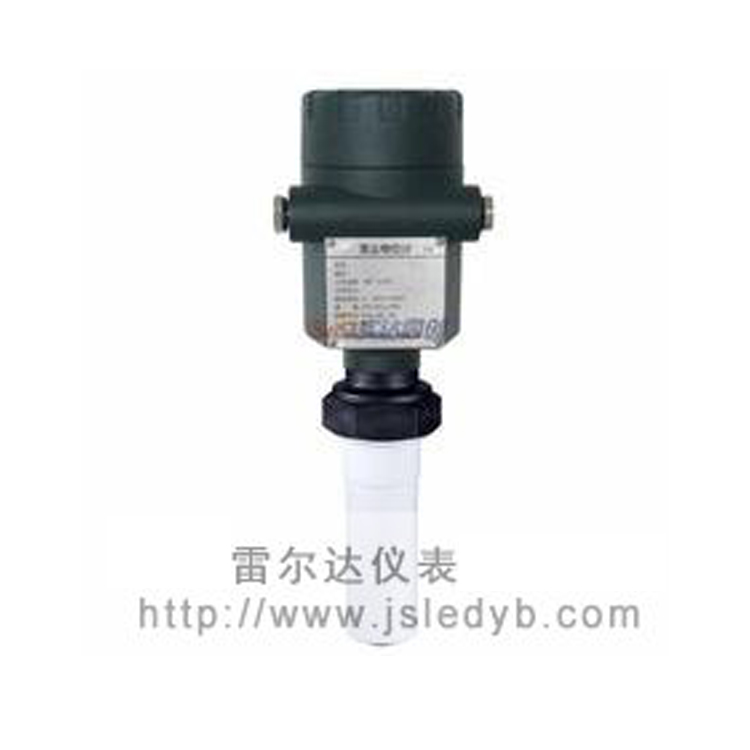
High-Frequency Radar Level Gauge Principle: The radar level gauge antenna emits extremely short pulses with very low power. These pulses propagate through space at the speed of light and, upon encountering the surface of the medium being measured, part of their energy is reflected back, which is then received by the same antenna. The time interval between the transmitted and received pulses is proportional to the distance from the antenna to the surface of the medium being measured.
LERD55 High-Frequency Radar Level GaugePrimarily used for liquid measurement, frequency 26GHZ, with a maximum range of 10 meters. Due to its transmitting antenna being fully sealed with PTFE, it offers excellent performance in harsh corrosive environments.
LERD55 High-Frequency Radar Level Gauge Overview:
Application: Ideal for liquids, particularly for highly corrosive liquids, and corrosive environments such as various acid and alkali storage tanks. When installed on a small tank, the beam angle, which is smaller than that of the 6G radar level gauge, allows for a smaller actual measurement dead zone by adding an appropriate installation short tube.
Maximum Range: 10m
Measurement Precision: ±5mm
Process Temperature: (-40 to 130) °C
Process Pressure: (-0.1 ~ 0.3) MPa
Frequency Range: 26 GHz
Signal Output: (4~20) mA/HART/Modbus
Power Source: Two-wire system (DC24v)
4-Wire System (DC24V)/(AC220V)
On-site Display: Standard Configuration
Shell: Standard configuration
Process Connection: Threaded/Facing (Optional)
Antenna Structure: Rod-shaped
Antenna Material: Teflon
LERD55 High-Frequency Radar Level Gauge Electrical Connection
1. Power Supply Voltage
(4-20) mA / HART (Two-wire) - Power supply and output current signal share a two-core cable. Specific voltage range for power supply is detailed in technical data. A safety barrier must be added between the power supply and instrument for intrinsically safe models.
(4-20) mA / HART (4-wire system) - Power supply and current signal each utilize a separate two-core cable. Specific voltage range for power supply please refer to technical data.
The standard radar level gauge current output can be grounded. The explosion-proof radar level gauge current output must be floating. The instrument and its terminal connections should ensure a good ground connection, typically connected to the tank's grounding point. For plastic tanks, it should be connected to the adjacent ground.
2. General Installation Guidelines for Cable Connections
The power cables utilize a standard two-core cable with an outer diameter of (5 ~ 9) mm to ensure the seal at the cable entry. If electromagnetic interference is present, it is recommended to use shielded cables.
(4-20) mA / HART (two-wire) – Power supply cable can use a standard two-core cable.
(4-20) mA / HART (4-wire) - Power cables should use cables with a dedicated ground wire.
Cable shielding and wiring
Both ends of the shielded cable should be grounded. Inside the sensor, the shield must be directly connected to the internal ground terminal, and the external ground terminal on the housing must be connected to the earth.
If there is a grounding current, the shielding end of the shielding cable away from the instrument must be grounded through a ceramic capacitor (such as 1nF / 1500V) to serve as a direct current isolation and bypass high-frequency interference signals.
询价单

