
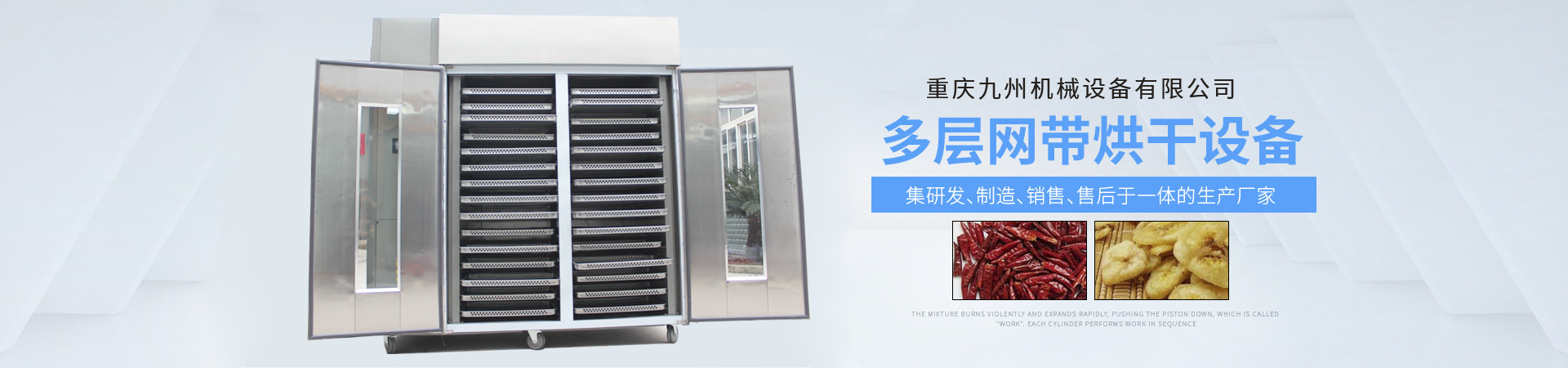

A dryer is a device that uses a heat source to heat the cold air drawn in by a blower, converting it into hot air for drying materials. Traditional dryers, under the action of the blower's suction power, draw in fresh, cold air through the intake of the blower and blow it into the heating chamber of the hot air unit. Inside the heating chamber, heating elements heat the air to become hot air, which then enters the dryer through the intake of the oven to dry materials placed on racks or conveyors. Since the heating chamber of the hot air unit is a whole cavity, the incoming cold air is dispersed and stays for a short time, thus the heating elements have a general heating effect on the air and the utilization rate of the heat source is low.
Additionally, due to the isolated internal air circulation within the drying machine, the moisture vapor emitted by the food during the initial drying stage accumulates in the drying environment without effective treatment, making it difficult to ensure the desired drying effect of the food.
Technical Implementation Elements:
This novel utility model addresses the shortcomings of existing technology by providing a food drying machine that can prevent the accumulation of steam released during the drying process from affecting the drying operation. The machine ensures a uniform internal environment temperature within the oven, resulting in excellent drying results.
This utility model is realized through the following technical solution:
We offer a food drying machine featuring an oven with an inlet and outlet vent. The oven's inlet vent is connected to the fan's exhaust pipe via a heating chamber, while the oven's outlet vent is connected to the fan's return air pipe. Inside the heating chamber, there are at least two parallel, spaced baffles with at least one protrusion and/or indentation each. These baffles are set along the inlet to the outlet of the heating chamber, dividing it into at least three hot air channels, each equipped with a heating element. The fan's return air pipe is parallel to an external air intake pipe, and the oven's exhaust pipe is parallel to an external exhaust pipe, both equipped with valves.
Due to the external intake duct being connected in parallel to the fan exhaust duct, and the external exhaust duct being connected in parallel to the oven exhaust duct, with valves set on all the fan exhaust duct, intake duct, and exhaust duct, during the initial drying stage, the valve on the fan exhaust duct is closed while the valves on the external intake and exhaust ducts are opened. The fan draws in external air, which passes through a baffle with projections and/or indentations in the heating chamber, dividing the heating cavity of the hot air device into at least three hot air channels. These channels have a smaller cross-sectional area and a longer length compared to the distance between the intake and exhaust of the hot air device, leading to more concentrated and prolonged exposure of cold air within the channels. This requires fewer heating elements to achieve effective heating with lower energy consumption. The heated air is then sent into the oven, where the moisture vapor from the food is exhausted through the external exhaust duct into the atmosphere, thus avoiding the issue of moisture vapor not being able to escape due to the internal circulation between the fan and the oven.
After a certain period, most of the moisture vapor in the food has evaporated and been exhausted. At this point, close the valves on both the external exhaust and intake ducts, and open the valve on the return air duct of the hot air blower. This restores an internal circulation between the hot air blower and the drying chamber, thereby dividing the entire drying process into two steps: preheating and moisture removal, followed by constant-temperature drying, resulting in an improved drying outcome.
As an option, the oven's exhaust duct is equipped with a temperature sensor and a humidity sensor, which are respectively electrically connected to the heating element and the various valve switches via a PWM controller.
