
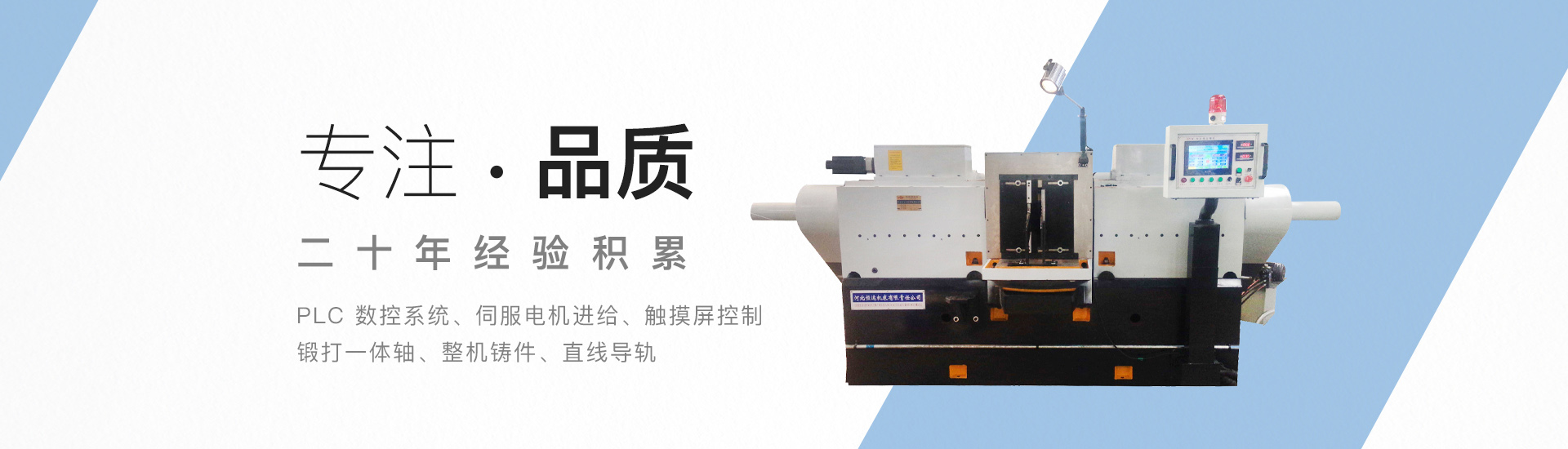

The Impact of Vertical Double-Sided Grinding Machines on Industrialization The time required for part processing on vertical double-sided grinding machines primarily includes active time and auxiliary time. The range of spindle speed and feed rate changes is greater than that of ordinary machine tools, allowing each process on the double-sided grinder to utilize favorable cutting conditions. Due to the good rigidity of the vertical double-sided grinding machine structure, it allows for larger cutting volumes, thus improving its cutting efficiency and saving active time. The moving parts of CNC machine tools have fast non-cutting movements, short workpiece clamping time, and automatic tool changes, significantly reducing the time compared to general machine tools. The emergence of vertical double-sided grinding machines has greatly enhanced industrial production efficiency. Firstly, this equipment has changed the structure of traditional single-sided grinders, directly doubling the processing efficiency of many components. This is achieved by altering the structure of the grinding and tooling, allowing for greater exposure angles and the same operations on both sides, as well as the ability to process two workpieces simultaneously. Moreover, the introduction of double-sided grinding machines has also raised the technical requirements for operators, as consistent cutting results on both sides require high concentration and complete mastery of operation skills. In the industrial production process that prioritizes efficiency, the vertical double-sided grinding machine has made an indelible contribution to production rate improvements. With its increasing applicability, the processing speed of various common industrial components will significantly increase, promoting an overall enhancement of industrialization.
News Center Co., Ltd.
