



Pre-treatment Methods for Pressure-Assisted Ultrafiltration
Based on fluctuations in raw water type or ultra-filtration feed water quality, pretreatment can include processes such as flocculation and sedimentation, air flotation, or filtration.
The sedimentation method utilizes the settling properties of suspended particles in water, which, under the influence of gravity, produce a downward movement to achieve solid-liquid separation.
Skew Plate/Skew Tube Sedimentation Tank
A sloping plate/sloping tube sedimentation tank is a sedimentation tank equipped with many closely spaced parallel sloping plates or small-diameter parallel sloping tubes within the tank. Its features include high sedimentation efficiency, small tank volume, and minimal land area required. Due to the shorter sedimentation time, the water volume and quality are more sensitive during operation, so attention should be paid to daily operation and management monitoring.
Under the same water treatment volume, the larger the sedimentation area, the higher the efficiency of the sedimentation tank. Adding a set of inclined plates (tubes) within the sedimentation tank not only increases the sedimentation area but also shortens the sedimentation time. At the same time, the water flow between the plates (tubes) changes from turbulent to laminar flow, further enhancing the sedimentation efficiency. To facilitate timely sludge removal, the plates (tubes) are installed at an angle of 45 to 60 degrees to the horizontal surface. The inclined plate (tube) sedimentation tank is available in three types: concurrent flow, opposite flow, and transverse flow.
2. Platen Sedimentation Tank
The flat-flow sedimentation tank has a simple structure, consisting of a rectangular water pool. This type of tank is directly connected to the plate-folded coagulation tank. Water inflow is achieved through perforated wall irrigation, while outflow is collected using finger-type collecting channels. Sludge removal is carried out by mechanical siphon. The flat-flow sedimentation tank offers excellent sedimentation performance, though it occupies a large area and is commonly used in water treatment projects with high water volume.
High-density sedimentation pond
The Efficient Sedimentation Pool Technology is a new generation sedimentation process that integrates sludge separation and concentration functions. It relies on multiple theories such as sludge flocculation, recirculation, inclined tube separation, and concentration. Through reasonable hydraulic and structural design, it achieves this by using an external sludge reflux method and adding high molecular weight flocculants, resulting in uniformly dense flocs with high sedimentation rates. Additionally, the lower part of the sedimentation pool is equipped with a larger concentration area, allowing the discharged sludge to have a solid content of 3-14%, reducing the waterworks' self-water usage rate and benefiting sludge treatment.
II. Aeration浮选
The air flotation process differs from sedimentation, as it relies on microbubbles to carry pollutants attached to flocs, forcing the flocs and pollutants to rise to the surface, achieving solid-liquid separation. Due to the much smaller mass of the bubbles compared to water, the buoyancy is significant, thus promoting the rapid rise of floc particles and enhancing the speed of solid-liquid separation.
Common types of air flotation machines include pressure dissolved air flotation machines with horizontal flow, vertical flow pressure dissolved air flotation machines, high-efficiency shallow layer air flotation machines, and vortex air flotation machines, etc.
Section 3: Filtration
Multimedia Filter
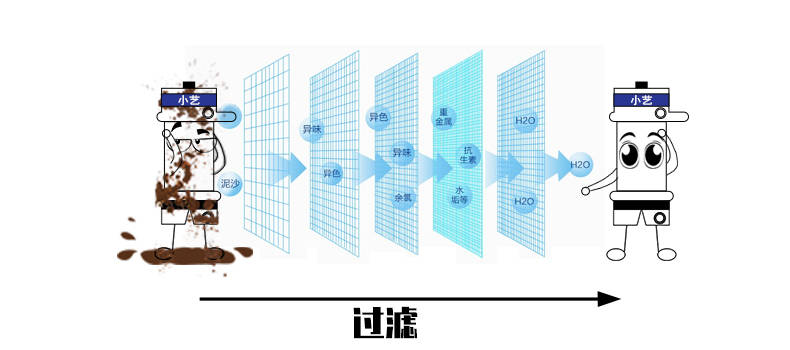
The multi-media filter utilizes one or several filtering media to clarify water with high turbidity by passing it through a certain thickness of granular or non-granular material under pressure, effectively removing suspended impurities. Common filter materials include quartz sand, anthracite coal, and manganese sand.
Multi-media filters commonly used in water treatment include: smokeless coal-quartz sand-magnetite filter, activated carbon-quartz sand-magnetite filter, and activated carbon-quartz sand filter, etc.
The design of the filter layer for multi-media filters primarily considers the following factors:
Different filter media have significant density differences, ensuring that no stratification occurs after anti-backwashing disturbance.
Select filter media based on water production use.
③ The particle size requirement is that the lower filter material has a smaller particle size than the upper filter material to ensure the effectiveness and full utilization of the lower filter material.
V-Type Filter Pond
The V-type filter basin is a type of rapid filter, named for its V-shaped inlet channel. It is also known as a Uniform Grain Filter Media Basin (using uniform grain filter media, i.e., uniform particle size filter media) and a Six-Valve Filter Basin (with six main valves on various pipelines).
After untreated water passes through the main inlet channel and the inlet valve and square holes, it overflows the weir mouth and then enters the submerged V-shaped groove through side holes. It then flows through evenly distributed water holes at the bottom of the groove and into the filter bed via the V-shaped weir. The filtered water, after passing through the uniform filter material layer, flows into the bottom space through long-handled filter heads and collects in the square holes, eventually merging into the air-water distribution channel. It travels through the water seal well, outlet weir, and clear water channel into the clear water pool.
3. Valveless Filter Pond
The Valveless Filter Pond is a type of rapid filter. As this filter does not install gate valves in its construction but relies on the siphon principle of hydraulics for automatic water inflow and backwashing, it is named the Valveless Filter Pond.
The incoming water to the valveless filter pool is delivered through the inlet pipe, filtering downward through the filter layer. The filtered clean water then enters the storage tank via a connecting pipe, where it is stored. The tank is robust, and the water flows from the outlet trough into the clear water pool. During the filter pool's operation, the filter layer continuously retains suspended particles, causing its resistance to gradually increase, which in turn raises the water level in the siphon rise pipe. When the water level reaches the siphon-assisted pipe's siphon initiation point, the water falls from the pipe, and the air in the siphon下降 pipe is continuously drawn out through the suction pipe, creating a vacuum within the siphon tube and initiating the siphon action. During the siphon process, the water in the tank rises upward through the filter layer, thereby backwashing the filter layer.
IV. Miscellaneous
Advanced Oxidation
Advanced Oxidation Technology, also known as Deep Oxidation Technology, is characterized by the generation of hydroxyl radicals (·OH) with strong oxidative capacity. Under reaction conditions such as high temperature and pressure, electricity, sound, light radiation, and catalysts, it converts large,难degradable organic molecules into low-toxic or non-toxic small molecules. Depending on the method of free radical generation and the reaction conditions, it can be categorized into photochemical oxidation, catalytic wet oxidation, sonochemical oxidation, ozone oxidation, electrochemical oxidation, and Fenton oxidation, among others.
2. Biochemical Treatment
The biochemical treatment in water purification is a secondary treatment method, primarily designed to remove suspended solids and biodegradable organic matter from water bodies. Its processes are diverse, including activated sludge process, oxidation ditch process, SBR process, and more. Currently, most urban sewage treatment plants use the activated sludge process. The principle of biological treatment involves the decomposition of organic matter and the synthesis of organisms through biological action, particularly by microorganisms, transforming organic pollutants into harmless gases, water, and solid products.
Summary
Pre-treatment of ultrafiltration is a critical step for its proper operation. The performance of the ultrafiltration membrane is closely related to the properties of the membrane elements, the design of the membrane process, and the on-site operation and maintenance.
