

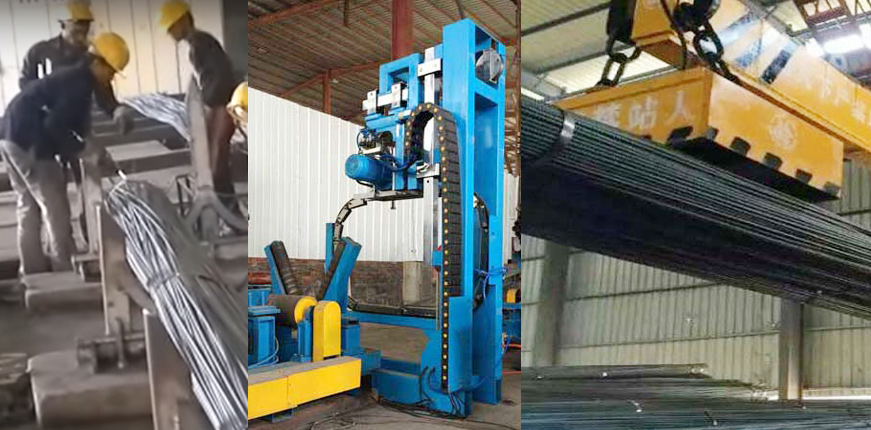
As society evolves, customers' demands for the quality and appearance of metal products are increasing, and the prevalence of automated production in steel enterprises is rising year by year. More and more steel producers realize that high-quality packaging is crucial for the mass output of products, as traditional manual packaging cannot be performed in harsh environments, leading to severe consequences such as unfastened bundles after binding. The entire manual bundling process involves 12 complex procedures, including threading, opening clamps, locking, tensioning, cutting, folding back, and releasing clamps, etc. Therefore, large steel enterprises are beginning to abandon manual packaging and replace it with fully automated packaging systems. Practice has proven that businesses benefit significantly: dramatically improving work efficiency, reducing labor costs, avoiding tape waste, liberating human labor from the work environment, and saving on lock clip costs, among others.
More than a decade ago, due to a lack of domestic technology, many large steel companies like Shougang, Tanggang, and Baosteel all imported fully automatic packaging systems from abroad. However, the issue was that importing fully automatic systems consumed a significant amount of foreign currency, the cost of packaging equipment was high, and maintenance and upkeep posed a challenge.
Currently, most steel companies utilize unlatched bite connection and welding methods, while a small number still use latched connection methods. However, these three methods still cannot avoid the issue of disengagement and package separation. Our company has improved upon the unlatched bite connection by adding a pair of folds at the overlap of the steel strip's head, tearing a small section of the edge upwards, thereby reducing the disengagement rate. The joint of the bundled steel strip can remain intact during transportation, offering strong connection strength, and the bundling process takes only 28 seconds, enhancing production efficiency for steel companies. Additionally, the modular design of the product and its high stability allow our products to operate seamlessly in environments with high temperatures, impacts, and dust.
