





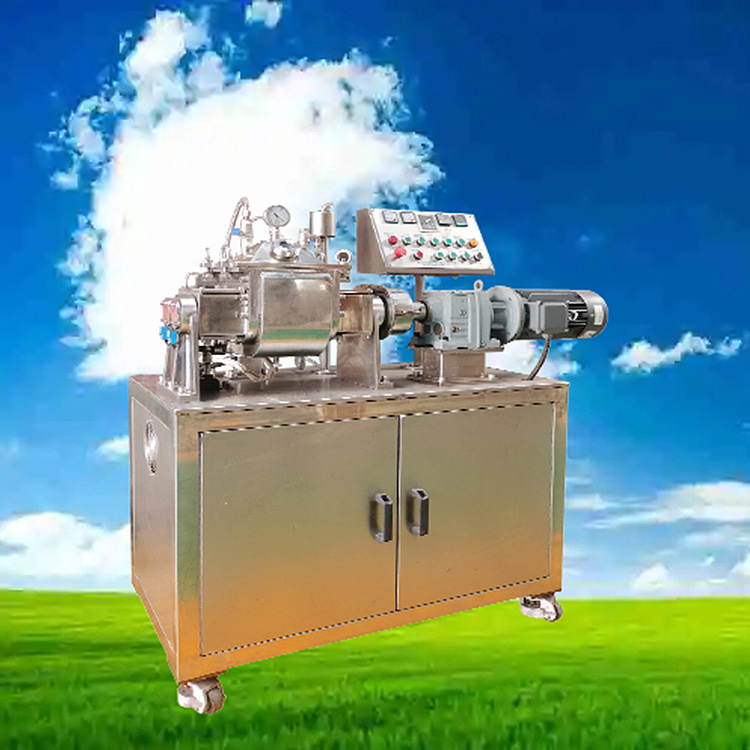
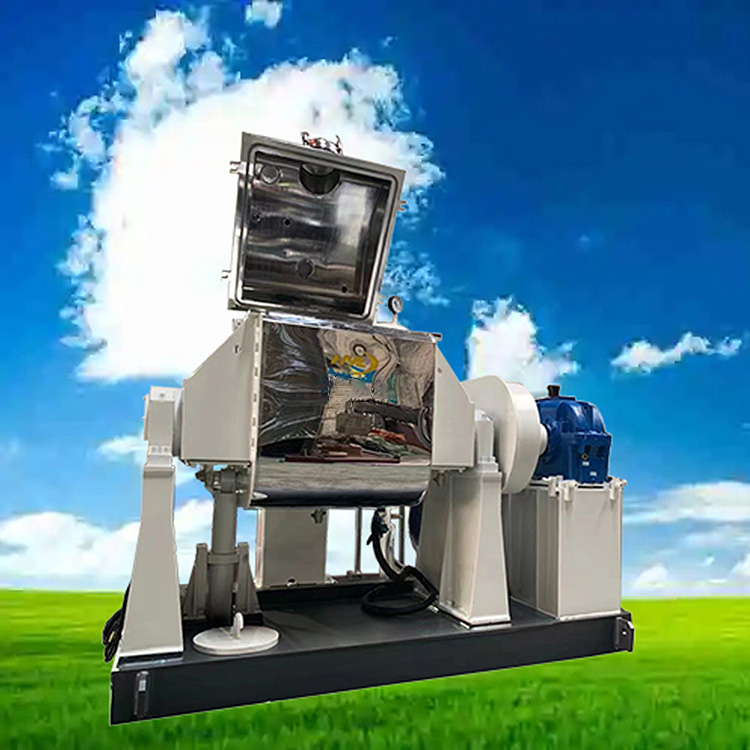

The working principle of the vacuum kneading machine is achieved through the strong shearing action generated by a pair of interlocking and rotating Sigma (or Z-shaped) blades, which allows semi-dry or rubbery, thick plastic materials to react quickly, resulting in a uniformly mixed and stirred mechanical device.
Blending machine manufacturers in the light industry are trending towards semi-automation and automation. The blending machine industry is also aiming for automation, with the automation of consumable equipment for blending machine processing fundamentally improving blade quality. CNC machine tools fundamentally address the advancement of automation technology, marking the first step for enterprises to enter the mid-to-low-end market of light industry automation, aligning with the theoretical needs of blending machine users. The spirit of the blending machine's product quantity reflects the enterprise's process level, which determines the blade manufacturing capability. It ensures the production of high-quality, high-grade products, guarantees the blending machine's presence at high processing frequencies, and maintains product precision. This essentially achieves the automation of the entire production process. Mixing Machine Categories:
1. Depending on product specifications and size: Masticators are available in capacities ranging from 5 liters to 6,000 liters.
2. Depending on different usage purposes: kneading machines can be made into atmospheric, vacuum, pressure-type, gravity-type, and other configurations.
3. Depending on the type of medium: Masticating machines can be categorized into steam-heated, oil-heated by conduction, and water-cooled models, among others.
4. Depending on the discharge method: Mixers can be categorized into hydraulic tilting cylinder discharge, ball valve discharge, and screw extrusion types, among others.
5. Depending on the load weight and impact intensity: kneading machines can be categorized into standard and reinforced high-force types.
6. Depending on the properties of the material or the nature of the liquid added during blending: mixers can be classified into standard, explosion-proof, and intrinsically safe types, among others.
7. Based on the stirrer speed: kneading machines can be categorized into single-speed, dual-speed, and variable-speed types, among others.
Structure of Vacuum Molding Machine:
The vacuum kneader is mainly composed of six major parts: kneading section, base section, hydraulic system, transmission system, vacuum system, and electrical control system. The kneading section consists of cylinder body, paddle shaft, wall plate, cylinder cover, etc. The hydraulic system is operated by a hydraulic station to control two small cylinders and two large cylinders, completing the functions of opening and closing the large cover and tilting the mixing cylinder. The system is designed with a pressure of 7.0 Mpa. The electrical control system includes manual and automatic control systems, which can be freely selected and required by the user, offering convenient and reliable operation. The transmission system is composed of an electric motor, a reducer, and gears, and is matched with the motor according to the kneader model. During the transmission process, the motor's synchronous speed can be transmitted to the reducer via an elastic coupling, and then to the output device to drive the fast paddle to reach the specified speed. Speed regulation can also be achieved through a variable-frequency inverter.
-/gbahehf/-
