
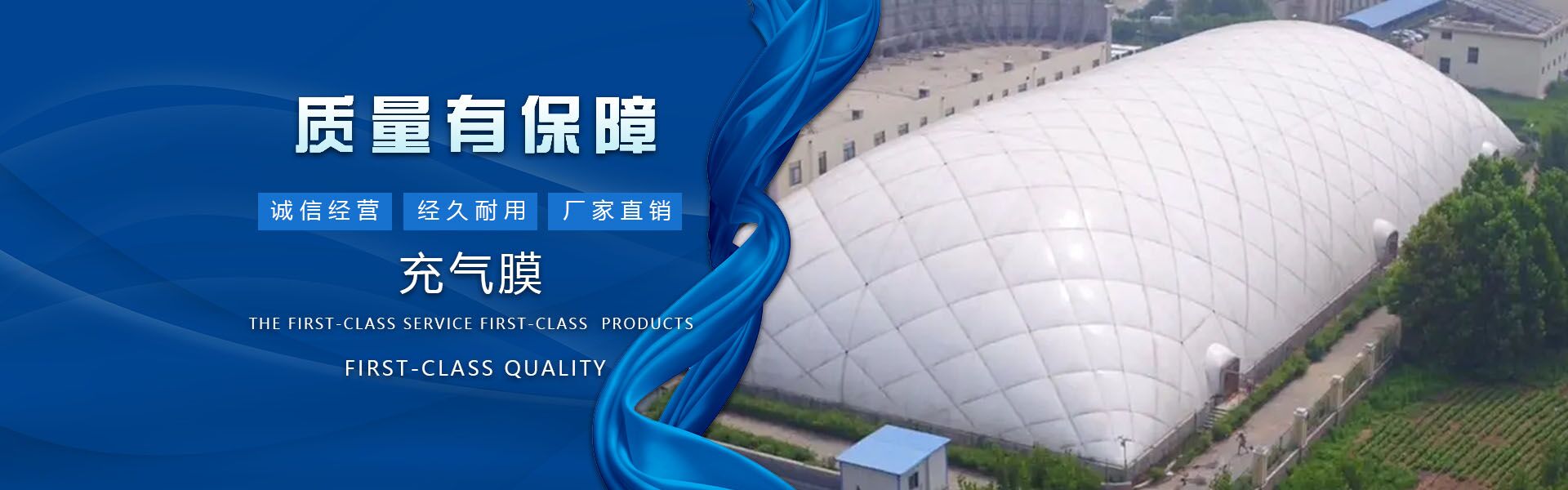

Membrane structures are categorized into frame-type, tensioned-type, and inflation-type membranes, each with its distinct mechanical principles. This article aims to share with you the classifications and principles of inflation-type membrane structures.
Principles of various inflatable membrane structures:
In membrane structures, the use of air pressure to create tension in the membrane, thereby resisting external forces, is known as an inflated membrane structure. These can be classified according to the different mechanical properties of the inflated membrane structures, into air-supported inflated membrane structures and air-inflated tubular inflated membrane structures.
Air-supported inflatable membrane structure
The pneumatic inflation membrane structure involves securing the periphery of large-area membrane materials, utilizing the pressure difference between the inside and outside of the membrane to create tension and form the structure. A typical example is to inflate air into the interior of a membrane cut into a dome shape, causing the membrane to bulge into a dome structure, known as an inflation dome. When air is filled between two membranes that are securely fastened around the edges, each membrane retains the same mechanical properties as the inflation dome. Such structures are collectively referred to as pneumatic inflation membrane structures.
To create tension in the membrane, it is not necessary to have the internal air pressure of the dome higher than the external air pressure. As long as the required support conditions are met, the internal air pressure of the dome being lower than the external pressure can also produce tension on the membrane surface.
2. Inflatable Tubular Air Membrane Structure
The inflatable tubular membrane structure is formed by inflating air into a tube-shaped membrane material, which can be imaginatively understood as filling a tube-shaped membrane with air instead of sausage meat. When the straight tubular membrane is inflated and placed horizontally, it forms a beam; when the curved tubular membrane is inflated, it creates an arch. By connecting multiple such inflated beams or arches side by side, architectural spaces can be created. The beams or arches are not independent of each other but are connected by structural elements to be used as a whole. The tubular inflatable membrane structure is known as the inflatable membrane structure.
As mentioned above, an inflatable membrane structure requires a pressure difference between the internal and external gases of the membrane. The required pressure difference varies greatly between the air-supported inflatable membrane structure and the air-inflated tubular inflatable membrane structure.
