


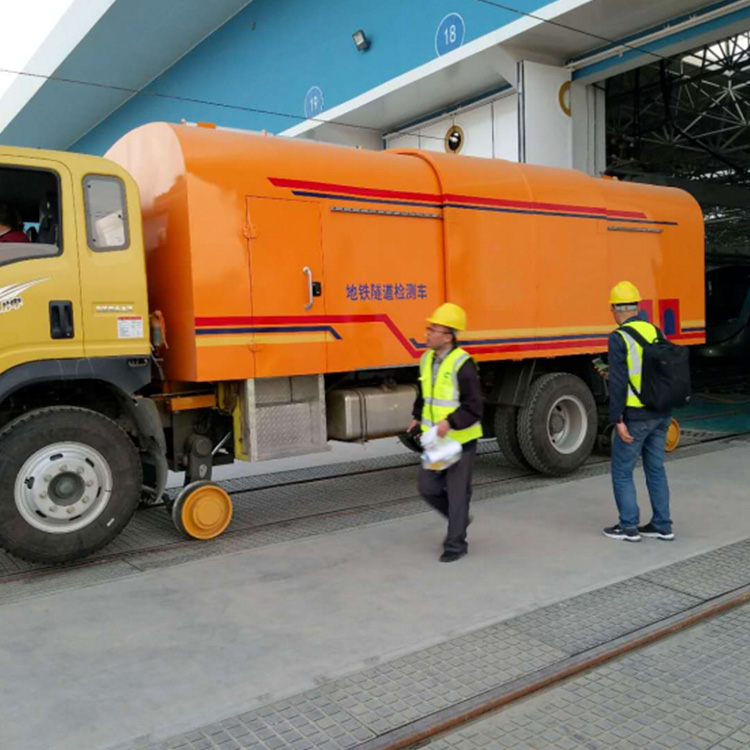


The dual-mode subway inspection vehicle is composed of three parts: the heavy-duty Wangpai truck chassis, railway running system, and detection system. The railway running system, including the lifting system, guidance system, and hydraulic system, is installed at the front and rear of the truck to enable road and railway running as well as conversion.
Currently, domestic railcars are primarily driven by rubber tires, with the entire weight borne by both the guide wheels and the tires. This shared contact with the rail surface reduces the normal pressure on the guide wheels, increasing the risk of derailment at high speeds. Our company's dual-mode railcars can meet both steel wheel driving and vertical track entry/exit requirements, significantly enhancing their operational safety performance.
The vehicle lifts the entire train and detaches the tires from the ground by using the oil cylinder while traveling on the railway. It moves along the tracks by relying on steel wheels. This method ensures safe travel without derailing.
The rear guidance device of the vehicle can be rotated arbitrarily by the reverser, allowing the public railway vehicle to pass through level crossings by tilting the vehicle vertically onto the tracks. Rotate the guidance device to lower the steel wheels onto the tracks, lift the rear half of the vehicle, turn the steering wheel, continue reversing, align the vehicle parallel to the tracks, and lower the front guidance wheel onto the tracks, lifting the entire vehicle, it can then travel on the railway.
The rear compartment houses a detection system capable of measuring rail gauge, level, and parameters of the subway electrical system, and records the data.


