
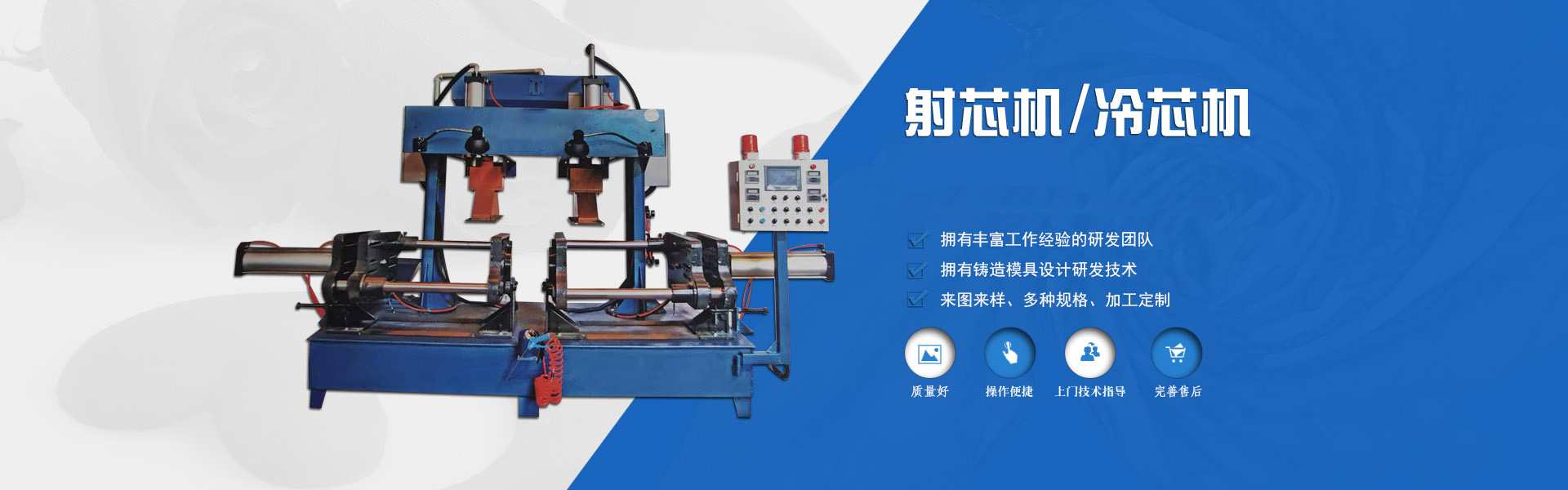


The double-station core shooter uses compressed air to uniformly shoot molding sand into the pre-compacted sand box, followed by applying pressure for compaction. Common types include the vertical split moldless shot molding machine and the horizontal split boxless shot molding machine. The vertical split moldless shot molding machine does not require a sand box for molding; the molding sand is directly shot into a mold room equipped with a template. The produced sand mold dimensions have good accuracy, the sand box has mold cavities on both sides, and the production rate is quite good, but it is challenging to remove the core, and strict quality requirements are placed on the molding sand. The horizontal split boxless shot molding machine uses a sand box for molding, and after the sand mold is formed, it is clamped and the box is removed, making core removal easy and maintaining a good production rate.
The introduction of the two-shot mold machine has revolutionized the mold industry. Whether for individuals or companies, the two-shot mold machine is widely used. For companies, with technical personnel to install, it can be completed quickly and, after use, there won't be quality issues due to installation errors. For individuals, without technical training, the difficulties during installation are not even mentioned, let alone the uncertainty of product quality after installation. Therefore, a proper installation method is highly necessary.
How much do you know about the specific operation process of a dual-station shot-casting machine? Below, we'll provide a detailed introduction.
Following the operation of the twin-shot core shooter, it's crucial to properly complete the post-operation procedures. This ensures its longevity and sets a solid foundation for the next use.
2. Once the twin-station core shooter is operational, operators must not leave their posts without authorization. They should focus their attention, follow the process procedures meticulously, and operate the machine with care, but they are not allowed to operate two valves simultaneously. Regularly monitor the twin-station core shooter's operation for any signs of poor lubrication, loose fasteners, damaged parts, leakage in the piping, or other anomalies. In such cases, immediately shut down the machine and notify maintenance personnel for repairs if necessary.
During the production process, if the double-station core shooter is found to have weak shock, or weak compaction, or weak flipping, or weak clamping, notify the maintenance personnel to inspect and repair. Keep the shock piston in a lubricated state, regularly blow sand off the piston, and then apply lubricant. When lifting the sand box, do not allow the sand box to collide with the model or valve handle to prevent damage to the model or incorrect operation. Regularly clean the sand accumulated on the double-station core shooter and its surroundings to prevent sand from entering the cylinder. In the event of an accident with the double-station core shooter, immediately stop the equipment, secure the scene, and report to the relevant department for inspection, analysis, and handling.
Three Core-Making Methods for the Double-Station Shot Blasting Machine:
1. Film-coated sand core making. Using thermoplastic solid phenolic resin as the binder and melamine as the hardener, the core sand is blown into a heated core box, maintaining the appropriate shell formation time. Once a thin shell is formed (5-20mm), the excess core sand is poured into a sand storage bin using a shaker, resulting in a hollow thin shell sand core. The core sand used is called film-coated sand, hence the method of core making is termed film-coated sand core making. Film-coated sand is as loose as dry sand, with good fluidity, suitable for producing various complex sand cores. Additionally, it is convenient for transportation and storage.
2. Cold Box Core Making. Cold box core making involves injecting resin sand into the core box without heating it, and then allowing the sand core to solidify within the box through chemical or physical reactions. This method does not require heating equipment for the core box, offering a wider range of material choices and a longer service life for the core box. Since the core box does not need to be heated, the dimensional accuracy of the sand cores is good. Cold box cores have a lower gas evolution compared to cores produced by other methods, resulting in excellent application effects when manufacturing sand cores for complex castings.
3. Hot Core Box Core Making. Hot core box core making involves using core sand made from thermosetting resin adhesive and catalysts, which is injected into a core box heated to the appropriate temperature. After the sand core hardens, it is removed to obtain a sand core with a smooth surface and precise dimensions. It has a good production rate, is easy to clean, does not require additional sand core curing equipment, and is easy to mechanize the core-making process, but it produces a pungent odor during core making.
Shell core making is a widely used method that can produce sand cores in various shapes. Shell cores can be categorized based on their structure into integral shell cores, half-shell shell cores, and shedding shell cores. Integral shell cores are often used for making simple-shaped sand cores that have a large flat surface.
Integrated Flipover Core Box Core Making: In the general core-making process, the core box is cleaned thoroughly, placed on a flat surface, and then, according to the size of the core, a corresponding thickness of core sand is placed inside the core box. Typically, a thickness of 30-40mm is used. For larger sand cores, it is possible to place 70-80mm thick sand by hand-tamping, and 100-150mm thick sand when using sand-tamping. The core-making process for the integrated frame core box is essentially the same as that for the flipover core box, except that the core frame is reversed (the frame is placed at the bottom, with the inserts facing up). The core box does not need to be flipped; it is gently tapped to remove the sand core.
