
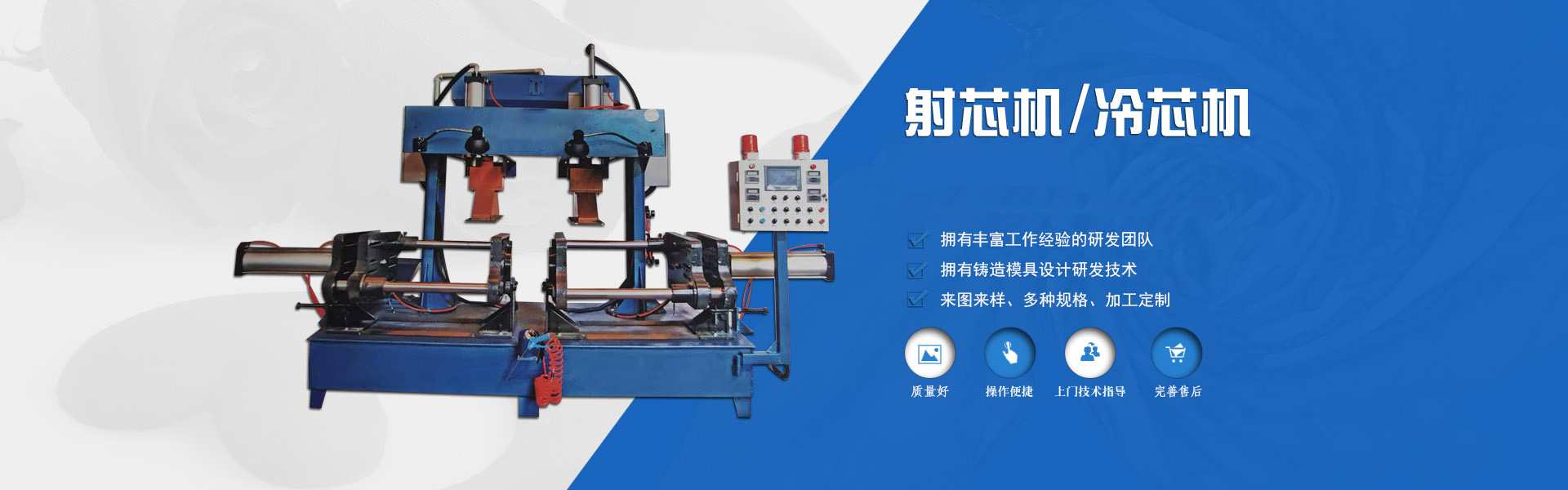


The core shooter sanding method produces high-quality cores that are easy to automate, making the core shooter molding process widely used for its short production cycle, excellent quality, low cost, and reduced noise. Here's an explanation of the sanding process in the core shooter's core-making technology.
The shot blasting process is quick, starting from a shot second on a small shot blasting machine, compressed air enters the shot blasting cylinder until the core box is filled, taking only 0.3 to 0.5 seconds. Just before and after the small pressure in the shot blasting cylinder reaches its peak, the blasting is mostly complete, and the core box is filled.
The core shooter machine operates by compressing air, which then abruptly expands to shoot core sand into a mold box. In modern foundries, the application of core shooters is increasingly widespread, leading to a rise in the number of corresponding enterprises and an ongoing intensification of competition in the core shooting industry.
Below, we analyze the advantages of the injection mold machine and the reasons for its widespread application.
The core shooter boasts high production efficiency. The hot box core shooter completes the process of filling sand and compacting simultaneously, and the cores harden immediately in the heated box, with a cycle time of just a few seconds to a couple of minutes, enabling the production of sand cores for casting. The quality of the sand cores from the core shooter is excellent: capable of producing cores of any complexity, with precise dimensions and smooth surfaces, thereby reducing the machining allowance for castings.
The shot blasting process of the core shooter is roughly divided into three stages:
Phase One: Pre-Shooting
After the intake valve opens, during the initial phase when the pressure inside the sand shooting cylinder rises, the molding sand cannot be ejected. It is only when the pressure reaches a certain level that the molding sand can be shot out through the orifices.
Phase Two: Free Sand Shooting
Sand particles are propelled by air flow and ejected through perforations to fill the core box.
Three Stages: Sand Ball Compactness
After the shell is basically filled, the free-spraying sand stage ends, but the movement of the core sand into the shell box does not stop. Driven by the pressure difference between the pressure inside the spraying nozzle and the upper part of the shell box, the core sand continues to fill the shell box. The originally sparse air-sand flow in the sprue hole becomes a dense stream of sand balls pushing against each other. The sand in the part pushed in later is called the compressed sand ball, which allows the compactness of the sand in the upper part of the shell box to continue to increase.
