

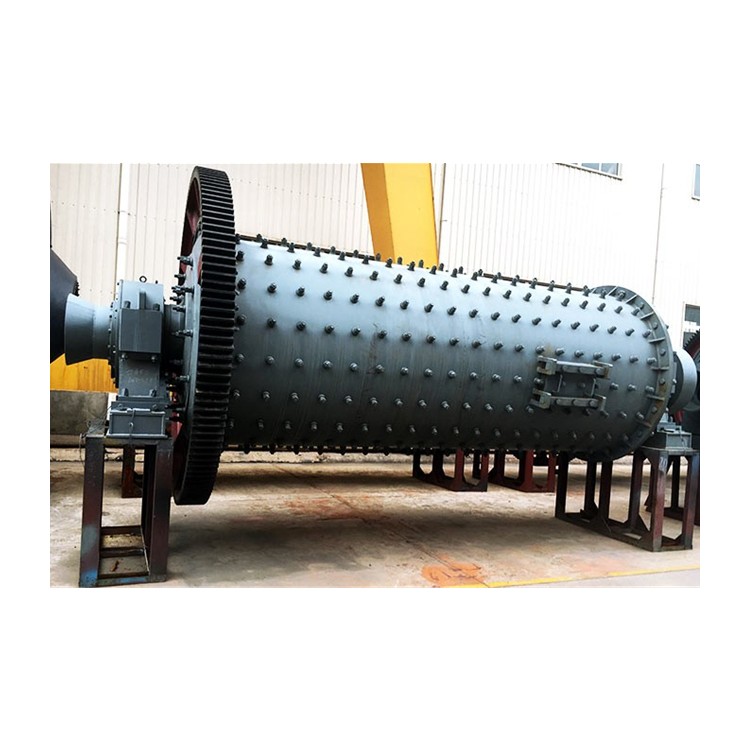


The ball mill is a crucial equipment for further crushing after the material has been broken. It is widely used in industries such as cement, silicate products, new building materials, refractory materials, black and non-ferrous metal ore beneficiation, as well as glass and ceramics production. It performs dry or wet grinding on various ores and other grindable materials. The ball mill is suitable for grinding various ores and other materials and is extensively used in the mining, construction materials, and chemical industries, and can be divided into dry and wet grinding methods. Depending on the discharge type, it can be classified into grid type and overflow type.
Working Principle:
The ball mill consists of a horizontal cylinder, a hollow shaft for feeding and discharging materials, and grinding heads. The cylinder is a long cylindrical tube, internally fitted with grinding bodies. Made of steel plates, the cylinder is secured with steel lining plates. The grinding bodies are typically steel balls, which are loaded into the cylinder in varying diameters and proportions. Steel segments can also be used as grinding bodies.
Select based on the particle size of the grinding material. The material is loaded into the drum through the hollow shaft at the feed end of the ball mill. As the drum rotates, the grinding bodies, due to inertia, centrifugal force, and friction, adhere to the drum liner and are carried along. When they reach a certain height, gravity causes them to be thrown down, and the falling grinding bodies, like projectiles, shatter the material inside the drum.
Material is evenly fed into the first compartment of the mill through the hollow shaft of the feeding device, where it encounters stepped or corrugated liners and various sizes of steel balls. As the drum rotates, centrifugal force elevates the steel balls to a certain height before they fall, exerting a heavy impact and grinding action on the material. After achieving coarse grinding in the first compartment, the material passes through a single-layer diaphragm plate into the next compartment, lined with flat liners and containing steel balls for further grinding. The powdered material is then discharged through a discharge grate, completing the powder grinding process.
During the rotation, the grinding media also exhibits a sliding phenomenon, exerting a grinding effect on the material during the fall. To effectively utilize this grinding effect, when the material's particle size is generally coarser, say 20 mesh, the mill's cylinder is separated into two sections by a partition, thus forming a double-bin mill. When the material enters the first bin, it is crushed by steel balls. Upon entering the bin, steel segments grind the material. The finely ground material is discharged from the hollow shaft at the discharge end. For materials with smaller feed particles, such as sand No. 2 slag and coarse fly ash, the mill's cylinder may not require a partition, becoming a single-bin tube mill. The grinding media can also be steel segments.
Material is fed into the hollow cylinder through a hollow shaft neck for crushing, where various diameter grinding media (steel balls, steel rods, or gravel, etc.) are contained inside. As the cylinder rotates around a horizontal axis at a certain speed, the media and material inside the cylinder are subjected to centrifugal and frictional forces. As the cylinder reaches a certain height, when the material's own gravity is greater than the centrifugal force, it detaches from the inner wall and falls or rolls down, breaking the ore due to the impact force. Simultaneously, during the rotation of the mill, the sliding motion between the grinding media exerts a grinding effect on the material. The crushed material is then discharged through the hollow shaft neck.

