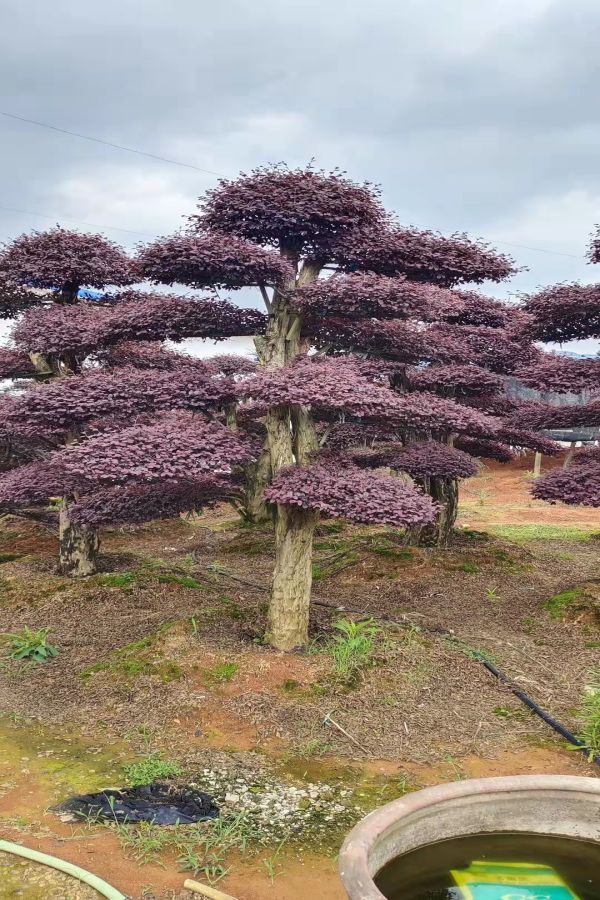


Chinese Red Loropetalum (Latin name: Loropetalum chinense var. rubrum), also known as Red Succeeding-willow, Red Osier, Red Elm, Red Loropetalum, Red Osier Flower, Red Elm Flower, and Red Succeeding-willow Flower, is a variant of the Loropetalum genus, a evergreen shrub or small tree. The bark is dark gray or light gray-brown, with many branches. Young branches are reddish-brown, densely covered with star-shaped hairs. Leaves are leathery, alternate, ovate or elliptic, 2-5cm long, with a short-pointed tip, a round and oblique base, asymmetrical, with star-shaped hairs on both sides, entire, dark red. Flowers have four petals, purple-red, linear, 1-2cm long, in clusters of 3-8 on branch tips. Capsules are brown, nearly ovate. Flowering period is from April to May, lasting about 30-40 days, with a second bloom during the National Day holiday. Flowers are 3-8 in clusters on the peduncle, forming an axillary capitulum, purple-red. Fruit period is in August. Mainly distributed in the middle and lower reaches of the Yangtze River and southward, as well as in northern India. Flowers, roots, and leaves are medicinal.
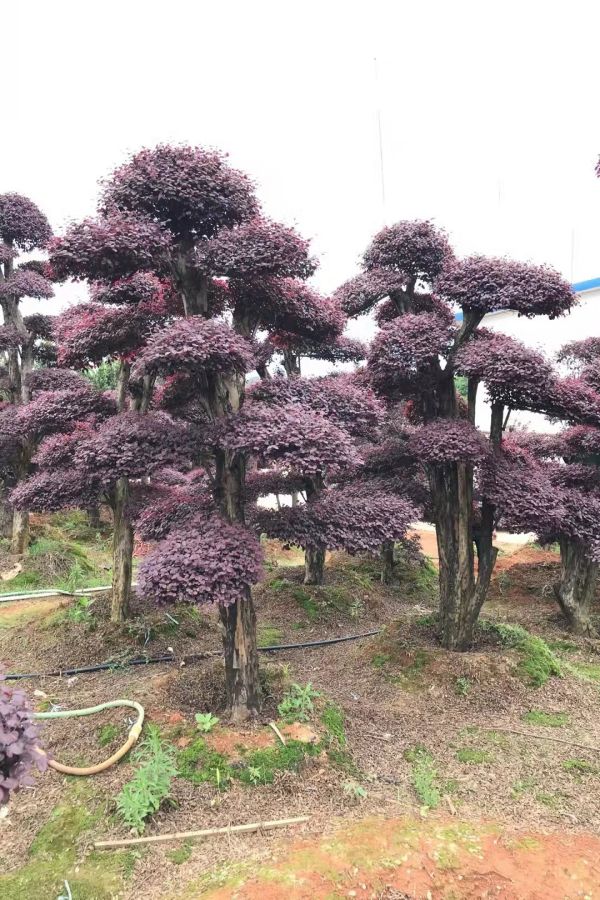
Shrubs, sometimes small trees, with many branches, small branches with stellate hairs. Leaves are leathery, ovate, 2 to 5 cm long, 1.5 to 2.5 cm wide, acute at the apex, obtuse at the base, unequally sides, slightly rough or glabrous on the upper surface, dark green when dry, without luster, with stellate hairs on the underside, slightly grayish-white, lateral veins about 5 pairs, prominent above, raised below, entire; petioles 2 to 5 mm long, with stellate hairs; stipules membranous, deltoid-lanceolate, 3 to 4 mm long, 1.5 to 2 mm wide, early falling.
The flowers are in clusters of 3 to 8, with short pedicels, purplish-red, blooming before or simultaneously with the young leaves. The raceme peduncle is about 1 cm long and hairy. The bracts are linear, 3 mm long. The calyx is cup-shaped, hairy, with ovate sepals, about 2 mm long, which fall off after flowering. There are 4 petals, strap-shaped, 1 to 2 cm long, with rounded or obtuse tips. There are 4 stamens with very short filaments and anthers that protrude in a horn-like shape. There are 4 staminodes, scale-like, alternating with the stamens. The ovary is completely inferior and hairy. The style is very short, about 1 mm long. There is one ovule hanging in the upper corner of the ovary.
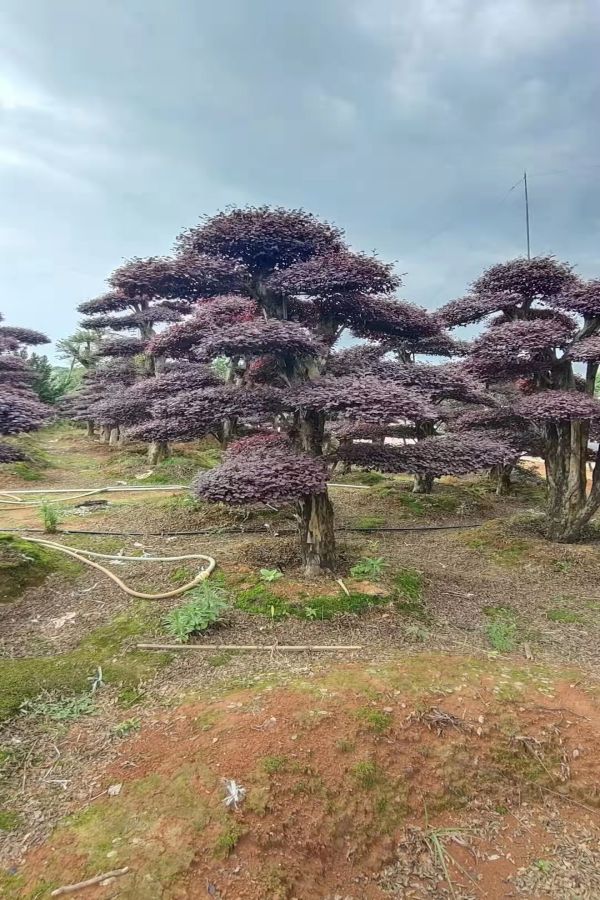
Specification form measurement
Red sandalwood is commonly found in natural shapes, spherical forms, and shaped bonsai styles. Natural shapes and spherical forms are measured by their natural height and crown width, while shaped bonsai styles require full, layered foliage with a rustic, simple elegance. For multi-stem measurements, the sum of each main stem is added sequentially.
Loves sunlight, moderately shade-tolerant, but the leaves tend to turn green when in shade. Highly adaptable, drought-resistant. Prefers warmth, cold-tolerant. Strong萌芽 and branching abilities, pruning-tolerant. Endures poor soil, but thrives in fertile, moist, slightly acidic soil.