

Let's discuss the characteristics of explosion-proof fans. Firstly, they are undoubtedly used in hazardous environments; otherwise, they wouldn't be called "explosion-proof." Therefore, they should possess certain explosion-proof capabilities. Consequently, the first thing that comes to mind is obtaining an explosion-proof certificate. Secondly, upon reviewing the CCC Catalog, we did not find a category for explosion-proof fans, so there's no need to consider CCC certification.
However, explosion-proof fans can apply for the explosion-proof CCC certification, which is quite different from the ordinary CCC certification. This is because some purchasing companies require that explosion-proof fans must possess the explosion-proof CCC certification qualification. Therefore, below we will explain how to obtain the explosion-proof CCC certification for explosion-proof fans.
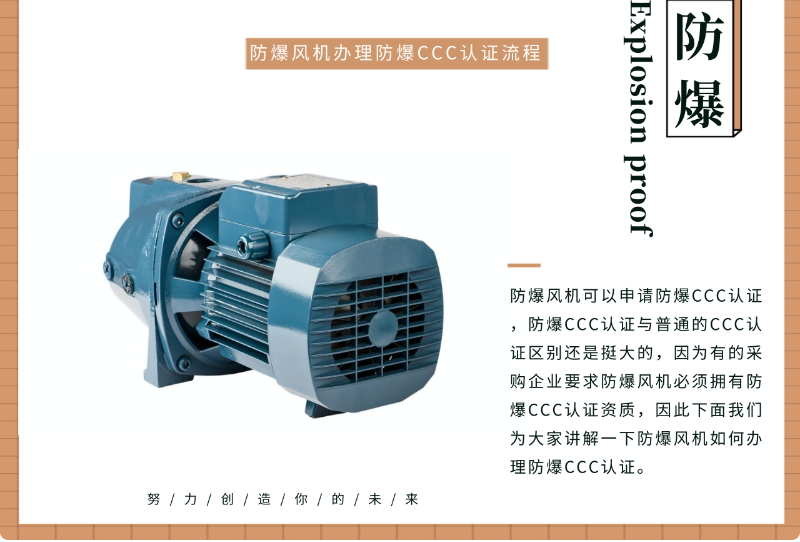
Process for防爆Fan Explosion-proof CCC Certification
I. In accordance with standards
GB3836.1-2010 - Explosive Atmospheres, Part 1: Equipment - General Requirements
GB3836.2-2010 - Explosive Atmospheres, Part 2: Equipment protected by "d" explosion-proof enclosures
GB12476.1-2013 Electrical Equipment for Combustible Dust Environments – Part 1: General Requirements
GB12476.5-2013 Electrical Equipment for Combustible Dust Environments, Part 5: Enclosure Protection Type "tD"
Note: Since most explosion-proof fans are of the intrinsic type, the referenced standards are also intrinsic type standards. For other explosion-proof types, please consult a professional engineer.
Preparation of Documents
Product Information: Schematics, Assembly Drawings, Structure Drawings, BOM (Bill of Materials), Component Distribution Maps, Component Assembly Drawings, etc.
Technical Documents: Product manuals, corporate standards, process files, etc.
Samples: Provided according to the requirements of the testing laboratory.
OEM/ODM Agreement (If it's a contract manufacturing, the production factory can issue an explanation).
Company Application Documents: Application Form, Business License (Tripartite).
III. Certification Process (General)
Submit documents to the CCC certification body for review, which is typically completed within 2 working days.
Product Testing (Explosion-proof models with a testing cycle of approximately 2 months)
Issue test reports (if the test is不合格, the company is required to cooperate in rectification until the test passes)
Factory Audit: Following the issuance of the test report, the certification body will schedule a factory audit within 3 working days. The audit typically takes 1-2 days and focuses on two aspects: production process and safety, ensuring that the samples are consistent with the production products in terms of parameters and processes.
A Certificate of Conformity (CCC) for explosion-proof products is generally issued one week after the submission of the test report and factory audit report.
