



Yunnan Steel Decking, Steel Decking Processing in Yunnan, Customized Steel Decking in Yunnan
The main characteristics of the roof deck:
1. Adaptable to the fast construction of the main steel structure, it provides a solid working platform in a short time, and allows for the installation of corrugated steel sheets on multiple floors for a sequential concrete slab casting process.
2. During use, the roof deck acts as the tensile reinforcement for the concrete floor slab, enhancing the floor's stiffness while also reducing the amount of steel and concrete required.
3. The embossed surface of the profiled sheet enhances the bonding between the floor deck and concrete, creating an integrated structure. Accompanied by stiffeners, the floor deck system achieves high load-bearing capacity.
4. Under cantilever conditions, the floor deck acts solely as a formwork template, and the cantilever length can be determined based on the cross-sectional characteristics of the floor deck. To prevent cracking of the cantilevered plate, negative reinforcement should be installed at the support according to the design of the structural engineer.
The construction and usage of floor decks:
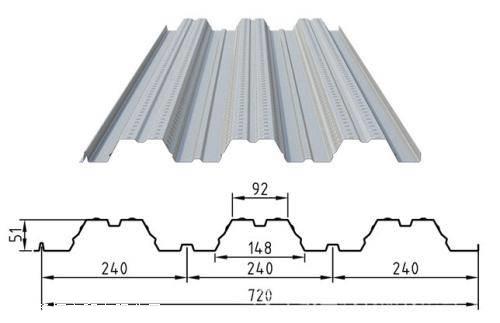
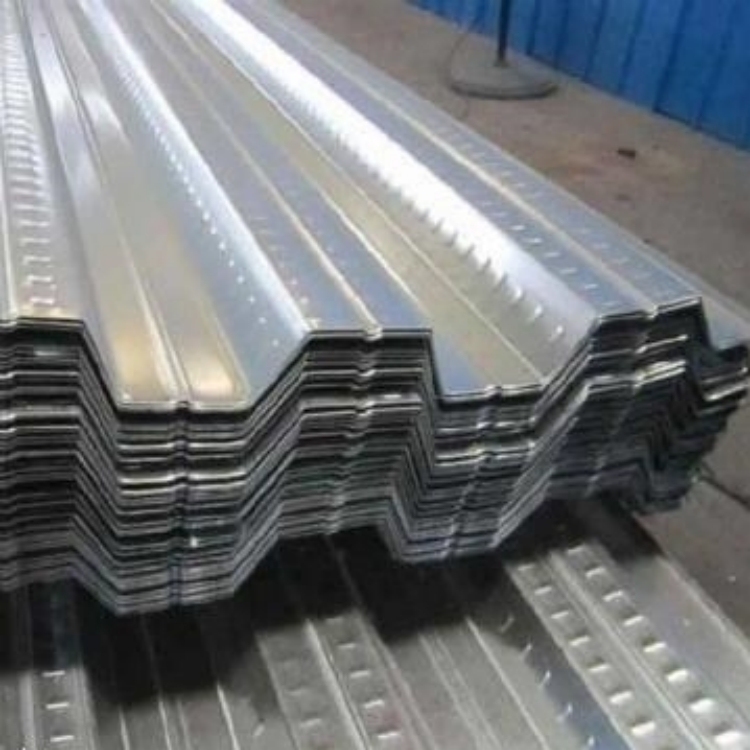
Floor deck profiles are available in thicknesses of 0.8mm, 1.0mm, and 1.2mm, widths ranging from 688mm to 940mm, and heights from 51mm to 76mm. The engineering floor deck works in conjunction with reinforced concrete structures, forming a composite structure. The floor deck is laid and connected to steel beams, with the ends of the deck spot-welded to the beams. Intermediate sections are connected using rivets and full penetration welds through the steel beams; the decks are joined using clamping pliers to press-fit the mating holes. End caps are welded to the floor deck and steel beams with spot welds. For curved area floor deck profiles, plasma cutting is used for non-standard cuts, resulting in smooth edges and a complete galvanized coating. The welding of floor decks is done manually using E4303 electrodes, with a diameter of 3.2mm, and full penetration weld points of 16mm. The original design had weld spacing at 305mm intervals, which was later doubled to ensure that the floor deck does not deform when personnel walk on it and to prevent leakage at the deck ends during concrete pouring. When the floor level structure elevation varies, additional welding of steel beams is employed to create stepped transitions. When lowering the elevation, angle steel is welded to the web of the I-beam; when raising the elevation, flange angles are welded to the flanges of the I-beam. For pre-existing holes in the floor, if the size is generally greater than 500mm x 500mm, a pre-drilling approach is used, involving the welding of steel beams to support the hole, increasing its rigidity, and the mesh reinforcement is cut and welded to the steel beams. For holes smaller than 500mm x 500mm, a post-drilling approach is taken, adding end cap dividing plates to the floor deck, allowing the mesh reinforcement to pass through, and the reinforcement can be cut after the concrete is poured and shaped.