




- AllProduct Category
-
Protocol Converter/Fiber Optic Transceiver
PDH/SDH Optical Terminal
Integrated Package Products
Military-Specific Communication Products
Party and Government Special Network Products
High-Definition Video Optical Terminal
Multi-service Optical Transmission Equipment
Telephony Optical Terminal (Mux)
Integrated Communication Products


详情描述
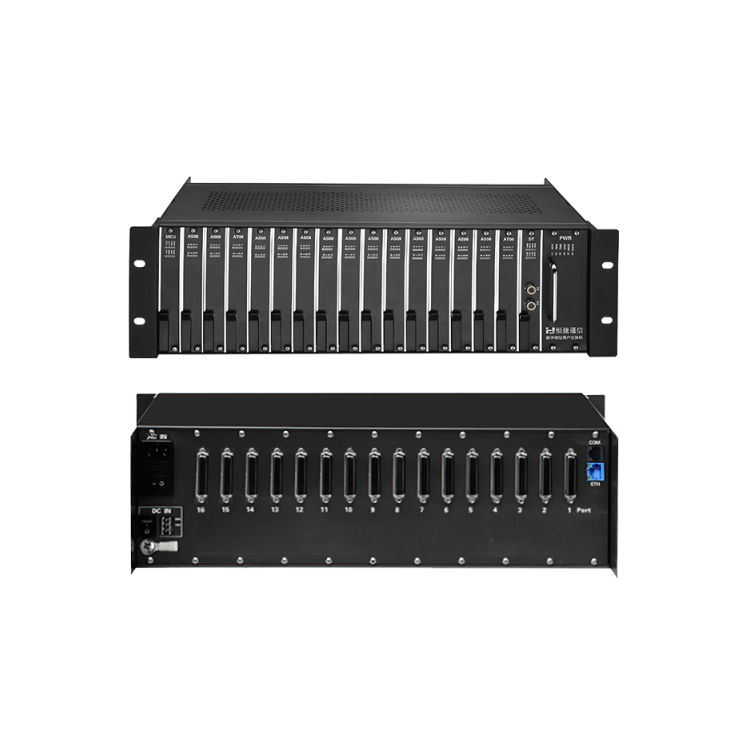
The HJ-E800C Digital Programmed Exchange is the most cost-effective new generation product in the E800 series. It integrates circuit and fiber optic access technologies to produce a new generation of digital programmed exchanges, supporting analog trunks such as loop, E&M, and carrier, as well as digital trunks with protocols like No.7, R2(NO.1), PRI, and V5 signaling. It supports the extension of remote modules via optical interfaces and E1 interface methods, making it an ideal device for users to improve communication conditions, enhance work efficiency, control phone bill expenditures, and implement office intelligence. It boasts user-friendly flexibility, high reliability, and large capacity. The system is widely used in business offices, factories, government agencies, hospitals, hotels, schools, and other corporate entities.
The HJ-E800C device features 1 MCU control and 16 user board slots, offering up to 128 voice phone lines.
The system supports up to 2 DT digital relay cards. Each DT card provides 1 E1 interface, which can be individually set as No.1, PRI, or No.7 signaling. The system can accommodate up to 64 loopback relay interfaces.
Feature Highlights:
Large capacity
The system offers 2 E1 interfaces, 64 ring-back trunks, and provides 128 voice ports.
2. Feature-rich
This equipment boasts robust call handling and billing capabilities, along with centralized network management features. The main control board and power board are equipped with redundant backup systems to ensure uninterrupted communication at all times.
3. Robust networking capabilities
We offer interfaces such as E1, E&M, Carrier, Magnet, Loop, and Fiber Optic, with E1 supporting signaling protocols like R2, NO.1, DSS1 (PRI), QSIG, SS7, and V5. These interfaces and signaling protocols can be interconnected, serving as a signaling and interface gateway.
4. Remote Module
Supports fiber or E1 remote module extension, significantly reducing the cost of manual wiring, and easy to maintain.
5. Highly reliable performance
Full decentralized control, modular structure, featuring DSP and FPGA technologies, K20 three-tier lightning protection measures, fault diagnosis and detection functions, hot-plugging technology.
6. Wide Range of Applications
Suited for operator access, private network deployment, virtual operations, government agencies, hotels and restaurants, corporate entities, dispatch communication, call centers, and emergency response platforms, etc.
7. Control System
On-chip processing system based on embedded technology, large-capacity NAND FLASH storage, supports online program upgrades.
8. Digital Audio Source System
Offer personalized extension ringback tones, hierarchical IVR voice guidance, and voice message mailbox services.
9. Voice Message Mailbox Feature
This voice mailbox system independently completes all the functions of a voice message system without a computer; it uses flash as the storage medium, with a total of 255 mailboxes. Mailboxes 0-64 can record up to 16 minutes of voice, while mailboxes 65-255 can record up to 4 minutes. Each mailbox can individually record a welcome message up to 16 seconds long; it also allows for simultaneous recording of up to 32 voice message mailboxes. Full digital recording with sound quality in accordance with the G.711 standard, ensuring telecommunication-grade call quality. It provides a perfect solution for hotels, motels, and small and medium-sized enterprises to implement a voice message system.
10. PCB Fault Detection
Advanced hardware card fault monitoring function, automatic fault masking feature, and full view of card operation status available in the background.
11. Low-power control
The system significantly reduces the number of backup power battery units and the overall power consumption of the entire unit while ensuring the normal operation of the communication lines.
12. Structurally sound, versatile configuration
A fully digital, all-time-slot seamless switching network, with unit modules centered around the switching network, featuring unified unit interfaces for interoperability among different units; true universal card slots allow for arbitrary placement of various interface boards, with adjustable capacities. Users can configure branch/relay ratios as needed, maximizing system resource sharing.
13. System Architecture
19-inch standard rackmount structure, featuring a spacious and aesthetically pleasing design.


