





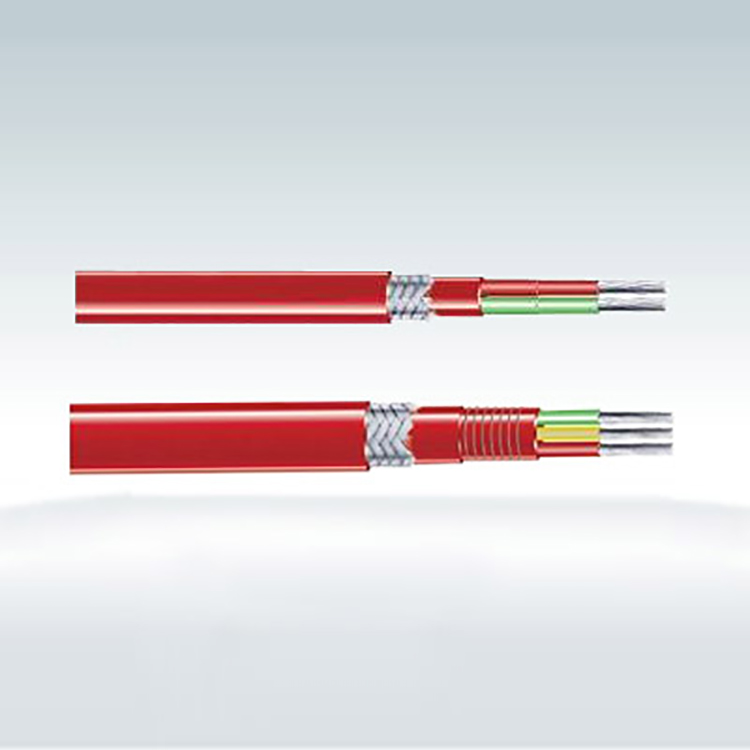


4. Product Features:
The constant power parallel heating tape maintains a consistent heat output per unit length, with the total output power increasing as the length of the tape used increases. The tape can be cut to any required length on-site. Additionally, due to its flexibility, the heating tape can be easily adhered to the surface of the pipeline. The metal shielding mesh on the outer layer of the tape prevents static electricity and ensures safe grounding, enhancing the overall strength of the tape while also serving as a heat transfer and dissipation medium.

When used in conjunction with a temperature controller, a constant power parallel electric heating tape can precisely maintain the medium temperature of the pipeline or heating body.
The reinforced electric heating tape is wrapped with an additional layer of insulation on the outer surface of the standard electric heating tape, with the rest of the structure being identical. The main features of the reinforced electric heating tape are its higher mechanical strength and better corrosion resistance compared to the standard type, although it has slightly lower thermal conductivity. It is primarily used for underground pipeline installations and in environments with corrosive gases. Due to the limited busbar cross-sectional area, there is a certain length restriction when a single-point power source is used for unidirectional output to avoid excessive voltage drop. When a single-point power source is used for bidirectional output, the usable length can be doubled (refer to Table 1, Figure 4). If longer heated pipelines are required, multi-point power supply can be used, or the HCR-type series electric heating tape produced by our company (introduction on the next page) can be adopted.
Three-phase electric heating tapes, in addition to the features of single-phase electric heating tapes, also have longer usable lengths, better uniformity in heat distribution, and the ability to balance the grid load.
Installation of electric heating cables and control devices typically includes overload, short circuit, leakage, and overheating protection.
5. Product Specifications and Main Technical Indicators:

6. Application of Products:
Electric heating tapes are mainly used for frost prevention and insulation of pipelines, valves, pump bodies, storage tanks, reaction towers, instrument boxes, etc., or to maintain the process temperature of instrument pipelines. Specific application scenarios include:
(1) Continuous flow through low solidification pipelines is used under normal conditions to prevent the medium from solidifying due to cessation of flow.
(2) Accommodation and insulation for liquid pipelines requiring strict control of operating temperature.
(3) Frozen region anti-freezing for water supply pipelines and valves, as well as for drainage pump pipes and condensate lines.
(4) Anti-freezing for offshore platform pipelines.
(5) Heating and insulation for general pipelines and instruments.
(6) Wellhead Oil Extraction Vertical Bore Heating (replacing water jacket), Waste Water Well Heating.
(7) Airport Runway Anti-Icing and Deicing Solutions
(8) Concrete Products Freezing Protection and Maintenance
7. Explosion-proof specifications:
Electric heating tapes are designed and manufactured in accordance with GB3836.1-2000 and GB3836.3-2000, which are the "General Requirements" for explosion-proof electrical equipment used in explosive environments and the requirements for increased safety electrical equipment. The explosion-proof grade is "eⅡ T3-T6". The products are flame-retardant and, when paired with increased safety electrical accessories, are suitable for use in areas of Zones 1 and 2 with explosive gas mixtures "T3-T6" that are not directly impacted by external forces.
