

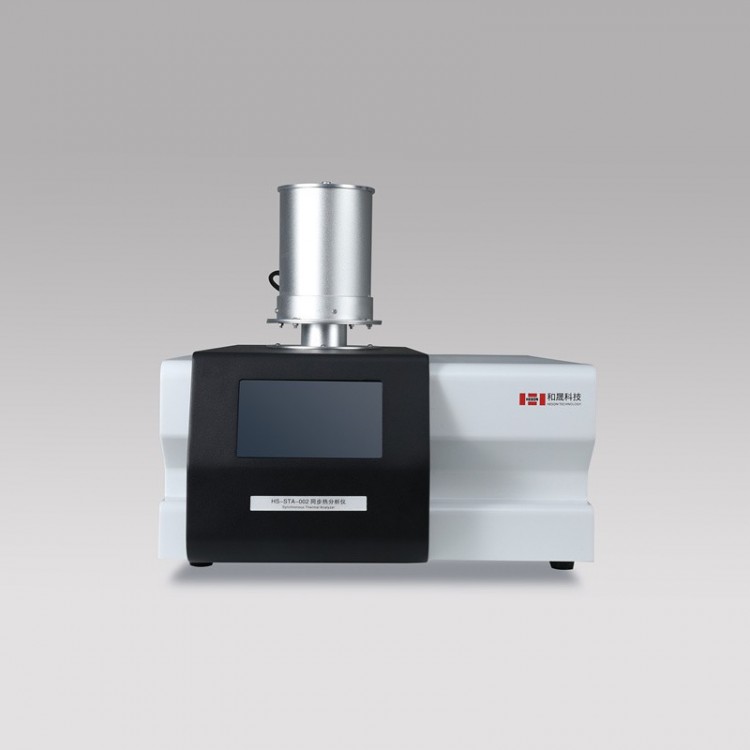

Simultaneous thermal analysis integrates thermogravimetric analysis (TG) with differential thermal analysis (DTA) or differential scanning calorimetry (DSC), allowing for the simultaneous acquisition of thermogravimetric and differential thermal information from the same sample in a single measurement.
Compared to individual TG and/or DSC tests, the following significant advantages are offered:
1. One measurement provides both quality change and thermal effect information, conveniently and time-saving. Moreover, it's particularly advantageous for costly or hard-to-obtain samples, as it requires less sample material.
2. Eliminate the influence of factors such as weight measurement, sample uniformity, consistency in heating rate, differences in atmosphere pressure and flow, resulting in a better correspondence between the TG and DTA/DSC curves.
3. Determining whether a thermal effect corresponds to a change in mass aids in distinguishing the corresponding physical and chemical process (such as distinguishing melting peaks, crystallization peaks, phase transition peaks, decomposition peaks, and oxidation peaks, etc.).
4. Monitor the sample quality in real-time for changes with temperature/time, and use the current actual sample mass (not the original mass before measurement) when calculating enthalpy, which is beneficial for accurately calculating phase transition heat, reaction heat, etc.
Product Features
The furnace heating employs a double row winding of precious metal nickel-chromium alloy wire, reducing interference and providing better high-temperature resistance.
2. Tray sensor, crafted from premium nickel-chromium alloy, boasts high-temperature resistance, anti-oxidation, and corrosion resistance.
3. Power supply, separate cooling loop from the main unit, reducing heat and vibration impact on the micro-thermal balance.
4. Features an easy-to-use top-opening lid structure. It's difficult to place samples by lifting the furnace body, which may easily damage the sample rod.
5. The main unit features a water-based constant temperature device to isolate the heat influence of the heating furnace on the cabinet and the micro-thermal balance.
6. Features a 32-bit ARM Cortex-M3 processor core for faster sampling and processing speeds.
7. 24-bit four-channel sampling AD collects DSC signals, TG signals, and temperature T signals.
8. The furnace body can be replaced according to customer requirements.


