
Currently, LEDs are widely used in residential, street, and commercial lighting sectors, gradually replacing traditional light sources. Although LEDs have many advantages, their measurement technologies for power, luminous flux (equivalent to power, but measured in lumens), and spectrum are not much different from those of traditional sources. The primary reason is that these sources emit non-coherent light that is uniformly radiated in all directions. At this point, if a sensor with a fixed aperture size is used to measure power, a complex collection device is required, which would result in high luminance.
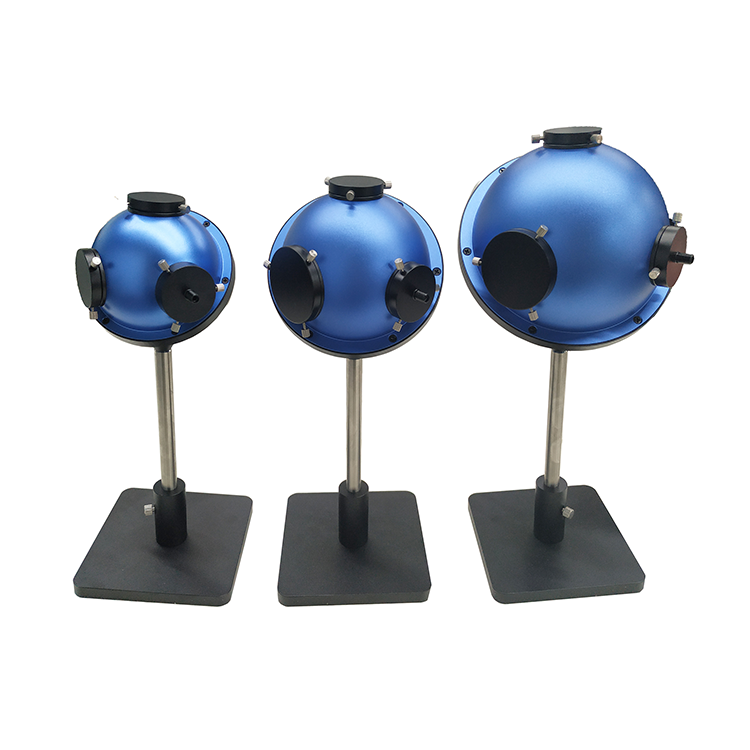
Limited-aperture power sensors, such as photodiode tubes, cannot measure the entire beam of highly scattered light sources. In such cases, a device that combines an integrating sphere with a sensitive photodiode can be used to measure the power of light sources (e.g., LEDs).
Multiple diffused reflections of light within the entire spherePoint BallInternal coating spectral reflectance coefficient
ScoreballThe interior surface is coated with a high-reflective material, when a divergent light beam is shone ontoScore BallWhen light strikes the inner surface of the sphere, it is reflected and scattered multiple times until the light intensity at one point on the spherical wall is the same. At this point, the photodiode sensor determines the total power of the beam by comparing the area of the receiving aperture to the total surface area of the sphere. The power detected by the sensor is proportional to the incident power and is unaffected by the divergence of the beam. To achieve this, the sensor must be positioned where it can only see scattered light and not the incident light. Furthermore, the integrating sphere also reduces the power entering the photodiode, allowing for the measurement of higher powers.
Based on the diffraction properties of light, Newport offers two different integrating sphere probe options.
1、819 D Series Probes - for Scattered Light Sources
2、819 Series C Probes - For Collimated Beam Input
3、NIST traceable calibration, low uncertainty
4、Our response time for high-power measurements is faster than thermocouple detection.
In the 819 D series, the baffle is positioned between the input end and the probe, ensuring that the non-divergent beam does not reach the probe directly. When measuring collimated beams, the placement of the 819 C series baffle should be such that the beam, after reflecting off the spherical wall, does not directly照射 onto the probe. Below is:
1、Collimated Beam Power Measurement
2、Scattered Light Source Power Measurement
Feature:
1、End Calibration Uncertainty
Each product undergoes a full-spectrum response calibration using NIST-traceable standards, and is calibrated with high-precision equipment installed on Newport optical probe calibration systems. Rigorous calibration equipment and process control ensure strict calibration uncertainty in the industry. To maintain accuracy and guarantee performance, Newport recommends an annual integration sphere probe calibration.
2、The selectable wavelength range includes ultraviolet, visible, and infrared.
Photodiodes with silicon photonics are suitable for measurements within the 400 nm to 1100 nm range, while models with InGaAs probes are ideal for measurements between 800 nm and 1650 nm. The UV version optimizes wavelengths from approximately 200 nm to 400 nm, thereby calibrating it to 1100 nm.
3、SMA Fiber Adapter Located in the North
All spheres are equipped with a standard North SMA fiber optic adapter, enabling minimal light pick-up for wavelength measurement or further analysis without affecting the overall system calibration. In cases where converters have been installed, all integrating sphere probes have been calibrated.
Details:
Model:
Spectrum Range
Calibrate Uncertainty
Power Range
819C-UV-2-CAL
200-1100 nanometers
±4%@200-250 nm,
±2.5%@251-950 nm
±5% @951-1100 nm
100nW-100mW
819 C- UV-5.3- CAL
220-1100 nanometers
±3%@220-829 nm
±3.5%@830-959 nm
±3%@960-1100 nm
100nW-850mW
819C-SL-CAL2
400-1100 nanometers
±2.5%@400-1000 nm
±3%@1001-1100 nm
100nW-1900mW
819 C- SL-5.3-CAL2
100nW-4000mW
819 C- SL-3.3- CAL
±1.5%@400-550 nm
±1%@551-950 nm,
±1.5%@951-1010 nm
±3%@1011-1100 nm
100nW-170mW
819C-IG-2-CAL
800-1650 nanometers
±5%@800-910 nm,
±2%@911-1650 nm
100nW-1500mW
819 C- IG-3.3- CAL
910-1650 nanometers
±5%@910-950 nm
±2%@951-1650 nm
100nW-3500mW
819 C- IG-5.3- CAL
930-1650 nm
±5%@860-920 nm
±2%@921-1650 nm
1uW-5000mW
819D-UV-2-CAL
220-1100 nanometers
±4%@200-250 nm
±2.5%@251-950 nm
±5%@951-1100 nm
100nW-100mW
819 D- UV-5.3- CAL
±3%@220-829 nm
±3.5%@830-959nm
±3%@960-1100 nm
100nW-6000mW
819D-SL-CAL2
400-1100 nanometers
±2.5%@400-1000 nm
±3%@1001-1100 nm
100nW-3200mW
819 D- SL-5.3-CAL2
100nW-6500mW
819 D- SL-3.3- CAL
±1.5%@400-440 nm,
±1%@441-950 nm
±1.5%@951-1000 nm
±3%@1001-1100 nm
100nW-180mW
819D-IG-2-CAL
910-1650 nm
±5%@910-960 nm
±2%@961-1650 nm
100nW-2500mW
819 D- IG-3.3- CAL
100nW-4500mW
819 D- IG-5.3- CAL
930-1650 nm
±5%@930-950 nm
±2%@951-1650 nm
1uW-6000mW
Additionally, the Newport integral ball is compatible with various types of headers:
Details available upon request.
Long-press to follow SenQuan's official WeChat - sources
Product information, business consultation, technical support, exhibition news...
Photonic Product Supplier!
Brighten Your Research Journey:
1、Laser Control:Laser Current Sources, Laser Temperature Controllers, Laser Control Systems, Servo Devices and Systems
2、Detector:Photoelectric detectors, single-photon counters, single-photon detectors, CCD, spectral systems, etc.
3、Positioning and Processing:Nano-positioning systems, micro-nano motion systems, multi-dimensional mobile platforms, rotating tables, miniature manipulators, etc.
4、Light Source:Semiconductor lasers, solid-state lasers, single-frequency lasers, single longitudinal mode lasers, narrow linewidth lasers, optical communication band lasers, CO2 lasers, mid-infrared lasers, dye lasers, and femtosecond ultrafast lasers.
5、Optical Mechanical Components:High-quality stress-free optical mechanical components for optical system assembly, including optical adjustment frames, mirror mounts, support rods, and fixed bases.
6、Optical Platform:Comprehensive solutions including active vibration isolation platforms, air-bearing vibration isolation tables, test benches, rigid workbenches, enclosure panels, vibration isolation, magnetic shielding, and soundproofing.
7、Optical Components:A variety of crystals, optical fibers, deflection mirrors, lenses, transmission mirrors, half-silvered mirrors, filters, attenuators, and glass slides.
8、Dye:Laser dyes, fluorescent dyes, color-shifting dyes, photoluminescent dyes, and absorbent dyes, etc.