

Optical Parameter Testing for LED Sources
1、Photometric Measurement
The intensity of light, or the light intensity, refers to the amount of light emitted at a certain angle. According to the CIE127 standard, due to the relatively concentrated light, the inverse square law is not applicable to light-emitting diodes. CIE127 proposes two conditions for measuring average normal light intensity: Measurement Condition A (far-field condition) and Measurement Condition B (near-field condition), both with a surface area of 1 cm². Generally, light intensity is measured under Standard Condition B.
2、Optical Throughput and Efficiency Testing
Light flux is the total amount of light emitted by a light source, also known as luminous flux. The main methods of testing include the following two:
(1) Comprehensive Approach
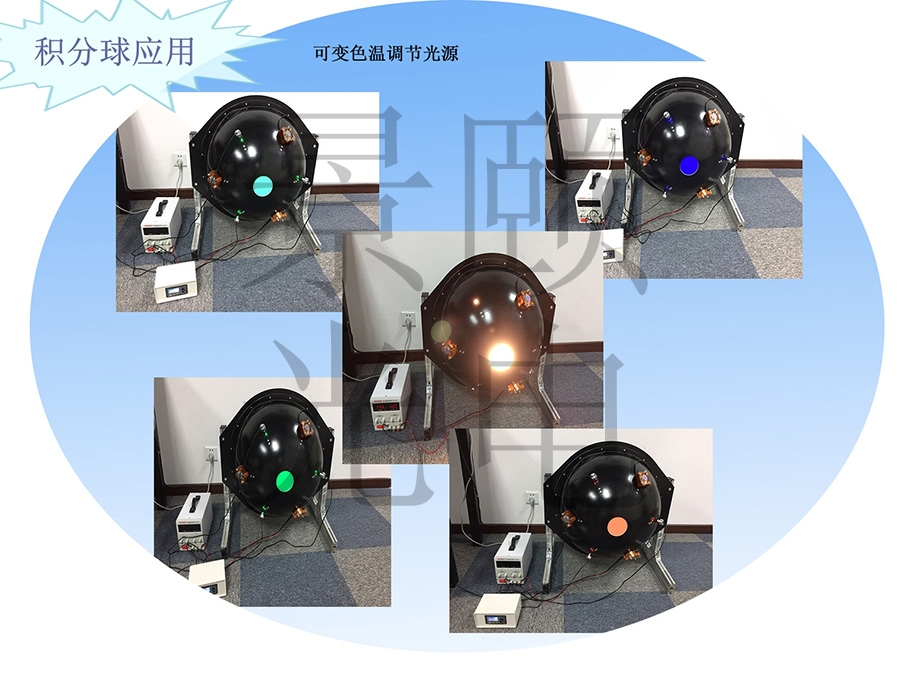
Please provide the Chinese content to be translated.Score BallThe standard lamp and the test lamp are sequentially ignited, with the photovoltaic converter readings being Es and ED, respectively. When the flux of the standard light source Φs is known, the flux of the test lamp ΦD is calculated as ED × Φs / Es. The integral method employs the "point source" principle, which is simple to operate, but is subject to significant measurement errors due to the color temperature deviations between the standard and test lamps.
(2) Spectroscopy
The luminous flux was calculated using the spectral energy distribution P(λ). Utilizing a monochromator, inScoreballThe company measured the spectral range of 380 nm to 780 nm for the light bulb, then measured the spectral of the light being tested under the same conditions, and compared and calculated the luminous flux of the tested bulb.
Lumens per watt, or luminous efficiency, is the ratio of a light source's luminous flux to its power consumption, commonly measured in a constant current mode for LED efficacy.
3、Spectrum Characteristic Detection
The spectral characteristic detection includes spectral power distribution, color coordinates, color temperature, and color rendering index, among others.
The spectrum power distribution represents that the light from a light source is composed of various wavelengths of color radiation, with different power levels for each wavelength. This variation with the order of wavelengths is known as the spectral power distribution of the light source. It is obtained by comparing and measuring the light source with a spectrophotometer (monochromator) and a standard lamp.
Color coordinates represent the number of light colors emitted by a light source in a numerical way on a coordinate chart. There are many types of coordinate systems in the color coordinate chart, with the X, Y coordinate system being commonly used.
Color temperature is a measure of the quantity (appearance of color) of the color spectrum that a person sees from a light source. When the light emitted by a source matches the color of light emitted by a black body at a certain temperature, it is considered to have that color temperature. Color temperature is an important parameter describing the optical characteristics of a light source. The theory of color temperature originates from black body radiation, and the color coordinates of a light source can be derived from the color coordinates that contain the black body trajectory.
The Color Rendering Index (CRI) indicates the degree to which a light source accurately reflects the color of the illuminated object, typically represented by Ra, which is the arithmetic mean of the CRI for eight color samples of the light source. The CRI is a key indicator of light source quality, determining the application range of the light source. Enhancing the color rendering index of white LED is an important topic in the research and development of LEDs.
4、Strength Distribution Measurement
The relationship between light intensity and spatial angle (direction) is referred to as the pseudo-light intensity distribution. The closed curve connected by this distribution is known as the light intensity distribution curve. Due to the large number of measurement points, each point requires data processing, typically using an automatic distribution photometer for measurement.
5、The Impact of Temperature on LED Optical Properties
Temperature affects the optical performance of LEDs. Many experiments have shown that temperature influences the emission spectrum and color coordinates of LEDs.
6、Ground Luminance Measurement
The brightness of a light source in a certain direction is the luminous intensity per unit projected area in that direction. Surface brightness is generally measured using a surface brightness meter or a sighting brightness meter, which consists of two parts: the sighting light path and the measurement light path.
Part 2
Measurement of other performance parameters for LED lights
1、Measurement of LED lamp electrical parameters
The electrical parameters of LED lights primarily include forward, reverse, and reverse parameters. These are crucial for determining the proper functioning of LED lights and serve as one of the criteria for assessing their basic performance. There are two methods for measuring the electrical parameters of LED lights: one is to maintain a constant current, and the other is to measure voltage parameters; or, to measure current parameters under a specific voltage. Measures include:
Positive Voltage
Applying a positive current to the tested LED light will cause a voltage drop across its terminals. By adjusting the current value of the power supply, record the corresponding reading on the DC voltmeter, which is the forward voltage of the LED. According to common sense, when the LED is forward-biased, the resistance is lower, making it more suitable to use the external current measurement method.
(2) Counterflow
Reverse voltage is applied to the LED tube under test, the voltage regulator is adjusted, and the ammeter reading is the reverse current of the LED being measured. Due to the higher resistance when the LED conducts in reverse, the internal resistance method is used to measure the forward voltage of the LED.
2、Thermal Characterization Tests for LED Tubes
The thermoelectric properties of the light-emitting diode (LED) tube have a significant impact on the optical and electrical performance of LEDs. Thermal resistance and junction temperature are the main thermoelectric characteristics of LED2. Thermal resistance refers to the thermal resistance from the PN junction to the surface of the casing, which is the ratio of the temperature difference on the thermal flow path to the dissipated power on the path. Junction temperature refers to the node temperature of the LED.
The measurement methods for LED junction temperature and thermal resistance typically include infrared micro-imaging, spectrometry, electrical parameters, and photo-thermal resistance, etc. Using an infrared temperature microscope or a miniature thermocouple to measure the surface temperature of the LED chip often results in insufficient accuracy.
The widely adopted electrical parameter method currently utilizes the linear relationship between forward voltage drop and PN junction temperature. It employs the forward voltage drop difference of the LED PN junction to obtain the junction temperature of the LED.