





- AllProduct Category
-
Construction Projects
High Filling Grouting
Grouting Construction
Curtain Grouting
Anti-Floating Anchor Bolt
Drilling Grouting
Compaction Grouting
Subgrade Grouting
Road浆压


详情描述
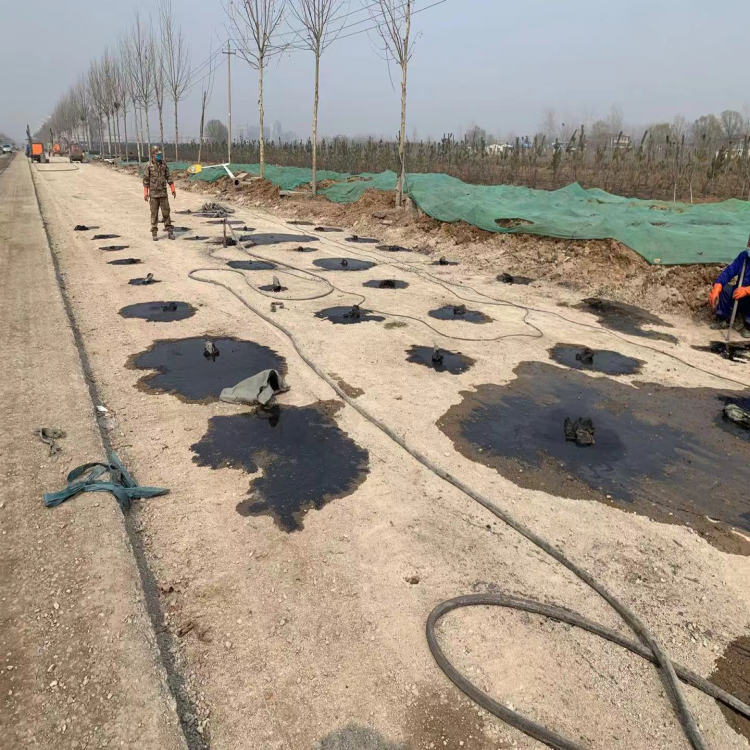
The roadbed grouting construction team explains that the roadbed grouting technology has evolved and made new breakthroughs based on the grouting reinforcement of soft soil foundations. This process overcomes soil disturbance and softening effects caused by grouting reinforcement. It achieves excellent results in controlling subsidence caused by underground construction excavation under overloading ground, and can significantly shorten the stabilization time of soil subsidence. This new method has achieved good effects in the foundation treatment project for controlling subsidence during the shield tunnel crossing the coal handling trestle of the Shidongkou Power Plant. It is continuously promoted and applied in municipal construction and various construction projects.
This process was explored and developed in conjunction with engineering examples in June 1988. By employing a variety of reasonable construction techniques, after two years of continuous improvement, a new method for underground construction protection of above-ground buildings under super-heavy loads was developed, which achieved significant effects and yielded substantial economic and social benefits. It was technically approved and awarded the First Prize of Shanghai Science and Technology Progress in 1991.
1. Method Features
1.1 The subgrade grouting technique can be widely applied in foundation reinforcement projects, suitable for both soft soil foundation reinforcement and rock foundation fracture zone reinforcement.
1.2 The formulated slurry boasts excellent fluidity, thixotropy, and diffusivity. It has a rapid initial setting and adjustable properties, allowing for timely strength enhancement. It can shorten the stabilization time of soil settlement and overcome the disturbance and softening effects caused during grouting.
1.3 This method offers a simple and flexible approach to controlling uneven ground settlement during underground construction, demonstrating a visibly effective and practical outcome.
1.4 Under ground overloading conditions, it is generally difficult to control the subsidence trend of buildings in a short period of time during underground construction. However, double liquid grouting has rapid setting properties, allowing for time adjustment, shortening the settlement cycle, and can provide immediate reinforcement and strengthening effects. This makes it more effective than single liquid grouting in controlling the subsidence of ground buildings.
1.5 Construction is safe, simple, fast, with a short duration, high quality, and quick results.
1.6 This construction method features compact equipment and instruments with flexible deployment, suitable for narrow urban construction sites and reinforcement at various depths, with minimal environmental impact on the surroundings.
2. Application Scope
This technique is not only suitable for reinforcing soft soil foundations but also applicable to fractured and broken zones in rock foundations, as well as for sealing projects. It is particularly effective for major municipal construction projects, especially underground construction in urban clusters, in protecting important building pipelines or pipelines near underground excavation sites (such as gas, cables, and large-diameter water pipes), and in controlling uneven settlement to prevent cracking.
3. Principle
Two-component grouting primarily overcomes the disturbances and softening effects caused by grouting reinforcement, as well as shortens consolidation settlement and controls settlement. Therefore, when the two-component slurry is promptly filled into the voids within the soil, especially in the construction voids created by machinery, due to its rapid setting and immediate initial setting characteristics, it can act as a reinforcement and strengthening agent. Meanwhile, the slurry loss during the grouting process is minimal, and the effective filling volume is increased, promptly compensating for the soil loss caused by various factors. It limits the displacement near the source of ground movement, reducing ground settlement before affecting the building structures. Additionally, once the two-component slurry reaches a certain saturation level in the soil voids, it will gradually expand under pressure, continuously filling the voids. This can exert pressure on the surrounding soil and split into the weak parts of the soil, forming a cross-grid solidification, enhancing soil density and compressive modulus, expanding the stress field, and increasing bearing capacity, thus significantly reducing the final settlement amount.
4. Construction Sequence and Process Flow
4.1 Construction Sequence
Design holes in the solid material according to the actual engineering requirements and construct as per the technical specifications and drawings.
4.1.1 Drill to the specified depth as per design requirements.
4.1.2 The aperture is generally φ91mm or vertical or slanted holes.
4.1.3 Injecting sealed mud, poured into the drill pipe, with a mud viscosity of around 80 seconds. The well should seal ground cracks to prevent mud leakage and similar issues.
4.1.4 When using two-component grouting, first remove the head, connect the pipeline, and start the grouting pump to inject into the hole.
4.2 Process Flow
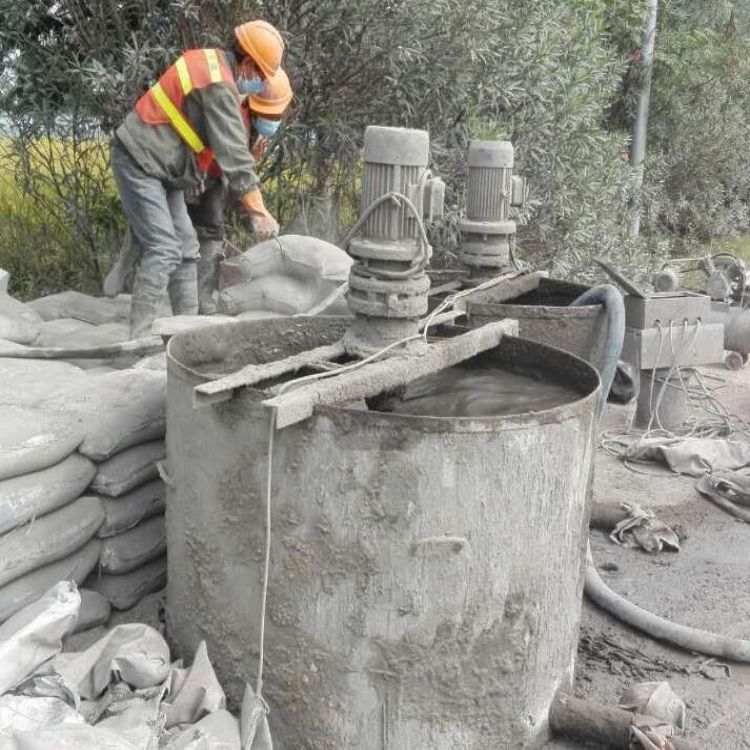
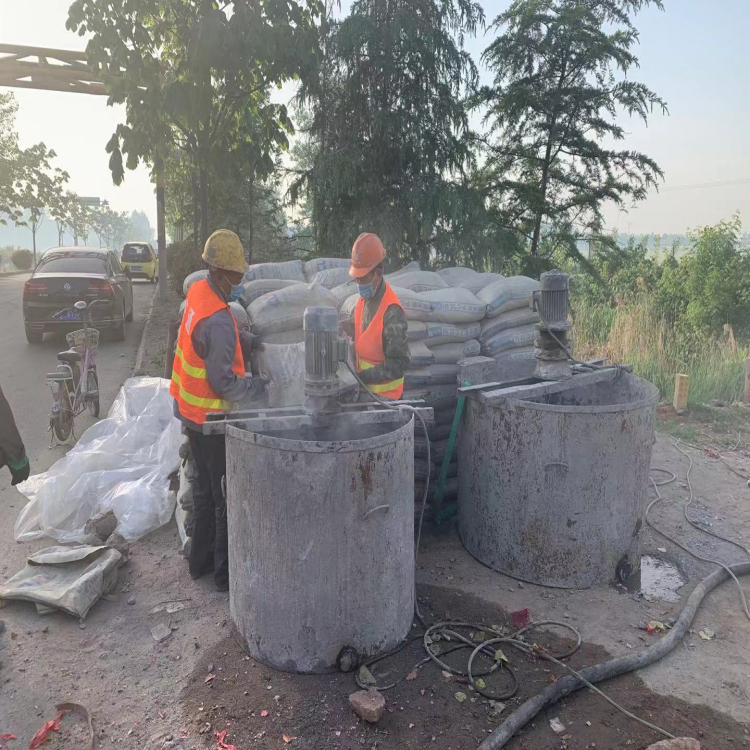
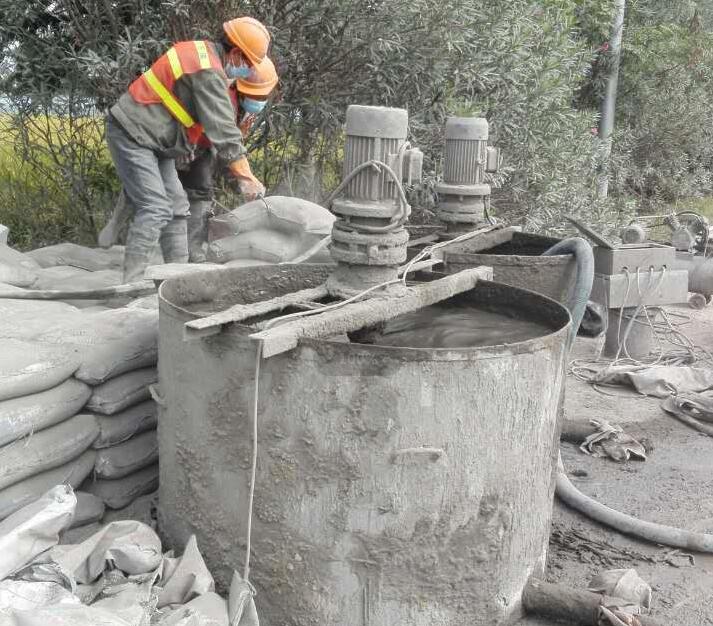
4.2.1 Mix the slurry using an SM200-1 external circulation or high-speed mixer in accordance with the design proportions.
4.2.2 Chemical Slurry Preparation
4.2.3 Place the mixed chemical slurry and cement slurry separately into the SS-400 mixing slurry tank for standby use.
4.2.4 When grouting is required, start the grouting pump, and simultaneously connect two Y-type connectors through two pipelines from the borehole to mix and inject the grout at the bottom, filling and diffusing into the voids or reinforced soil areas.
4.2.5 When starting or stopping the grouting pump, the chemical grouting pump must be turned on first and turned off last to prevent pipeline blockage.
4.2.6 Double liquid grouting should generally be carried out simultaneously with excavation, to promptly fill in gaps caused by construction, filling, and other reasons.
4.2.7 During the grouting process, the flow rate and pressure should be controlled as much as possible to prevent the grout from leaking.
5. Material Requirements
5.1 A Liquid Requirement
5.1.1 The slurry water should be potable river water, well water, and other clean water; it is not advisable to use water containing oils, sugars, high acidity, seawater, and industrial domestic wastewater.
5.1.2 The cement used for grouting should be ordinary portland cement, with a grade of 425#. The cement should remain fresh and generally not exceed 3 months from the date of manufacture. Cement that has absorbed moisture and formed lumps should not be used. All cement specifications must comply with national standards and be accompanied by a factory quality guarantee certificate. Slag portland cement and pozzolanic portland cement are not suitable for grouting.
5.1.3 Under the premise of meeting the strength requirements, fly ash can replace a certain amount of cement, and the proportion should be determined through testing.
5.1.4 To enhance slurry properties, it is advisable to add an appropriate amount of admixture when the slurry is well-mixed. For instance, adding 0.3% to 0.5% of KA-l based on the cement quantity can improve the slurry's spreading and pumping capabilities. Adding about 5% bentonite can enhance the slurry's uniformity and stability, preventing the separation and sedimentation of solid particles.
5.2 B Liquid Requirement
5.2.1 Purchase water glass with a Baume degree of 35° to 40° that meets national quality standards, available on the market.
5.2.2 Dilute the selected water glass to the required concentration and set it aside as backup.
5.2.3 Properly mix the two liquids A and B mentioned above, with the viscosity of the two-liquid slurry required to be greater than 35″.
Specific gravity: 1.3~1.5
Initial setting time: 2-3 minutes
Setting strength 3~4 MPa/2h
5.2.4浆注钢管 φ63.5mm or single-direction valve pipe for grouting and Y-type connector.
6. Equipment Provided
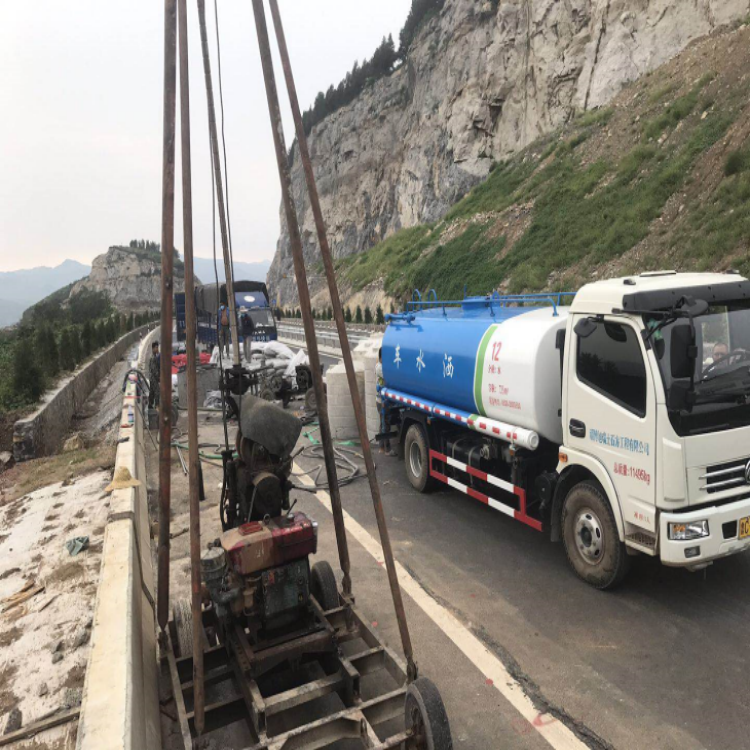
6.1 Drilling Rig
The standard small geological drilling machines are applicable, such as the Wuxi 30 model and Hangzhou SG2-150, etc. The drill rods typically use a diameter of φ42~50mm.
6.2 SM-200 External Circulation or High-Speed Mixing Machine, featuring self-feeding capability. Quickly and efficiently prepares slurry, ensures even mixing, easy maintenance, and corrosion resistance.
6.3 SS-400 Slurry Mixing Tank, featuring filtration of impurities and large particles, maintains uniform slurry and prevents sedimentation, has a simple structure, easy maintenance, and a large slurry capacity.
6.4 The SYB50/50 hydraulic grouting pump features stepless speed regulation, grouting flow rate of 0~50L/min, and the grouting pressure can be set to the maximum value without unlimited pressure increase. The maximum pressure is 5MPa, and it can pressurize mortar with particle size <5mm. It operates without leakage for extended periods, has good sealing properties, is safe and reliable, and is suitable for outdoor machinery!


