

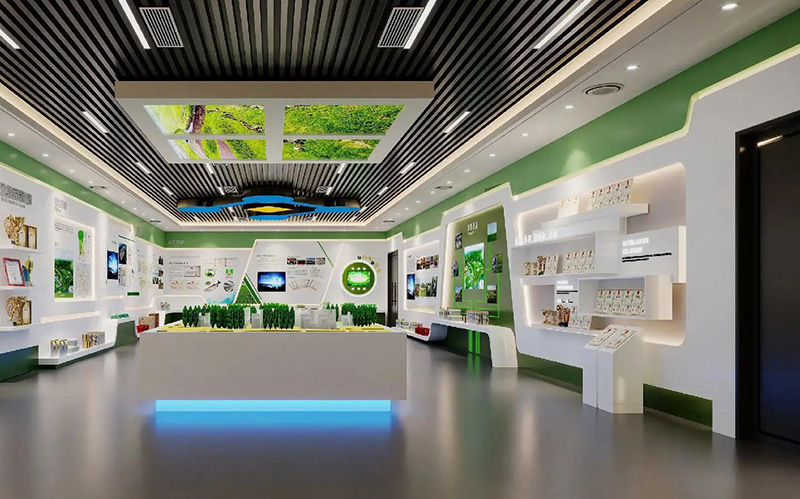
The grand exhibition hall, as the core space for business exhibitions, cultural exchanges, and technological displays, its internal comfort and stability are crucial. However, due to its large scale, fluctuating foot traffic, and versatile usage functions, selecting the central air conditioning system to serve the core area is far from simple as in ordinary buildings.
One,Central Air Conditioning in ShowroomSystem Selection and Configuration
1. Air ConditionerSystem Format Selection
The all-air system is perfectly suited for large-scale exhibition halls, allowing for centralized control and even air distribution.
For regions with varying demand for zonal usage, a mixed approach can be adopted for fan coil units.+ Ventilation Systems or Variable Refrigerant Flow (VRF) Systems
Choose cooling and heating sources based on local climatic conditions: wind-cooled modules, water-cooled units, or air-source heat pumps, etc.
2. Load Calculation
The display hall's chilled load is generally calculated as...150W/m², heat load estimated at 120W/m²
Key considerations must include lighting load, personnel load, and heat gain through the protective structure.
When the height exceeds the standard, load adjustments are necessary to prevent capacity insufficiency.
Two,Central Air Conditioning in the ShowroomKey Selection Criteria for Terminal Equipment
Air Conditioner Unit Selection Criteria
Insulation of Enclosure: Thermal Resistance of Insulating Layer≥0.68 m²·K/W, condensation prevention, preferably use PEF or polyurethane foam materials.
Windward Surface Wind Speed: Controlled2 to 2.5 m/s; anything higher can lead to condensate at the evaporator's outlet, affecting the air delivery performance.
Air Permeability: National Standard Requires Static Pressure Inside the BoxAt 700Pa, the air leakage rate is ≤3%, preventing energy loss.
2. Air Supply Terminal
High-velocity swirl diffusers are used for taller rooms to ensure effective heating during winter; double-layer louver diffusers are suitable for standard room heights.
Avoid the use of diffusers to prevent issues during the winter."Top hot, bottom cold" phenomenon
The air outlet wind speed should≤6m/s, return air velocity ≤3m/s, balancing comfort with noise levels
ThreeCentral Air Conditioning in the Exhibition HallAirflow Organization and Duct Design
Delivery Method
Uniform air distribution through ducts to prevent localized overcooling or overheating
The duct layout should be simple, minimizing the number of regulating valves for ease of operation and adjustment.
2. Entry Processing
Primary entrances and exits should be equipped with air curtains to prevent outdoor air from intruding and affecting the indoor environment.
Four,Exhibition HallNew Air and Air Quality
New Air Volume: As per80 m³/h per person or not less than 10% of the total air supply volume, ensuring air quality
Establish an independent fresh air system, process the air before introducing it indoors, and avoid contamination by not mixing it with return air.
FiveCentral Air Conditioning in the Exhibition HallEnergy Efficiency Assessment Indicators
When selecting, it is essential to focus on the following core energy efficiency parameters:
EER (Energy Efficiency Ratio): For refrigeration conditions, ≥10 is considered an energy-efficient product.
COP (Coefficient of Performance): For heating conditions, a COP of ≥3 is an ideal choice.
SEER (Seasonal Energy Efficiency Ratio): Comprehensive refrigeration efficiency, products with ≥16 are energy-saving.
HSPF (Heating Season Performance Factor): Overall heating efficiency; ≥8 is ideal.
