

In the industryIn the 4.0 era, the production efficiency and working environment in factory workshops are increasingly interconnected. High temperatures and stuffiness not only directly threaten employee health but also lead to a rise in equipment failure rates and a decrease in product yield. As the core equipment for workshop cooling, the selection of a central air conditioning system is no longer as simple as "buying a few air conditioners." It is a comprehensive project that requires coordination of area, height, process requirements, energy consumption standards, and post-maintenance operations.
One: Clarify Air Conditioning Needs: Workshop Environmental Analysis
Square footage and height
- For small areas (≤2,000㎡) or low ceilings: Split-type air conditioning or ductless air handler options available.
For areas larger than 3,000 square meters or with a height of 10 meters or more: screw-type chilled water units or air-cooled modular units are required.
2. Humidity and Temperature Requirements
Precision Manufacturing/Electronics Workshop: Requires temperature and humidity controlled air conditioning (±1℃/±5%RH).
- Standard Workshop: Temperature control at 26-28℃ is sufficient, with an optional central air conditioning system featuring a water system.
3. Special Environments
Chemical/Fire and Explosion Hazardous Workshop: Explosion-proof Air Conditioners.
-High humidity environments (such as textile factories): Evaporative cooling or enhanced dehumidification systems.
Section II: Comparison and Selection of Workshop Air Conditioning Systems
1. Multi-Link (VRV): For small to medium-sized factories (≤ 3,000㎡), advantages: zoned temperature control, energy-saving (energy efficiency ratio ≥ 7.0), disadvantages: high initial investment, limited unit cooling capacity
2. Water System (Chilled Water Plant + Fan Coil Units): Suitable for large-scale factories (such as steel mills). Advantages: Strong scalability and comfort; Disadvantages: Requires maintenance of water pipes, frost and scale prevention.
3. Air-cooled Modular Unit: Medium-sized area (3,000-10,000 sqm), Advantages: Flexible installation, simple maintenance; Disadvantages: Slightly lower energy efficiency than water-cooled systems.
4. Screw Chiller Units: For ultra-large factories (>10,000 sq. m.), benefits include large cooling capacity and precise temperature control. Drawbacks are high initial investment and require professional maintenance.
5. Evaporative Cooling: Suitable for high-temperature and high-humidity workshops (such as food factories), benefits: low electricity consumption, environmentally friendly; drawbacks: requires enhanced humidity control.
Section III: Key Calculations and Design for Workshop Air Conditioning
Cooling Capacity Calculation
- Estimation Formula: Cooling capacity (W) = Area × Floor height × 250 × Temperature difference (5-8℃ difference between indoor and outdoor temperatures).
Accurate Calculation: Add the heat output of the equipment (each 1kW of equipment ≈ 860W of cooling load), human heat dissipation (100W per person), and solar radiation (with an additional 10-20% redundancy).
2. Workshop Air Conditioning Airflow Method
High Ceiling Spaces: Utilize jet or swirl air outlets (air throw distance up to 20-30 meters) to avoid stratification.
- Local Workstation Cooling: Optional with supplementary wind-sending system (such as portable air conditioners).
Section 4: Workshop Air Conditioning Brand and Energy Efficiency Recommendations
- Leading brands: Gree, Midea, Trane, Carrier, etc., with priority given to products with a first-class energy efficiency ratio (EER≥3.6).
-Energy-saving Measures: Pairing with variable frequency technology (such as magnetic levitation chillers), energy consumption can be reduced by over 30%.
Section 5: Air Conditioning Case Reference for Workshop
- Electronics Factory (constant temperature and humidity): Multi-split (VRV) + precision air conditioning units, zonal control ±1℃.
Textile Factory (high humidity and high temperature): Evaporation cooling system + dehumidifier, comprehensive energy consumption reduced by 40%.
- Automotive stamping workshop (high-ceiling space): Screw-type chilled water unit + jet air outlet, covering 12,000 square meters.
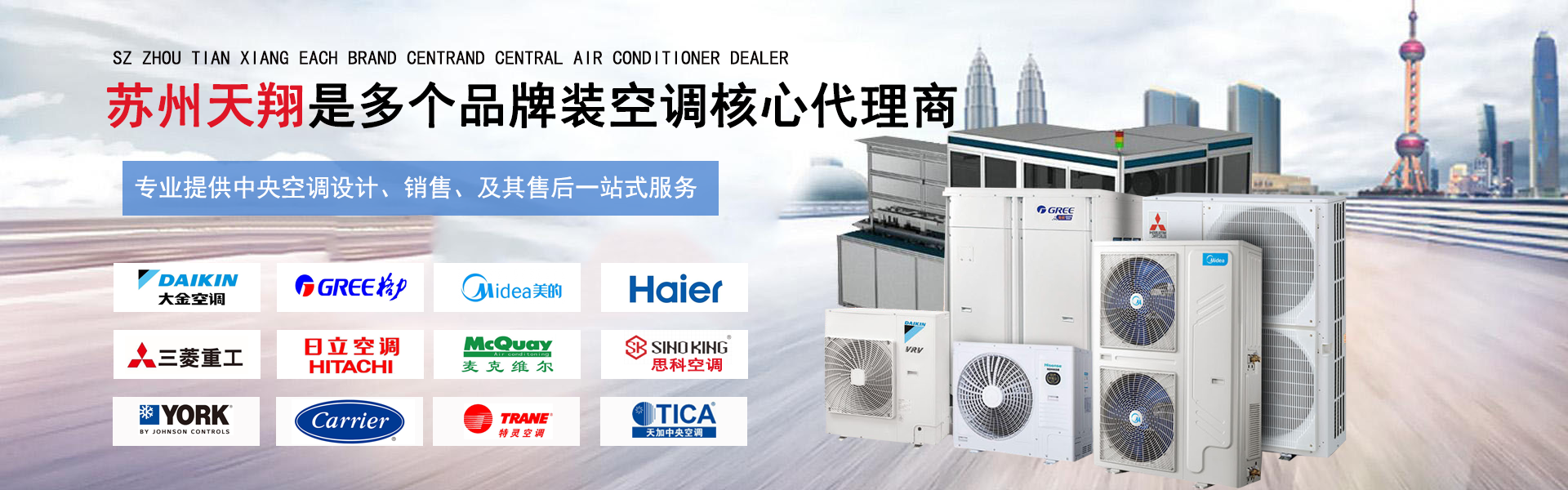
Suzhou Tianxiang Electromechanical Engineering Co., Ltd. has been dedicated to central air conditioning for many years, offering an all-in-one solution provider encompassing sales, design, installation, and maintenance.
World-renowned brands such as Mitsubishi, Daikin, McQuay, Hitachi, Midea, Gree, Haier, and Chigo are our core agents for central air conditioning, while Carrier, York, Trane, and Tianjia are our exclusive dealers. We offer design, installation, and maintenance services for central air conditioning and ventilation systems in commercial spaces such as villas, clubs, apartments, hotels, hospitals, kindergartens, and office buildings. Over the years, we have maintained a strong cooperative relationship with manufacturers, securing their strong support and ensuring product supply and quality.
The company has established a comprehensive service system covering design, sales, installation, and after-sales service, and boasts a team of experienced and proactive after-sales professionals."Embracing the philosophy of 'Exquisite Design and Craftsmanship,' we are dedicated to providing comprehensive and timely services in areas such as customer design, sales, after-sales, and installation. As the company grows, we have gradually expanded our business to surrounding regions of Suzhou, broadening our service coverage while enhancing our corporate reputation. We have established a service network centered around Suzhou with support from neighboring areas, and have fostered strong business relationships with numerous local and foreign enterprises as well as individual consumer groups, earning client recognition and maintaining long-term cooperative partnerships."
