


In today's industrial production sector, the indoor environment of industrial buildings directly impacts production efficiency and product quality. ForA 3,500-square-meter industrial workshop faces the challenge of high temperatures, and installing a water-cooled air conditioning system is an effective cooling strategy. Water-cooled air conditioning, with its energy-saving, environmentally friendly, and significant cooling effects, has become the preferred cooling solution for many workshops.
One, Selection of Water System Air Conditioning Equipment
Based on factors such as the factory's area, height, structure, and the heat generated during production, accurately calculate the required cooling capacity, select the appropriate model and capacity of water-cooled air conditioning equipment, and ensure it meets the factory's cooling needs.
Considering the production process and usage requirements of the factory, selecting the appropriate type of water-cooled air conditioning system, such as water-cooled screw chillers and water-cooled centrifugal chillers, is essential. For large industrial factories, water-cooled screw chillers are a common choice.
Section II: Installation Location for Water System Air Conditioning
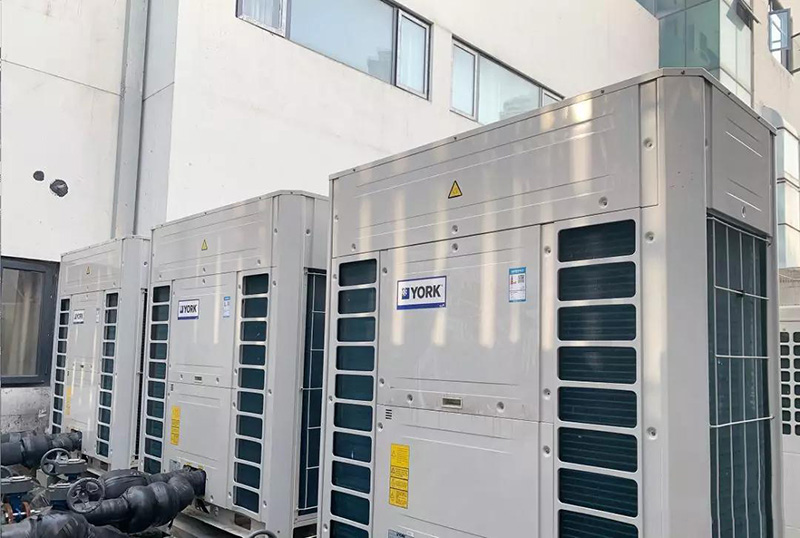
Chassis Location The main unit should be installed in a well-ventilated area, avoiding dusty, oily, salty, or sulfur-rich environments that could impair heat dissipation and lifespan. Additionally, the base of the main unit must be sturdy enough to support the weight of the equipment and withstand vibrations during operation, with the base height elevated above ground level. Over 300mm in height, facilitating drainage and heat dissipation. Vibration dampers need to be installed between the equipment and the foundation, and the bolts must be securely fastened.
Indoor unit placement The installation location of indoor units should avoid placing any obstructions, such as debris, in the return and exhaust air outlets to ensure smooth air flow. Additionally, the indoor units should be installed in a location that is convenient for maintenance and repair, with the bottom of the units higher than the ceiling. Approximately 200mm to prevent backflow of rainwater.
Cooling Tower Location Cooling towers should be placed in well-ventilated areas, avoiding high-temperature, smoke, harmful gases, and other regions to prevent affecting their heat dissipation efficiency. Sufficient distance should be maintained between the cooling tower and walls or other obstructions to ensure smooth air flow; generally, the distance between the intake side and buildings or other obstructions should not be less than... The air intake face has a side length 1.5 times larger, and the distance from the exhaust face to the building or any other obstacle must be no less than 3 meters.
Section 3: Water System Air Conditioning Pipe Installation
Pipe Connection Pipe connections must be firm and sealed, with no leakage. All welding operations must be performed by qualified professionals, and nitrogen must be filled into the pipe during welding to prevent internal oxidation. The joints of the pipes should undergo rigorous sealing treatment to prevent refrigerant leakage. Additionally, drain points should be set at the low points of the pipes for system drainage.
Insulation for Water Pipes Insulate the inlet and outlet pipes to prevent condensation in summer; the thickness of the insulation should meet the design specifications, typically not less than... 30mm thickness, thermal insulation materials should possess excellent thermal insulation and waterproof properties.
Pipe Fastening Properly install pipe supports to ensure the stability and correct positioning of the piping system. All supports and hangers must be securely fastened. Insulation pads should be placed between pipes and their supports or hangers, with the thickness of the pads not less than the thickness of the insulation layer and the width greater than the support surface width of the supports or hangers.
Section 4: Water System Air Conditioning Duct Installation
Duct layouts should be rational, minimizing bends and turns to reduce air resistance and ensure smooth airflow. Connections between ducts should be well-sealed to prevent air leakage, which can be achieved using sealing tape or sealant.
The installation of ductwork should be kept flat, and during hoisting, it must be ensured that it remains level, with no deviation in level exceeding To prevent poor discharge of condensate water, the ventilation ducts should be insulated in accordance with the design requirements, usually with materials like rubber-foam, and the external insulation should be wrapped with foil tape to prevent heat loss.
