







1. Simple Frequency Modulation Transmission and Reception
At that time, to free themselves from the束缚 of microphone cable, people thought of principles similar to those of FM broadcasting, which involved the conversion principle of the microphone, and the process of audio modulation, amplification, and transmission. Then, the signal was received and played back through a FM radio or a special receiver (at specific frequencies). It can be imagined that the sound quality, stability, and anti-interference capabilities of this method did not meet the practical application requirements.
2. Frequency-modulated transmission and reception of quartz oscillation
Due to the environmental impact on the stability of the oscillation frequency, which is generated by electronic circuits using RC or LC oscillations, the frequency cannot be very high, usually no more than a few hundred megahertz. In such a frequency band, interference from other signals is more likely, which is why transmitting and receiving circuits using quartz oscillators are employed. As is known, the oscillation frequency of quartz crystals is highly stable, and the transmitters and receivers for wireless microphones made with them operate much more stably. Additionally, their operating frequency can be within the V band (30MHz-250MHz) and U band (200-1000MHz), where external interference signals are not severe, resulting in better performance for wireless microphones.
Due to the unadjustable oscillation frequency of quartz crystals, for a set of wireless microphones, both the receiving and transmitting frequencies are fixed and must be individually matched, which is not very convenient. If there is interference at this frequency point in a specific location, the wireless microphone will not be functional.
3. Adopted PLL-enabled wireless microphone
PLL stands for Phase-Locked Loop, a term used in wireless microphones for transmission and reception. It employs frequency synthesis to satisfactorily receive signals within a given bandwidth, allowing for arbitrary switching between working channels within that bandwidth. Theoretically, within a 24MHz bandwidth, using a channel resolution of 1MHz, you can switch between 25 channels; with a resolution of 125kHz, the number increases to 193 channels. The number of channels depends on the receiver's bandwidth and channel resolution. In practical applications, various factors must be considered, but it is certain that wireless microphones using PLL technology offer tunable and multiple reception channels, providing great flexibility. Transmitters and receivers can be combined arbitrarily, with the ability to switch working channels at any time within a bandwidth to prevent interference.
The specific type of wireless microphone has been phased out in the market, now only used in routine experiments. This type is also found only in mid-to-low-end products or older models, while the majority of applications are for wireless microphones utilizing PLL technology.
4. Modular Integration
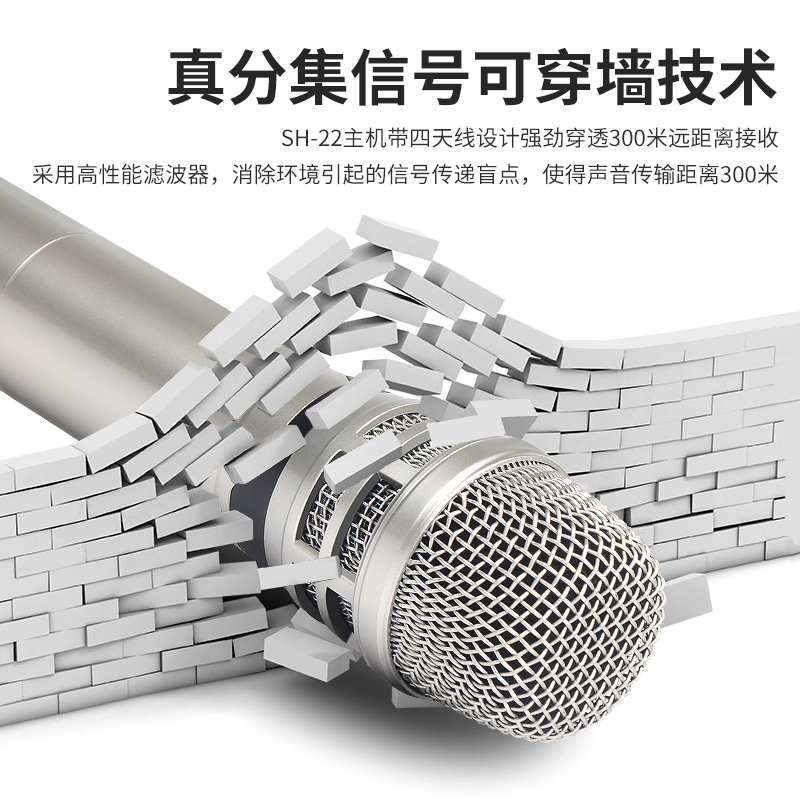
Due to the use of FM technology in wireless microphones, their operating frequency ranges in the V or U band, where the radio waves propagate in straight lines and can only reflect upon encountering obstacles, but not diffract around them. This results in shadows or dead zones, which can negatively impact the microphone's performance (such as faint sound and FM noise). To prevent such issues, a diversity reception technique is currently employed in wireless microphones. Diversity reception involves having two identical receiver installations within a system. A signal emitted from a transmitter is simultaneously received by two FM receivers, which then demodulate and amplify the low frequencies before being sent to a combiner. This combiner, essentially a selector, chooses the stronger reception signal at each instant to be the output signal, effectively improving reception quality.
