


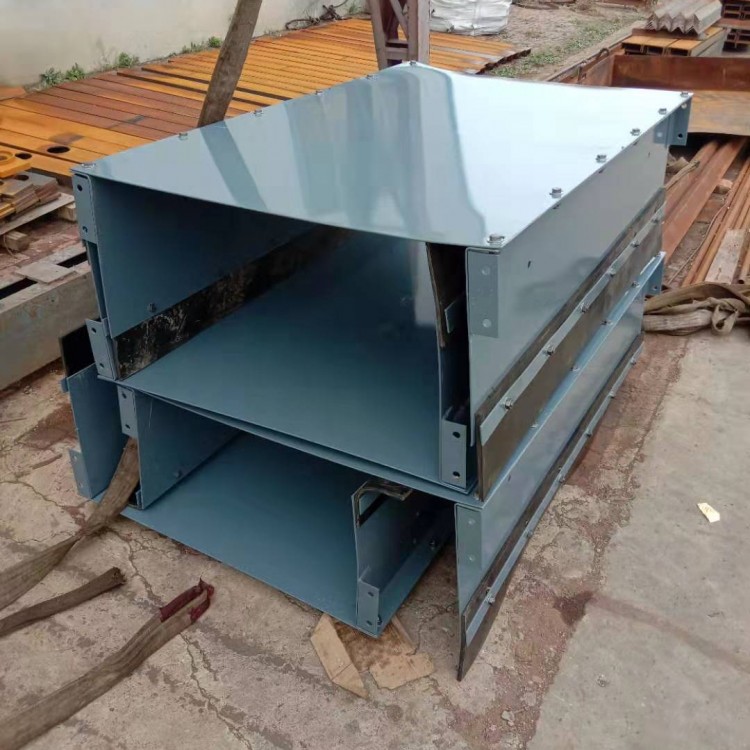
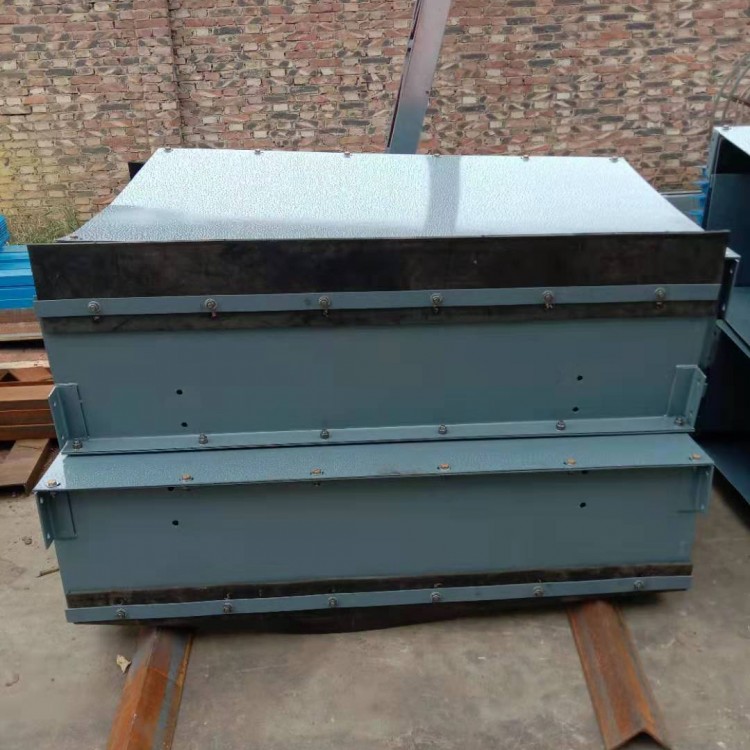


The feed chute can be divided into overflow skirt board type and fully enclosed type; if it is a fully enclosed type, it consists of three parts: the upper, middle, and lower sections. The middle side panel is connected to the conveyor frame, serving as the fixed part. The upper cover and lower base plate are connected to the side panels with bolts, allowing for easy disassembly for installation and maintenance.
The feed channel can be custom-made according to the specific requirements of the customer, and can be divided into sections, such as a 14-meter feed channel, which can be divided into 7 sections, each 2 meters long, with each section equipped with 4 support legs. The front and rear ends of the feed channel are fitted with multiple sealing boards and curtains to form an equal pressure dust suppression system, which reduces the pressure, speed, and settlement of dust, allowing cleaner air to exit at the feed channel outlet. The entire feed channel forms a closed structure, ensuring that dust will not spill or spread when the wind and dust vortex exert impact pressure on the feed channel.
Sealing Performance
Below the conveyor belt, replace the original troughed roller assembly with a short trough roller assembly to support the material gravity section of the conveyor belt. On the non-gravity sides of the conveyor belt, use a bottom plate with anti-friction and wear-resistant materials for support, which not only supports the conveyor belt but also serves as a sealing function. This support bottom plate is connected to the side plate, which in turn is connected to the top plate, together forming a shell-type sealing structure.
The bottom width of the material guide channel is 2/3 to 1/2 of the belt width.
The cross-sectional shapes of the feed chutes are divided into two types: rectangular and arched.
The design of the material chute is divided into three parts: the rear baffle, the chute body, and the front curtain.
Material confined at the feeding point of the belt conveyor does not spill outward.
Conveyor Chute: Allows material falling from the hopper to be concentrated at the center of the conveyor belt before reaching the belt speed.
The bottom width of the feed trough is 2/3 to 1/2 of the belt width.
The cross-sectional shapes of the feed chutes are divided into two types: rectangular and trumpet-shaped.
The design of the material chute is divided into three parts: the rear baffle, the chute body, and the front curtain.
