





Third-party structural steel warehouse load-bearing capacity safety inspection
Widely applied in modern construction and architecture, a technical challenge in the actual application of steel structures is the welding process, and defects in welds are quite common. How to identify specific causes during the inspection of steel structural construction? The use of ultrasonic technology is an effective method. The characteristic of non-destructive testing for steel structure weld defects is to detect the quality of the weld features without damaging the material and performance of the components. Ultrasonic testing detects defects by analyzing the reflections of ultrasonic waves from the weld. Addressing the shortcomings of traditional ultrasonic testing, such as low accuracy, significant subjective errors, and the difficulty of observing both dynamic and static reflection waveforms simultaneously, a digital ultrasonic flaw detection method is proposed.
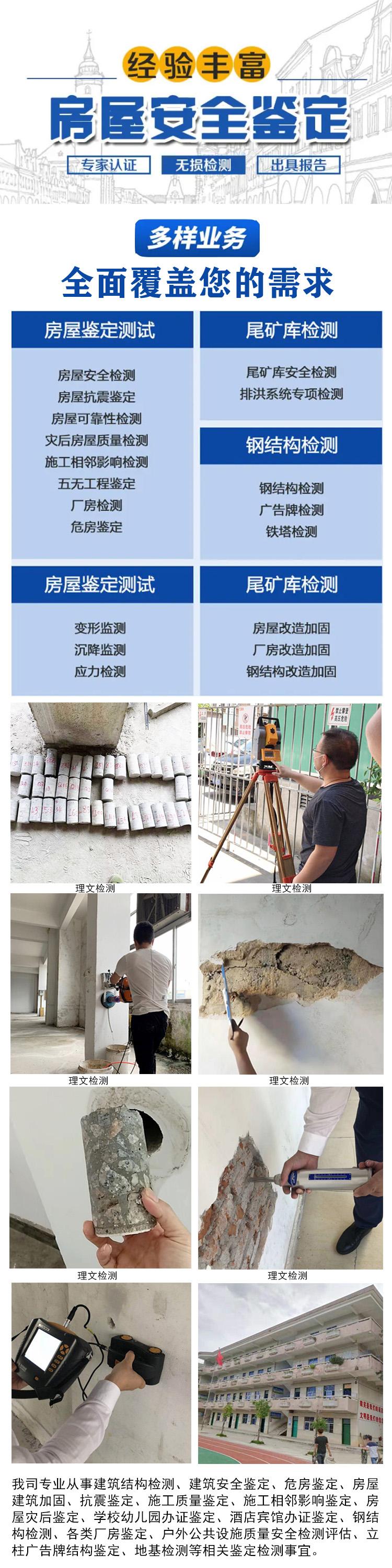
The inspection of steel structural dimensions shall comply with the following regulations:
– The number of components to be sampled for testing should be determined based on the specific situation, but it should not be less than the minimum sample size required for the corresponding testing category as specified by the minimum sample size for structural sampling inspection.
– The scope of dimension inspection should cover all dimensions of the sampled components. Each dimension should be measured at three locations on the component, and the average of the three test values should be taken as the representative value for that dimension.
– Methods for dimension measurement can be carried out according to the specifications of relevant product standards; the thickness of steel can be measured using an ultrasonic thickness gauge; dimensions and tolerances
–The evaluation criteria for component size deviation should be determined according to the corresponding product standards.
– For critical dimensions of the inspected batch components, the qualification of the batch should be determined through either a normal single sampling of the main control items or a normal double sampling of the main control items. For the determination of general dimensions of the inspected batch components, the qualification of the batch should be determined through either a normal single sampling of general items or a normal double sampling of general items, as specified by this standard.
– In special areas or under special conditions, select the parts or damaged areas that significantly affect the component's safety or are representative of the damage for inspection. The dimensional deviation of steel components should be calculated based on the dimensions specified in the design drawings; the allowable deviation values should be determined according to the "Code for Acceptance of Construction Quality of Steel Structures" GB50205.
2.3 The detection items and methods for the installation deviation of steel components shall be determined according to the "Code for Acceptance of Construction Quality of Steel Structures" GB50205.
2.4 For the thickness of components after corrosion, the corroded layer should be removed completely, revealing the metallic luster before measurement. Defects, damage, and deformation
The inspection of 2.5 steel's surface quality can be divided into several aspects: uniformity, the presence of laminations, cracks, non-metallic inclusions, and obvious segregation.
2.6 When in doubt about the quality of steel, conduct mechanical property testing of the steel raw material or a chemical composition analysis.
2.7 The detection of steel structure damage can be categorized into cracks, local deformation, corrosion, etc.
