

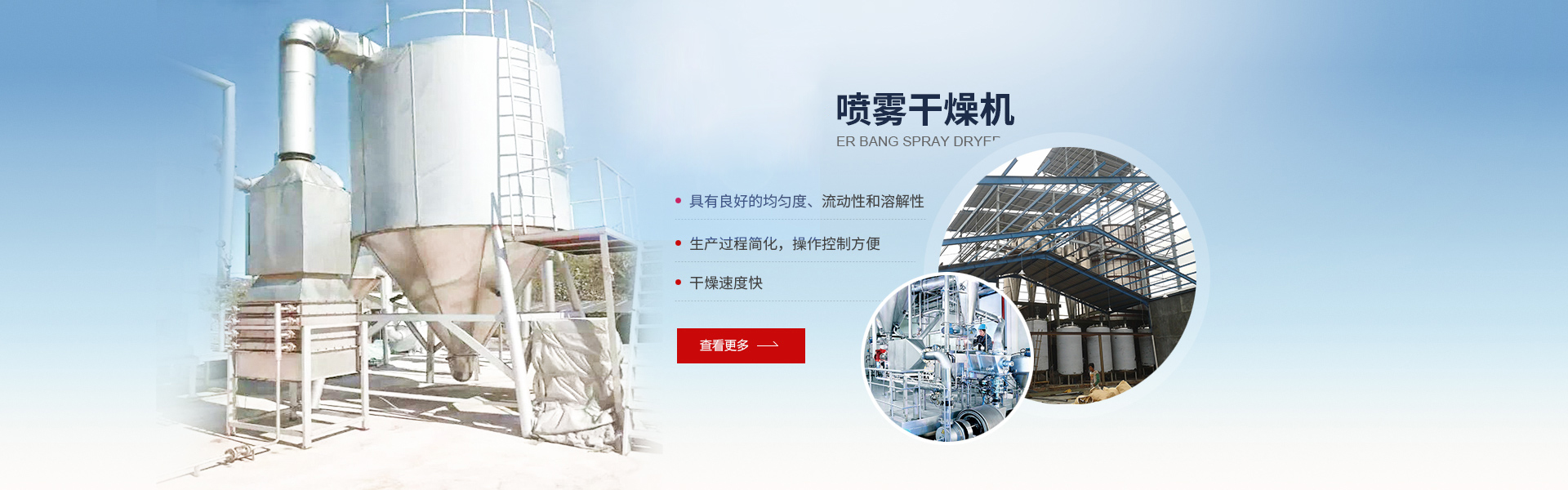

Centrifugal spray dryers come in various types, categorized by process as: open system, closed-loop, semi-closed-loop, and self-loop; by the direction of spray and gas flow as: co-current, countercurrent, and mixed flow; and by atomization methods as: centrifugal, pressure, and air-jet. Among these, the atomization method classification is the most commonly visible. The following will focus on atomizers.
The atomizer is the heart of the entire spray process, directly affecting product quality and economic indicators. The higher the atomization dispersion, the greater the atomization power; the more uniform the atomization, the smaller the change in product moisture content. Therefore, the atomizer must ensure the dispersion of the liquid while also keeping the particle size change to a minimum.
Features of the nebulizer
Centrifugal Atomizer
Centrifugal atomization: The liquid is atomized by being ejected from the edge of a high-speed rotating disk (circumferential speed of 90~160 m/s) due to the effect of centrifugal force. This process utilizes the effect of high-speed rotation, where upon the liquid injection onto the disk surface, it is subjected to two forces: first, the acceleration and fragmentation due to the centrifugal and gravitational forces; second, friction at the contact surface between the liquid and the surrounding air, which promotes the formation of droplets. The former is centrifugal atomization, and the latter is speed atomization, although both are actually present simultaneously. The atomization effect of centrifugal atomizers is directly related to the characteristics of the liquid, flow rate, diameter and speed of the disk.
(2) Pressure atomizers utilize a high-pressure pump to achieve high pressure in the liquid. As the high-pressure liquid passes through the nozzle, the pressure energy is converted into kinetic energy, resulting in the dispersion into droplets at high speed. The atomization obtained from the liquid passing through a single orifice after being pressurized is due to the effect of an external force. The liquid overcomes surface tension from a distance near the nozzle exit, tearing into fine lines. Influenced by the radial velocity of turbulence and the relative velocity of the surrounding air, the liquid lines are further split into droplets of varying sizes. The pressure atomizer operates on this principle.
(Airflow Atomizer)
Aerosolization by air-jet (also known as two-fluid spray), utilizes compressed air ejected from the nozzle at high speeds (≥300 m/s). It relies on the friction generated by the velocity difference between the gas and liquid phases, splitting the liquid into droplets. This process employs the high-speed movement of steam or compressed air, causing the liquid to meet at the nozzle exit and undergo film splitting and atomization. As the liquid velocity is not high while the airflow velocity is very high, the relative velocity between the two fluids stretches the liquid film into threads, which are then split into fine droplets. The size of the droplets depends on the relative velocity and the liquid's viscosity.
