
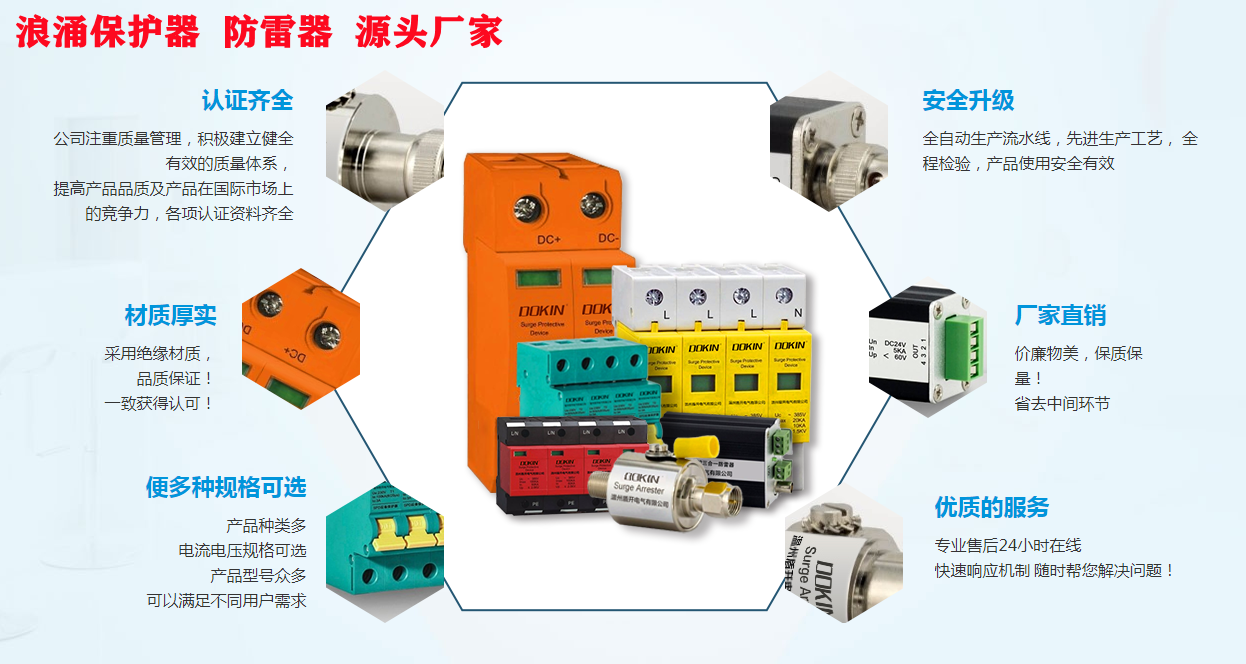


The SPD surge backup protector's function is to prevent surge damage to equipment from inductive lightning products, an indispensable component for protecting electronic products. As electronic products are increasingly integrated into people's lives, surge protectors are becoming more familiar. In fact, lightning protection for electronic systems is still a relatively new field, and there are many争议存在 regarding the selection and application of surge protectors. This article explains issues such as the response time of surge protectors and the operation sequence of multi-stage surge protectors.
Section 2: Operation Sequence of Multi-stage Surge Protectors
When a single-stage surge protector fails to suppress the侵入 overvoltage to below the specified protection level, a surge protector with secondary, tertiary, or more stages of nonlinear suppression elements should be used.
The nonlinear components Rv2 and Rv2 are both voltage-sensitive resistors. In practical applications, RV1 can also function as a gas discharge tube, and Rv2 can be a voltage regulator or a surge suppression diode (TVS). The isolation component Zs between the two poles can be an inductor Ls or a resistor Rs. If the conductive voltages of RV1 and RV2 are Un1 and Un2 respectively, the selected components will always have Un2 > Un1.
Someone believes that when the invasion shock wave is applied to the X-E terminal, it's always the primary RV1 pilot copper followed by the stage. In reality, it's possible for either the primary or the stage pilot to conduct first, depending on the following factors:
(1) The waveform of an invasion shock wave, primarily the acoustic velocity of the current front (di/dt).
(2) The relative magnitude of the conduction voltages Un1 and Un2 for the nonlinear components Rv1 and RV2.
(3) The nature of the isolation impedance Zs is whether it is resistive or inductive, as well as its magnitude.
When Zs is the resistance Rs, the stage usually conducts first. After the stage conducts, the first stage only conducts when the surge current I reaches iRs + Un2 ≥ Un1. After the first stage conducts, due to the much lower equivalent impedance of the next stage under high currents compared to the sum of Rs and the stage's equivalent impedance, most of the surge current is discharged through the first stage, while the current discharged through the stage is significantly smaller. If the first stage is a gas discharge tube, the residual voltage after conduction is usually lower than the conduction voltage Un2 of the stage, causing the stage to cutoff, and the remaining surge current is all discharged through the first stage gas discharge tube.
If Zs represents the inductance Ls, and the initial rate of rise of the侵入 current is quite fast, and the condition Ls(di/dt) + Un2 > Un1 is met, the primary conductor will conduct first. If the limiting voltage during the initial conduction is Uc1(1), then as the rate of rise of the侵入 current (di/dt) decreases, the conductor will only conduct when the condition UC1(1) ≥ Ls(di/dt) + Un2 is satisfied. Once the conductor conducts, the voltage at the output terminal Y will be suppressed to a lower level.

