

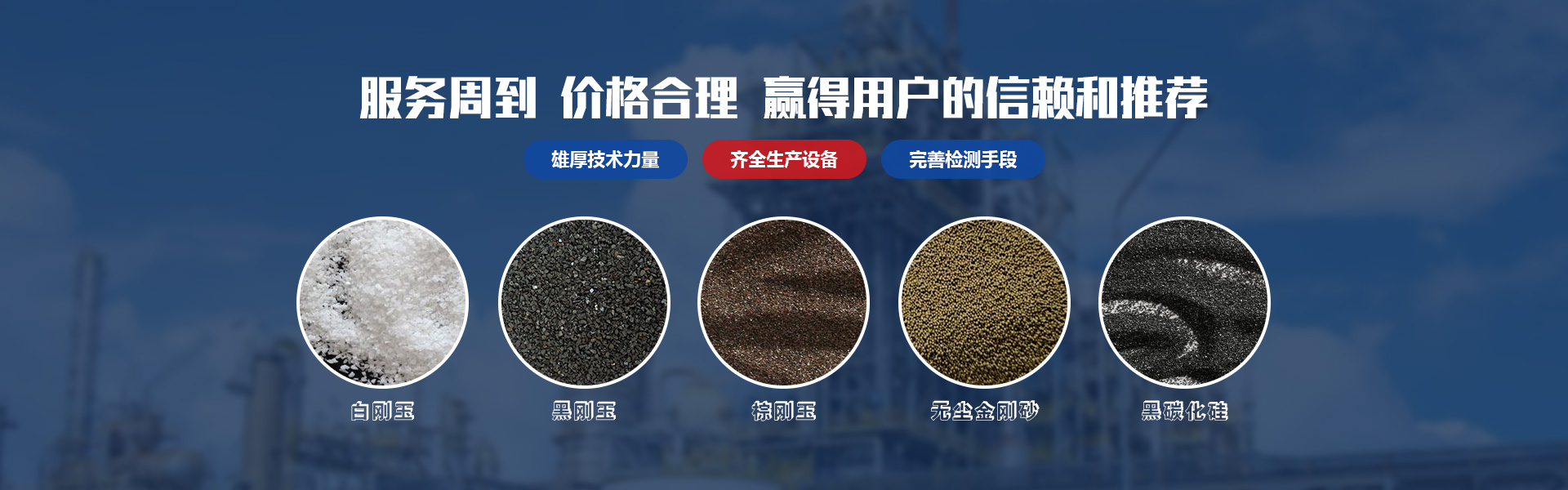

White fused alumina is often widely used in various places due to its high hardness, resistance to high temperatures, and acid and alkali corrosion. This is closely related to the product's manufacturing process, such as the smelting process. Many users may not be aware of the functions and characteristics of these processes. The following section will provide an introduction to them.
One: Metallurgical Process:
1. By adding conductive materials to aluminum oxide powder, it is dissolved by applying electricity in the furnace, then water is sprayed, cooled, solidified, crushed, and forms white corundum blocks with over 98% Al2O3 content.
Then, proceed to the Bamak production line, where the material is crushed and sieved to the desired particle size as per customer specifications. The particles that are sifted out are referred to as "particle sand," with the general particle size ranging from F4 to F220.
3. The fine powder is processed through a water-washing technique, followed by sieving and real-time monitoring, then dried to produce white corundum micro-powder.
White Corundum
Section II: Process Features:
The molten liquid temperature exceeds 2050°C.
2. Furnace Material Layers: The upper layer is the solid state, the middle layer is the melting state, and the lower layer is the molten state.
3. Power Distribution: Initially arc heat, followed by resistive heat.
4. Smelting Process: By controlling power, material ratio, and layer thickness, we ensure the depth and melting area of the melt at all times.
The above provides a detailed introduction to the smelting process and characteristics of white corundum. According to this introduction, it can offer effective assistance for the subsequent use and efficiency of the product.
