

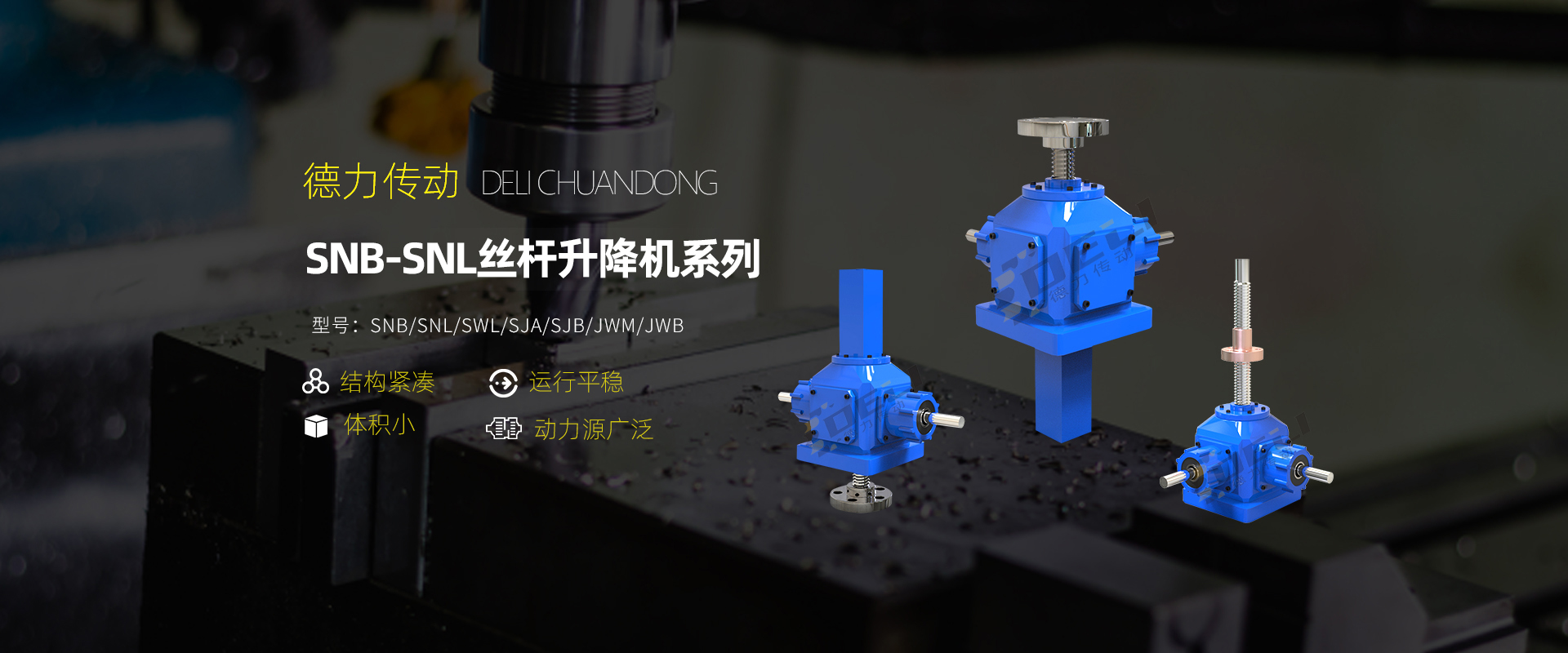

The ball screw lifting jack, as an electric actuator, offers remote and centralized control capabilities, boasts a wide range of power sources, and is extremely easy to install and operate. It has gained popularity among customers in recent years.
The itinerary can be customized according to the specific usage conditions of the customer, generally serving as execution machinery in the process flow, such as in the automotive industry, hydraulic engineering, logistics, and various fields of mechanical automation. However, what should be done if a ball screw lifting machine is required for normal operation, but its motor cannot roll?
We evaluate the situation in three different scenarios. Firstly, the speed is inconsistent. When the motor operates normally, its speed is stable and even. If there is uneven rolling, the first consideration should be whether the load of the ball screw lifting machine is fixed. Because this is simply the cause of the uneven rolling of the motor.
Next, the motor is rolling slowly and does not reach the theoretical speed. In this case, we need to determine if the issue is due to overload. If not related to overload, we should check if the motor is not used frequently, leading to rust or insufficient lubrication. The last scenario is that the motor does not roll at all. In this situation, we need to inspect for severe overload or if its working path is blocked by other objects.
Customers new to our company often assume that a 5-ton ball screw lifting machine can only handle a 5-ton load, after all, why is it called a 5-ton ball screw lifting machine? Some clients even mistakenly believe that factories overstate the tonnage. Is that really the case? Not at all. Let me explain in detail.
Our commonly referred-to 5-ton ball screw lifting machine can be understood as follows: within a stroke of 300mm, its static load is 50KN. However, even when using it according to this specification, it is crucial to maintain a safety factor. As the ball screw lifting machine operates, its load-bearing capacity decreases, and the faster the rotation speed, the weaker the load-bearing ability. This is similar to how humans consume more energy as they run faster. Similarly, the ball screw lifting machine requires more power at higher speeds.


